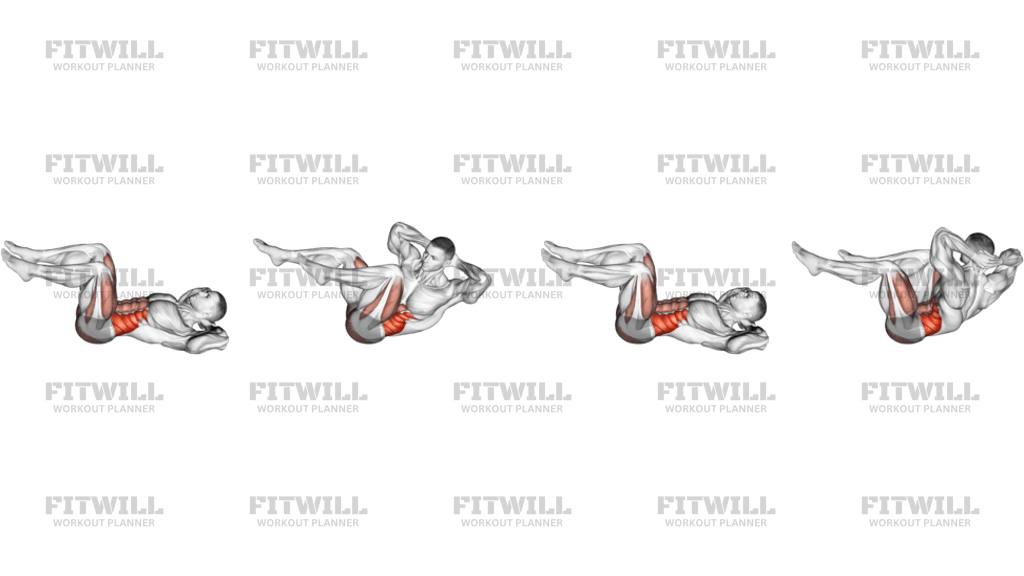
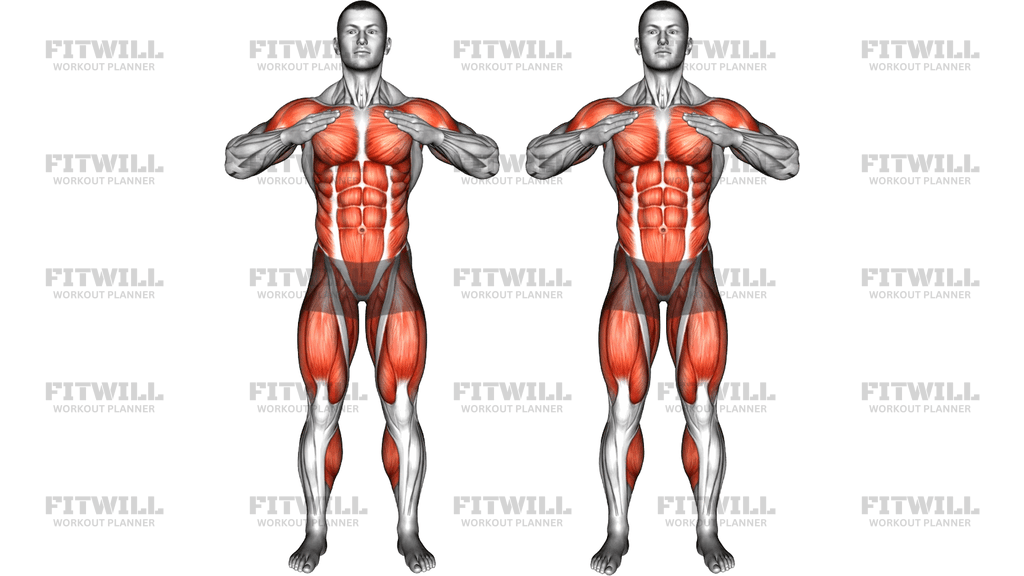
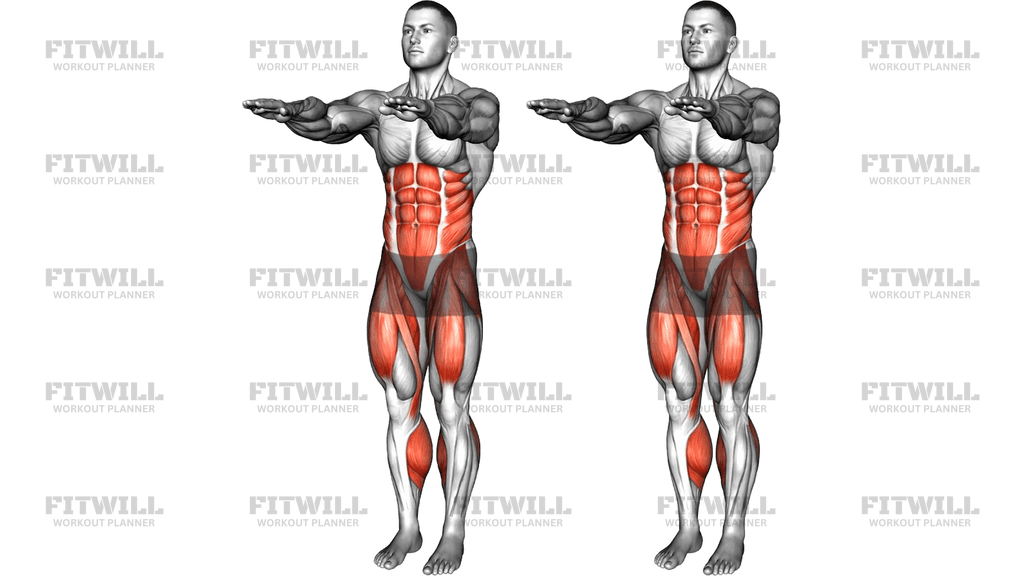
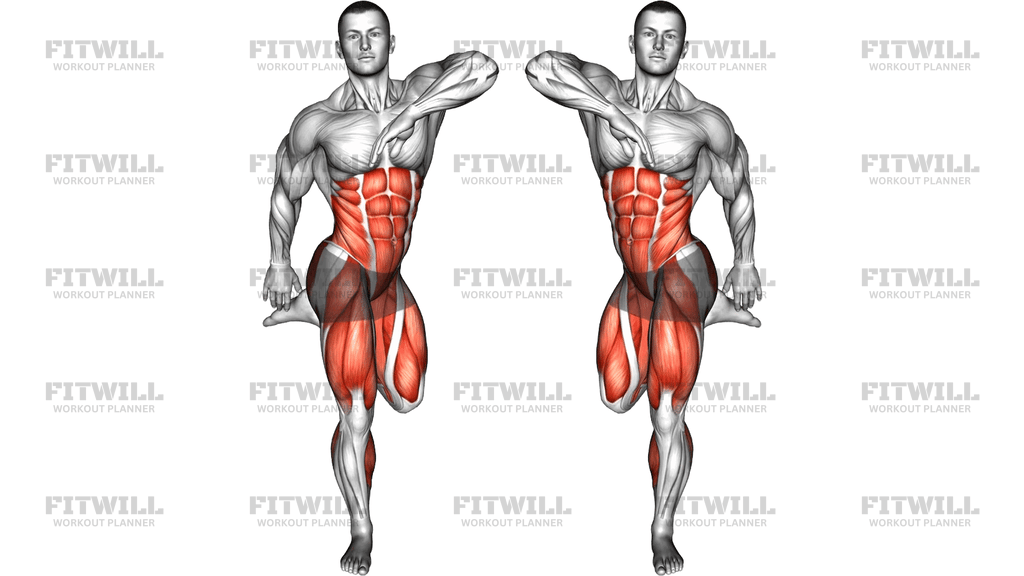
Sitting Alternate Abduction Twist On A Chair
The Sitting Alternate Abduction Twist On A Chair is a seated body-weight movement that pairs a knee abduction with an upper-body rotation. You sit upright on a sturdy chair with your hands clasped in front of your chest, then lift one knee out to the side while twisting your torso so the opposite elbow drives toward the raised knee. You alternate sides with each rep, which keeps the obliques and outer hip muscles working continuously in a smooth, rhythmic pattern.
The muscles doing most of the work are the obliques on the sides of your waist, which power the trunk rotation and resist the pull of gravity as you return to center. The outer hip — mainly the gluteus medius and tensor fasciae latae — lifts the knee away from the midline, while the hip flexors hold the thigh off the seat. Because the movement is done sitting, the lower back and legs are largely supported, so the demand concentrates on the waist and hips rather than the spine or knees.
This version works well for people who want rotational core work without getting down on the floor. Office workers can do it at a desk chair, older adults benefit from the stable, supported position, and anyone managing sore knees or lower back sensitivity can usually tolerate the seated setup more comfortably than standing twists or floor crunches. It also serves as a low-effort warm-up drill before heavier oblique or hip exercises.
The chair setup matters more than it looks. Your feet should rest flat on the floor, your sit bones planted evenly on the seat, and your spine tall rather than slumped. Keeping the hands clasped at chest height gives the rotation a fixed lever, which forces the twist to come from your ribcage and waist instead of your shoulders. If you let the torso collapse or the hands drift, the twist turns into a shoulder swing and the obliques lose their job.
To execute it well, think of each rep as two actions happening together: the knee opens out to the side, and the opposite elbow rotates toward it. Move at a steady tempo, squeeze the waist at the top of the twist, then lower the foot and rotate back to center under control before switching sides. Avoid yanking with the arms or slamming the knee back down — the return is where the muscles work eccentrically, so treat it as part of the rep.
A typical approach is 10 to 20 alternating reps per set, or timed intervals of 20 to 40 seconds for warm-ups and circuit training. Progress by slowing the tempo, pausing at the top of each twist, or adding more reps. If you feel pinching in the hip, reduce how far you lift the knee; if you feel twisting stress in the lower back, shorten the rotation range and keep the chest proud.
[ Workout Log & Planner ]
Put your next workout in Fitwill
Keep your plan and training log ready when you are.


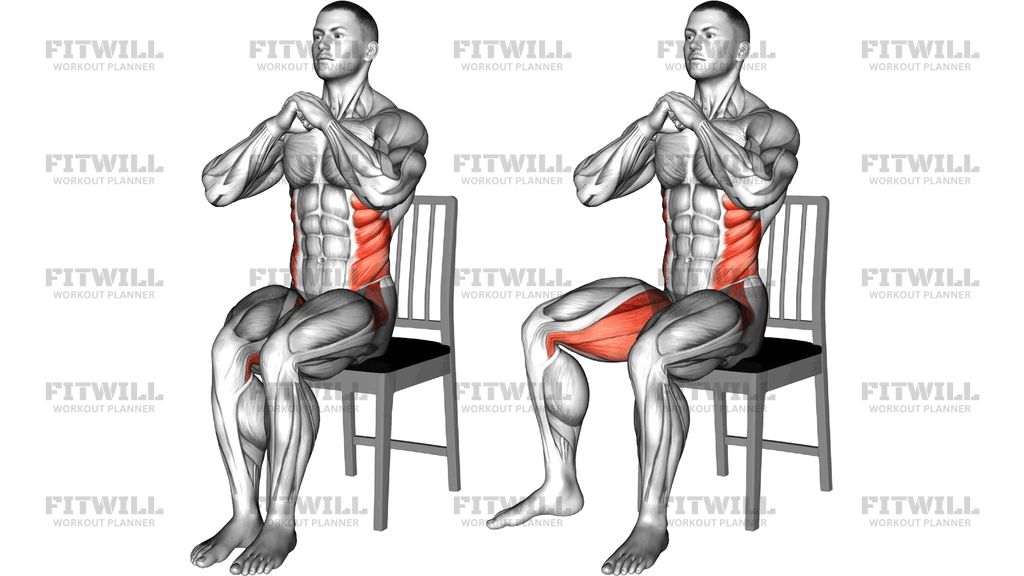
Instructions
- Sit on the front half of a sturdy chair with both feet flat on the floor and your knees bent roughly 90 degrees.
- Sit up tall with your sit bones planted evenly, then clasp your hands together in front of your chest with your elbows out to the sides.
- Brace your abdominal wall lightly so your torso stays upright and your lower back keeps its natural curve.
- Lift your right knee up and out to the right side, opening the hip away from your body's midline.
- As the knee rises, rotate your torso to the right so your left elbow travels toward the lifted knee.
- Squeeze the side of your waist briefly when your elbow and knee are closest together.
- Lower the right foot back to the floor and rotate your torso back to face forward under control.
- Repeat the same action on the left side, driving your right elbow toward the left knee as it opens outward.
- Exhale as you lift and twist, inhale as you return to center, and keep a steady rhythm as you alternate sides.
- Complete your target reps, finishing with your feet on the floor and your torso squared before standing up.
Tips & Tricks
- The most common fault is swinging the elbows instead of rotating the ribcage — keep your hands clasped tightly at chest height so the twist has to come from your waist.
- Do not let the seated side's hip slide forward as you twist; both sit bones should stay planted on the chair through the whole rotation.
- If your knee only lifts a few inches, you are probably leaning back to compensate — keep the chest tall and accept a smaller range until the hip lifts cleanly.
- Avoid dropping the foot back to the floor with gravity; a controlled return doubles the work the obliques and outer hips get per rep.
- Keep the neck relaxed and eyes forward rather than craning to chase the elbow with your chin.
- If the chair slides or wobbles, place it against a wall — a shifting seat changes your base and pulls focus away from the waist.
- Pause for one second at the point where elbow meets knee; the hold makes the obliques work harder without adding any equipment.
- Breathe out on the twist instead of holding your breath — many people unknowingly strain and hold air during the rotation portion.
- Alternate sides immediately rather than doing all reps on one leg; continuous switching keeps tension even across both sides of the waist.
Frequently Asked Questions
Which muscles does the Sitting Alternate Abduction Twist On A Chair target?
The primary muscles are the obliques, which drive the trunk rotation. The outer hips, including the gluteus medius, and the hip flexors assist by lifting and holding each knee off the seat.
Is this exercise a good choice for beginners?
Yes. The chair supports your weight and the range is easy to scale, so beginners can start with a small knee lift and a modest twist. It is one of the gentler ways to train rotational core strength.
Can I do the Sitting Alternate Abduction Twist On A Chair at a desk?
You can, as long as the chair is stable and does not roll or swivel unexpectedly. Lock the wheels or back the chair against a wall so the base stays fixed while you twist.
Why do I lift the knee out to the side instead of straight up?
The sideways knee lift combines hip abduction with rotation, so the outer hip muscles and obliques work together in the same rep. Lifting straight up would turn it into a standard seated knee raise with far less oblique involvement.
My lower back feels the twist — what should I change?
Reduce the rotation range and focus on turning from the ribcage while keeping your hips square on the seat. If discomfort persists, shorten the knee lift and stop the twist just before you feel strain.
How many reps should I do?
Start with 10 to 20 total alternating reps, counting a left and right twist as two reps, for 2 to 3 sets. For warm-ups or circuits, 20 to 40 seconds of continuous alternating works well.
What can I use if I do not have a suitable chair?
Any firm, stable seat works, such as a bench or the edge of a sturdy stool. Avoid soft couches or anything with wheels, because the twist needs a fixed base.
Should my hands press together during the twist?
Lightly pressing your palms together keeps the clasped position stable and gives your obliques a fixed lever to rotate against. Just avoid tensing your shoulders and neck while you do it.
Can this exercise help with hip stiffness from sitting all day?
The repeated abduction can gently mobilize the outer hips, and many desk workers use it as a midday movement break. It is a mobility-friendly side effect, though the main goal of the drill is oblique strength.