Cable Straight Leg Diagonal Kickback
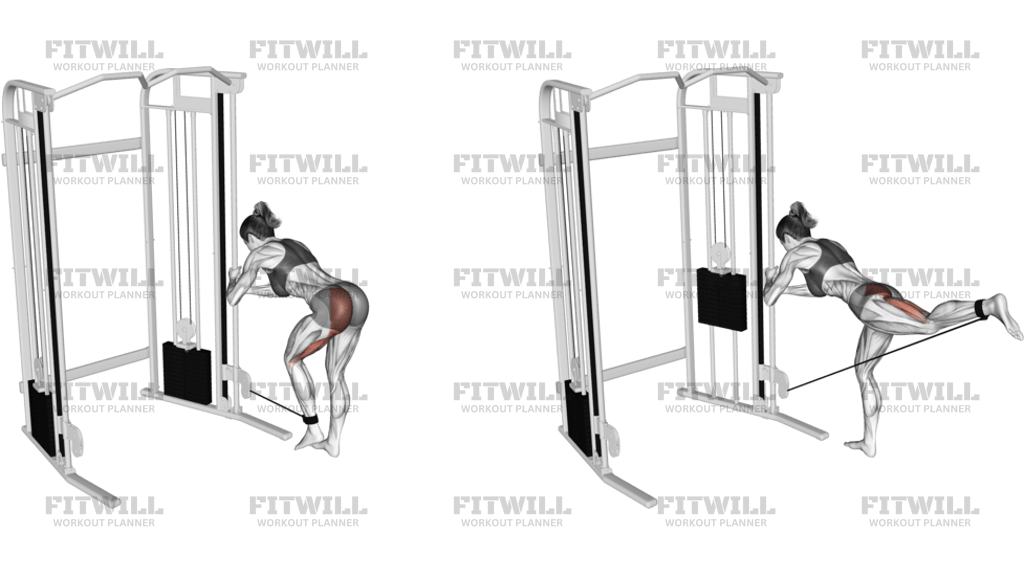
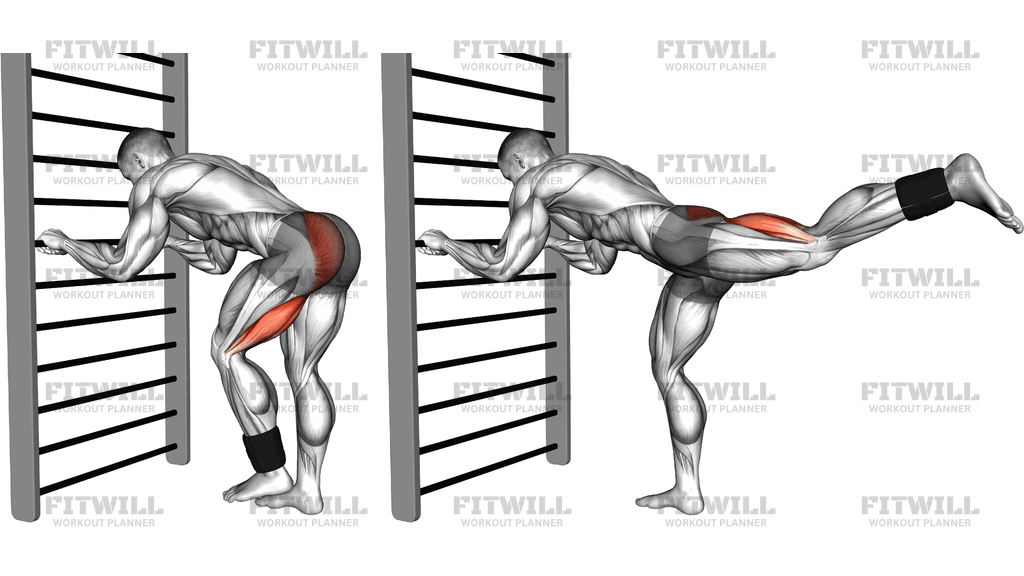
The Cable Straight Leg Diagonal Kickback is a single-leg cable exercise performed standing, with an ankle strap attached to the working leg and the cable running from a low pulley. Instead of kicking straight back or straight out to the side, the leg travels on a diagonal path, combining hip extension with a degree of hip abduction. That angle lets you load the gluteus maximus alongside the upper glute fibers, which is hard to do with plain kickbacks alone.
This movement suits lifters who want targeted glute work without loading the spine, as well as anyone rehabilitating or strengthening one side at a time after noticing a left-to-right imbalance. Because the weight stack provides smooth, even tension through the whole range, it is also a good choice for people who find free-weight glute exercises awkward or who struggle to feel their glutes during squats and deadlifts.
Setup matters here more than with most machine work. You face the cable machine, grip the frame for support, and hinge slightly forward from the hips while staying tall through the chest. Standing too upright lets the cable pull you off balance, while rounding your lower back turns the exercise into a spinal movement instead of a hip movement. The working leg starts under or slightly behind your body, and the support hand should be firmly planted so your torso can stay quiet while the leg does the work.
Execution is about a long, controlled sweep, not a fast snap. Push the leg back and outward on the diagonal until the hip is fully extended without arching your lower back, pause briefly at the end range to feel the glute contract, then resist the cable on the way down. The return is where most people lose the benefit, so treat the lowering phase as a slow, deliberate part of the rep rather than a reset.
You will commonly see this exercise slotted in as a finishing movement after heavier compound lifts, or used in higher-rep blocks when the goal is glute development with minimal fatigue to the rest of the body. It pairs well with hip thrusts or lunges in a glute-focused session.
From a safety standpoint, the main risks are swinging the torso, overextending the lumbar spine at the top, and using a weight so heavy that momentum takes over. Keep the load modest, move the leg only as far as your hips allow without compensating elsewhere, and swap sides after completing all reps on one leg so each side gets the same quality of work.
[ Workout Log & Planner ]
Put your next workout in Fitwill
Keep your plan and training log ready when you are.


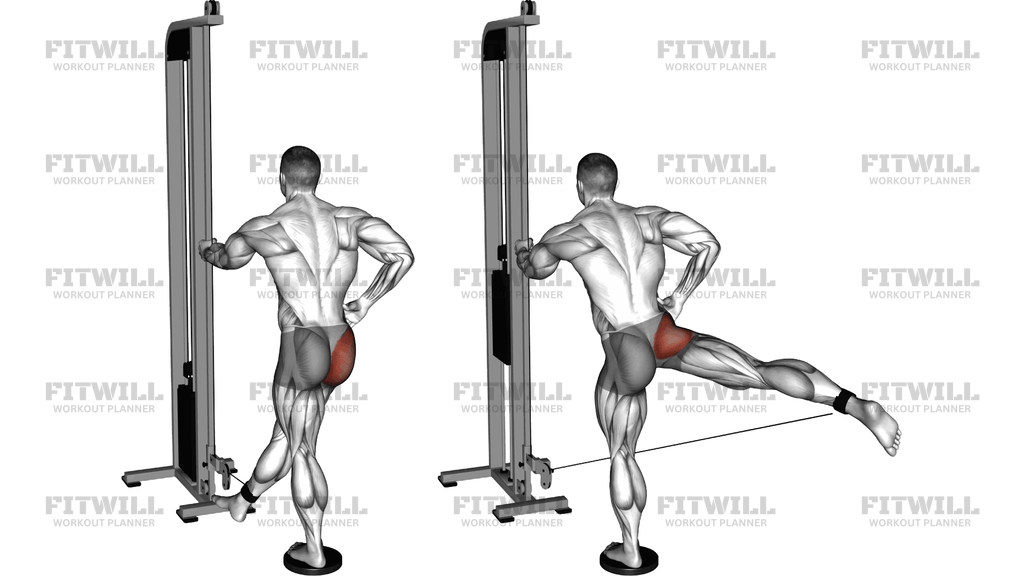
Instructions
- Attach an ankle strap around your working leg, securing it snugly just above the ankle, and clip it to the low pulley of a cable machine.
- Face the machine and stand roughly an arm's length away so the cable has room to travel, with your working leg closest to the pulley.
- Grip the machine frame with the hand on the opposite side of the working leg, and place your free hand on your hip for balance.
- Hinge slightly forward from the hips with a straight, braced spine, and shift your weight onto the standing leg with a soft knee.
- Brace your core and let the cable pull the working leg slightly forward and across your body to set the starting position.
- Exhale and sweep the leg back and outward on a diagonal path, keeping the knee nearly straight, until the hip is fully extended and slightly out to the side.
- Squeeze the glute for a beat at the end range without arching your lower back or rotating your torso.
- Inhale and lower the leg slowly and under control back to the starting position, resisting the cable's pull the entire way.
- Complete all reps on one side, then reposition the strap and repeat the same number of reps on the other leg.
Tips & Tricks
- If your torso swings backward as the leg kicks, you are pulling with your body instead of the hip; drop the weight one plate and re-grip the frame more firmly.
- The diagonal path is the point of the exercise. If the leg tracks straight back, you turn it into a standard kickback and miss the upper glute fibers.
- Watch that the toes of the working leg stay relatively neutral or slightly rotated out. Pointing them hard to the ceiling usually means the hip has rotated instead of extended.
- A common mistake is letting the standing knee snap fully locked for balance. Keep a soft bend in it so your base stays stable through each rep.
- Do not chase height. A leg that swings high while the lower back arches is training the spine, not the glutes; stop at the height where the hip, not the lumbar region, finishes the movement.
- Shorten the strap or step slightly farther from the machine if the cable goes slack at the start of the rep, as tension should exist before the leg ever moves.
- Because you finish all reps on one side before switching, expect the second leg to feel different. Match the weaker or less coordinated side first and let it dictate the load.
- If the ankle strap chafes during the sweep, reposition it higher on the calf or wear a longer sock; friction at the ankle is setup-related, not a reason to shorten the range.
Frequently Asked Questions
Which muscles does the Cable Straight Leg Diagonal Kickback work?
The gluteus maximus is the primary mover, with the upper glute fibers contributing because of the diagonal, abducted path. The hamstrings assist on the extension, and the standing leg plus core work to keep you stable.
Why is the kickback done diagonally instead of straight back?
The diagonal path blends hip extension with abduction, which biases the gluteus maximus and the upper glute fibers together. A straight-back version is more purely hip extension and shares more of the work with the hamstrings.
Is the Cable Straight Leg Diagonal Kickback suitable for beginners?
Yes, provided the weight starts light. The main learning points are hinging slightly forward without rounding the back and controlling the return, so beginners should do a few low-load practice sets before training it hard.
How high should my leg go at the end of each rep?
Only as high as you can extend the hip without arching your lower back or rotating your torso. For most people that is roughly in line with or slightly above the hip; beyond that the lumbar spine takes over the motion.
Can I use a resistance band instead of a cable machine?
You can, by anchoring a band low and looping it around the ankle, though the resistance curve changes. Bands are hardest at the top while the cable keeps tension more even, so reps may feel slightly different.
Should the working knee be locked or bent during the kickback?
Keep the knee essentially straight with only a tiny bend. Locking it hard is unnecessary and can be uncomfortable, while bending it much turns the movement toward a bent-knee kickback and reduces hamstring involvement.
Why do I feel this in my lower back instead of my glutes?
That usually means the torso is arching or swinging as the leg rises, so the lumbar extensors are finishing the rep. Reduce the range slightly, brace the core before each kick, and squeeze the glute deliberately at the end position.
How many reps and sets should I do?
Because it is an isolation exercise, it responds well to moderate-to-high rep work, commonly 3 sets of 10 to 15 reps per leg. Keep the load one you can control through the entire diagonal path without torso swing.
Is the Cable Straight Leg Diagonal Kickback safe for people with knee issues?
It is generally knee-friendly because the leg moves from the hip with minimal knee flexion and no external load pressing on the joint. If any position causes knee discomfort, shorten the range and check that the strap is not pulling the leg into an awkward rotation.