Landmine Sissy Squat
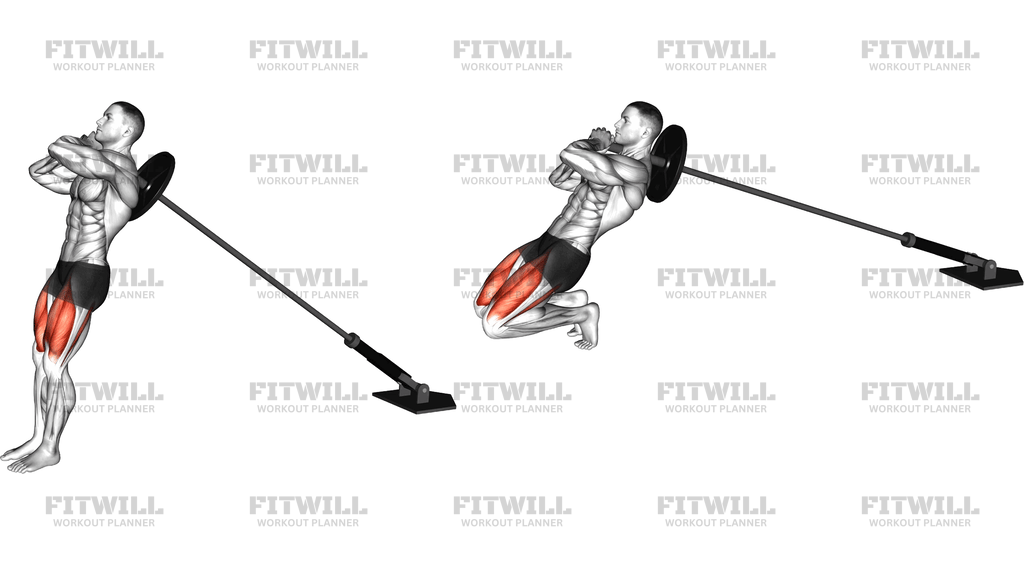
The Landmine Sissy Squat is a quad-focused bodyweight movement that uses a barbell set in a landmine attachment as a leaning support. The loaded end of the bar rests against your upper back while the opposite end sits anchored in the landmine base behind you, creating an angled guide rail you can lean into as your knees travel forward and your heels rise off the floor. This setup solves the biggest problem with a classic sissy squat: balance. Instead of fighting to keep your torso upright while your knees slide ahead of your toes, you can shift weight into the bar and let it control your backward lean.
The movement is essentially a deep knee-dominant squat with the hips extended rather than folded back. As you descend, your knees move forward past your toes, your heels lift, and your body forms a straight-ish line from shoulders to knees, leaning back against the angled bar. Your quadriceps, especially the rectus femoris crossing the hip, work hard both to control the descent and to pull you back up from a very deep knee extension position. The calves and ankle stabilizers handle the heel raise, and your trunk stays braced to hold your ribcage against the bar.
This exercise suits intermediate lifters who already own solid squat mechanics and want targeted quadriceps work without heavy spinal loading. It is popular in bodybuilding-style leg sessions as a finisher after squats or leg presses, and it is also useful for home or small-gym lifters who only have a barbell and a landmine anchor. Because the bar supports part of your bodyweight, it is more accessible than a free-standing sissy squat, but it is still demanding at the knee and should be loaded conservatively at first.
Setup quality determines whether this feels smooth or awkward. Set the bar height so the loaded end contacts your upper back near the base of your neck while you stand tall, and start with one modest plate so the bar is not top-heavy or tippy. Stand far enough from the anchor that the bar leans against you at a comfortable angle, roughly matching the backward path of your torso. If you stand too close, the bar pushes you forward; too far, and it drags you down and back before your knees are ready.
Execution comes down to patience at the knee. Push your knees forward and down, let your heels rise naturally, and keep your hips extended so the lean comes from the knee angle, not from folding at the waist. Descend only as deep as you can control with your thighs staying engaged, then drive the tops of your feet back into the floor to stand up. Depth builds over weeks; forcing the deepest range on day one is the most common way people irritate their knees with this pattern.
Treat the Landmine Sissy Squat as a precision exercise rather than a grind-it-out lift. Higher reps, slow tempos, and a short partial range at first will teach the pattern safely. Stop the set the moment your knees drift inward or your heels slam down, and keep the loaded plate collared so it cannot slide toward you mid-set.
[ Workout Log & Planner ]
Put your next workout in Fitwill
Keep your plan and training log ready when you are.


Instructions
- Load a light plate onto one end of a barbell and set that end into a landmine anchor or securely wedged corner, leaving the opposite end free.
- Face away from the anchor, bend under the free end, and rest the bar across your upper back and rear shoulders, holding it at your chest with crossed hands and a light plate collar to stop it sliding.
- Walk your feet out to hip-width and stand tall until the bar leans against your back at a slight angle, with your body weight balanced over the middle of your feet.
- Brace your core, lift your chest, and squeeze your glutes slightly so your hips stay extended before you begin.
- Inhale, then push your knees forward and down, letting your heels lift off the floor as your knees travel ahead of your toes.
- Continue descending while your torso leans back into the angled bar, keeping hips extended and the movement coming from the knees rather than a waist fold.
- Reach a depth where your thighs are working hard and your knees track straight ahead, ideally just before your shins settle near the floor or your form begins to slip.
- Exhale and drive the balls of your feet down through the floor, pulling your hips forward and your torso back up the bar's angle to a full stand.
- Reset your brace and heel position between reps, and recheck that the plate stays seated against your upper back before each descent.
Tips & Tricks
- Start with a 2-3 inch range of motion and only add depth once you can descend without your knees caving inward; most knee complaints come from chasing full depth too early.
- If the bar feels like it is tipping over your head at the bottom, you are leaning back too aggressively - drop a plate size or stand slightly farther from the anchor so the bar angle matches a gentler lean.
- Keep the plate collared on the free end; if it slides down the sleeve toward your neck mid-set, the balance point shifts and the bar can pop off your shoulders.
- Do not fold at the waist to create the lean - if your belly drops toward your thighs, your hips have broken and the quads lose tension; cue ribs down, hips squeezed.
- Let your heels rise passively rather than snapping onto your toes - actively hammering your heels up transfers the work away from your quads and stresses the forefoot.
- Place a pad or towel on the bar where it contacts your upper back if the knurling or plate edge digs in; discomfort there will make you lean crooked.
- Work barefoot or in flat shoes so you can feel the ball of the foot loading; cushioned runners make the heel raise mushy and harder to control.
- Use higher reps in the 10-20 range with slow eccentrics instead of adding heavy plates - the leverage at the bottom grows quickly and form breaks before load becomes meaningful.
- If your knees wander inward on the way up, think about spreading the floor with your big toes; internal knee collapse is the most common fault once fatigue sets in.
Frequently Asked Questions
What muscles does the Landmine Sissy Squat work?
The quadriceps are the primary movers, working through a long range as the knees travel forward and straighten. The calves and ankle stabilizers manage the heel raise, while the glutes and core hold the hips extended and keep your torso braced against the bar.
How is the Landmine Sissy Squat different from a regular sissy squat?
The anchored barbell gives you a leaning support and a fixed arc, so you do not have to balance your entire torso behind your hips unsupported. This makes the movement easier to control and lets you adjust difficulty by changing how far you stand from the anchor.
Is the Landmine Sissy Squat safe for beginners?
It can be, but it is not the best first quad exercise. Beginners should be comfortable with squats and split squats first, then start with a small range of motion and no more than one light plate. Anyone with existing knee pain should get clearance before attempting deep knee-traveling movements.
Why do my heels lift during the Landmine Sissy Squat?
Heel rise is intentional. As your knees travel forward over your toes, the ankle dorsiflexes fully and the heel naturally leaves the floor. Let it rise smoothly rather than forcing it, and make sure it comes back down evenly when you stand.
How deep should I go on the Landmine Sissy Squat?
Go only as deep as you can control with your knees tracking forward, your hips staying extended, and your heels rising steadily. Full depth where your shins approach the floor is a long-term goal, not a day-one requirement.
How far should I stand from the landmine anchor?
Stand far enough that the bar leans against your upper back at a gentle angle while you stand tall. If the bar pushes you forward at your heels or drags you down before your knees move, adjust your distance a few inches at a time until the lean feels natural.
How much weight should I load on the bar?
Start with a single modest plate just to stabilize the bar and keep it seated against your back. Because the bar acts as a counterbalance, extra weight changes the leverage quickly and rarely adds meaningful quad stimulus compared to more reps or slower tempo.
Can I do the Landmine Sissy Squat without a landmine attachment?
Yes - many lifters wedge the unloaded end of the barbell into a stable corner with a towel to protect the wall. The anchor just needs to hold the bar's end in place so the free end can pivot as you lean.
What can I use instead of the Landmine Sissy Squat?
A sissy squat machine or a free-standing sissy squat holding a doorframe are the closest substitutes. Spanish squats with a resistance band behind the knees and wall sits with heel raises also train deep knee-extension strength with less balance demand.
Why does my lower back work during this exercise?
Some trunk work is normal because you are bracing against an angled bar, but sharp lower back strain means you are hinging at the waist instead of leaning from the knees. Squeeze your glutes, keep your ribs stacked over your hips, and reduce depth until the lean stays knee-driven.