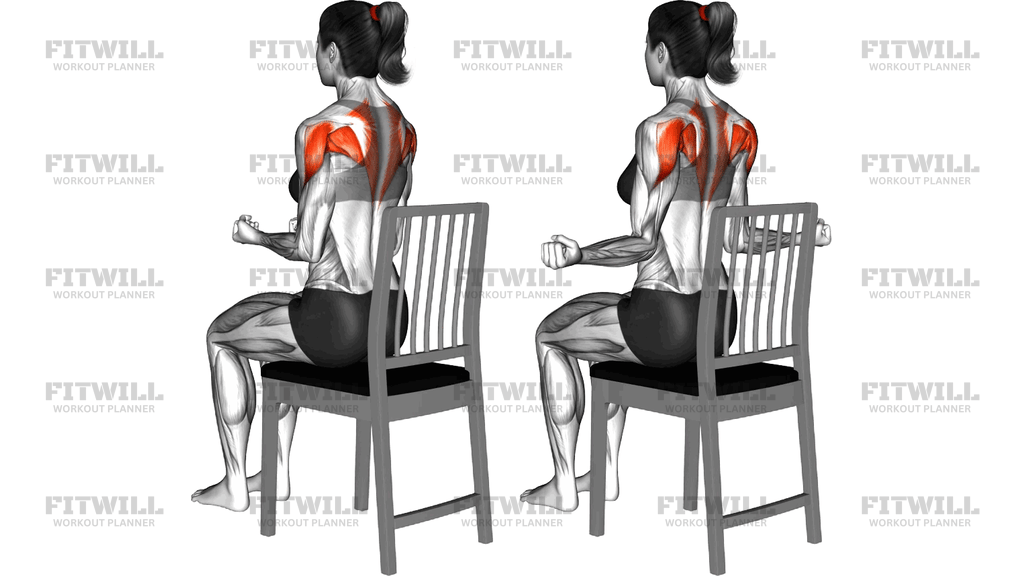
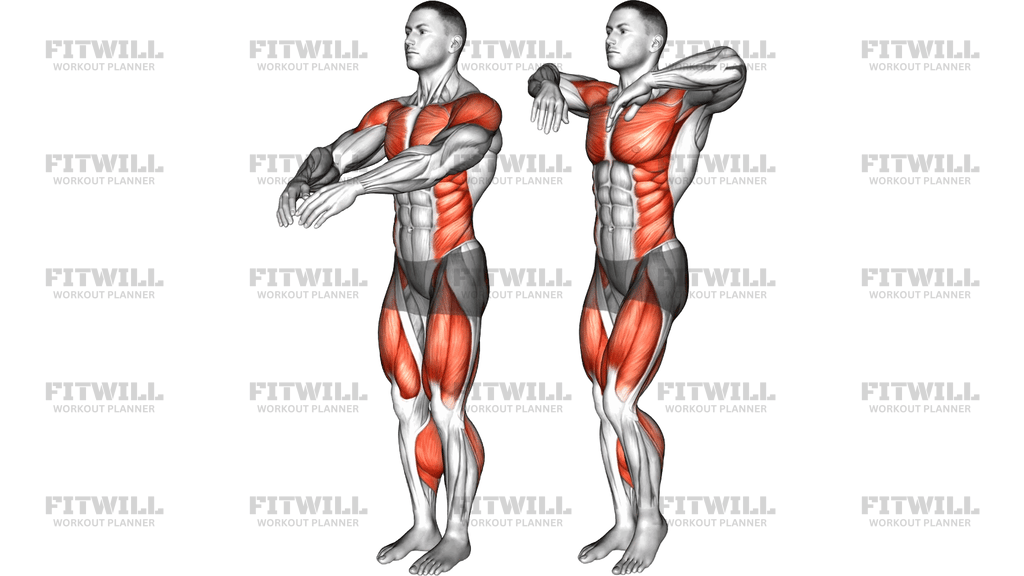
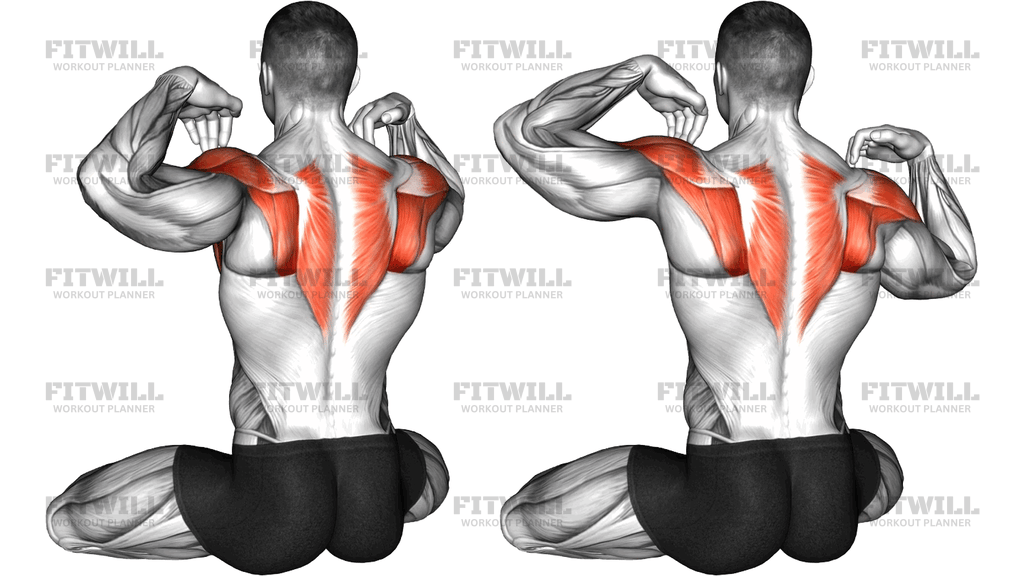
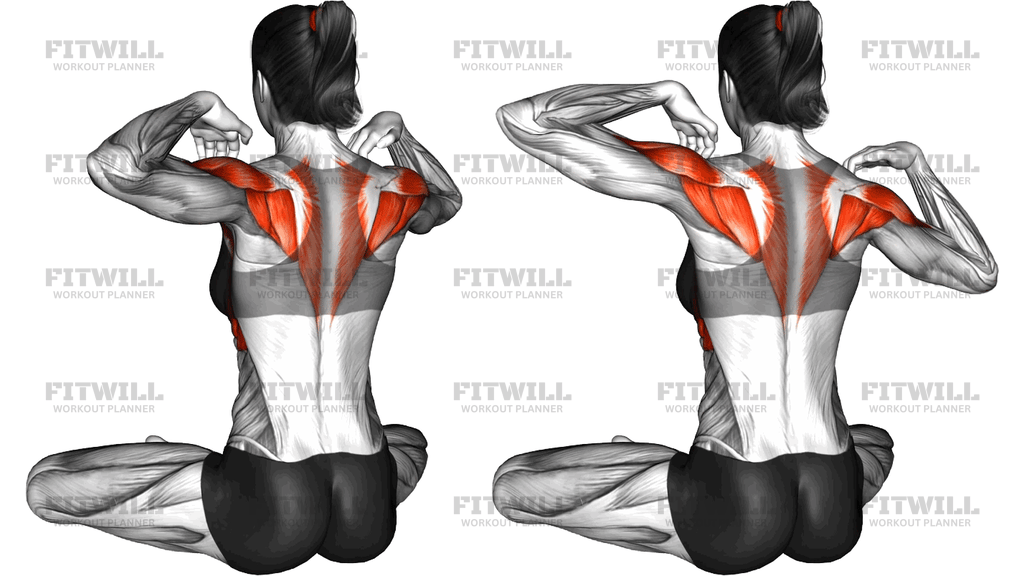
Bodyweight Standing Scapular External Rotation
Bodyweight Standing Scapular External Rotation is a shoulder health drill performed standing with the elbows bent at roughly 90 degrees and pinned lightly against the sides of the torso. From that position, you rotate the forearms outward so the hands swing away from the body while the shoulder blades squeeze gently together. Because there is no external resistance, the movement relies entirely on your own rotator cuff strength, which makes it easy to learn but surprisingly demanding when done with strict control.
This exercise primarily trains the external rotators of the shoulder, especially the infraspinatus and teres minor, along with the posterior deltoid. Because the emphasis is on the scapulae as well, the middle and lower trapezius and the rhomboids work to keep the shoulder blades pulled back and down as the arms rotate. That combination of cuff strength and blade control is exactly what most people are missing when their shoulders roll forward during pressing or pulling.
The standing setup matters more than it might seem. With no bench or floor to stabilize you, the trunk has to hold itself upright, and the elbows have to stay anchored at your ribs for the rotation to come from the shoulder rather than the elbow or the lower back. Keep the feet about hip-width apart, knees soft, and ribs stacked over the pelvis so you are not arching or leaning to fake extra range.
To execute the movement well, start with the forearms pointing forward or slightly across the body, then rotate outward until the hands are as far from the midline as you can move them without the elbows drifting away from your sides. Pause briefly at the end range, feeling the muscles across the back of the shoulder and between the blades, then rotate back inward under control. The tempo should be slow enough that you could stop the motion at any point.
This drill suits beginners learning shoulder mechanics, lifters warming up before bench or overhead pressing, office workers with rounded shoulders, and anyone rehabbing general shoulder function who has been cleared for rotational work. It also pairs well with band pull-aparts and wall slides as part of a short daily shoulder routine. Common use cases include pre-workout activation, active recovery between pressing sessions, and postural work at the end of a training day.
A few practical points: move within a range that keeps the elbows glued to your ribs, never force the rotation into a pinch at the front of the shoulder, and stop if you feel sharp pain rather than muscular effort. Because the load is minimal, quality of position beats volume every time, and two or three controlled sets of ten to fifteen reps are usually enough.
[ Workout Log & Planner ]
Put your next workout in Fitwill
Keep your plan and training log ready when you are.


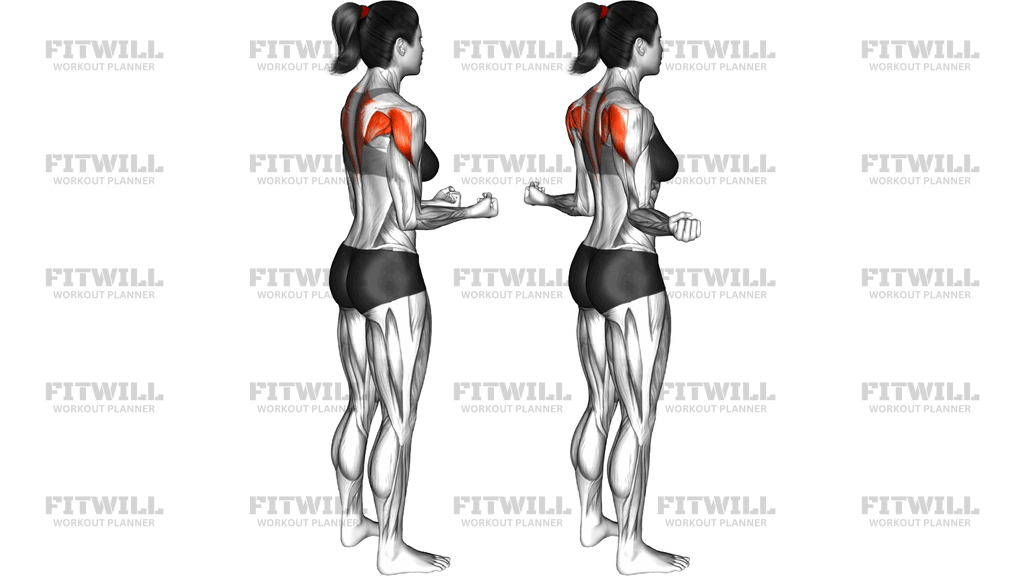
Instructions
- Stand upright with feet hip-width apart, knees slightly bent, and weight balanced evenly across both feet.
- Bend both elbows to about 90 degrees and tuck them lightly against your sides, arms relaxed at the torso.
- Let the forearms hang forward so the hands point ahead of you, palms facing each other or inward in loose fists.
- Draw the shoulder blades gently back and down, as if tucking them into your back pockets, and brace the trunk so the ribs stay stacked over the pelvis.
- Exhale as you rotate both forearms outward, swinging the hands away from the midline while the elbows stay pinned to your ribs.
- Continue rotating until you feel the muscles across the back of the shoulders and between the shoulder blades fully engage, and pause there for one to two seconds.
- Inhale as you slowly rotate the forearms back inward to the starting position, resisting the return instead of letting the arms fall.
- Keep the wrists neutral and the neck relaxed throughout; do not shrug the shoulders toward the ears.
- Complete all reps with the same tempo, then reset your posture between sets by taking a breath and re-establishing the blade position.
Tips & Tricks
- If the hands swing wide but you feel nothing in the rear shoulder, the elbows have probably drifted forward or away from the ribs; press them back against your sides before continuing.
- Watch for the lower back arching as fatigue sets in; squeeze the glutes lightly to keep the pelvis neutral so the rotation stays at the shoulder.
- Do not let the shoulders creep upward toward the ears; if shrugging shows up, reduce the range and consciously relax the upper traps.
- A mirror from the side is useful here: your elbow angle should stay close to 90 degrees for the entire set.
- Think of rotating around a fixed axis at the elbow rather than pushing the hands backward; the hands are just the end of the movement.
- Slow the return phase down if you tend to snap back to the start; the inward rotation builds control just as much as the outward turn.
- If one side rotates noticeably farther than the other, match the range to the stiffer side for a few sets instead of chasing symmetry with speed.
- Keep the fists loose; gripping hard recruits the forearms and neck and usually comes with unwanted shoulder elevation.
- Use this as a warm-up before pressing or as a standalone drill, but avoid doing heavy sets to failure since the rotator cuff responds better to moderate, crisp repetitions.
Frequently Asked Questions
Which muscles does the Bodyweight Standing Scapular External Rotation work?
The main workers are the external rotators of the shoulder, particularly the infraspinatus and teres minor, with help from the posterior deltoid. The middle and lower trapezius and rhomboids stabilize the shoulder blades throughout the rotation.
Why should the elbows stay pressed against the ribs during this exercise?
The elbows act as the hinge point that forces the rotation to come from the shoulder joint rather than the elbow or trunk. Once the elbows drift away, the drill loses its specificity and other muscles take over.
Is the Bodyweight Standing Scapular External Rotation suitable for beginners?
Yes, it is one of the most approachable shoulder drills because there is no external load and the range is naturally limited by your own rotation. Beginners should focus on slow tempo and elbow position rather than rep count.
How many reps and sets should I do?
Two to three sets of ten to fifteen controlled reps is a solid starting point. The goal is crisp, well-positioned movement, so stop the set when the elbows start wandering or the shoulders shrug.
What is the most common mistake in this movement?
Letting the elbows leave the torso and turning the drill into a backward arm swing, which shifts work away from the rotator cuff. Another frequent error is arching the lower back to fake extra rotation range.
Can I do this exercise before bench press or overhead pressing?
Absolutely. It works well as an activation drill in a warm-up because it wakes up the external rotators and scapular retractors that support pressing. Keep the reps moderate so the muscles are primed, not fatigued.
What can I use if I want more resistance than bodyweight provides?
A light resistance band held between the hands, or a very light dumbbell with the elbow supported, can add load once strict bodyweight reps feel easy. Progress gradually since the rotator cuff tolerates heavy loading poorly.
How is this different from a regular external rotation with a cable or band?
The standing bodyweight version removes resistance entirely, so the focus falls on scapular control and rotation quality rather than strength against load. It is a useful teaching and warm-up variation, while loaded versions are better for building rotational strength.
Should I feel any pinching at the front of the shoulder?
No, a pinch at the front of the shoulder usually means the range is being forced or the shoulder blade is losing its back-and-down position. Shorten the range, re-set the blades, and if the pinch persists, stop and have the shoulder assessed before continuing.