Weighted Plate Side Twist From Squat
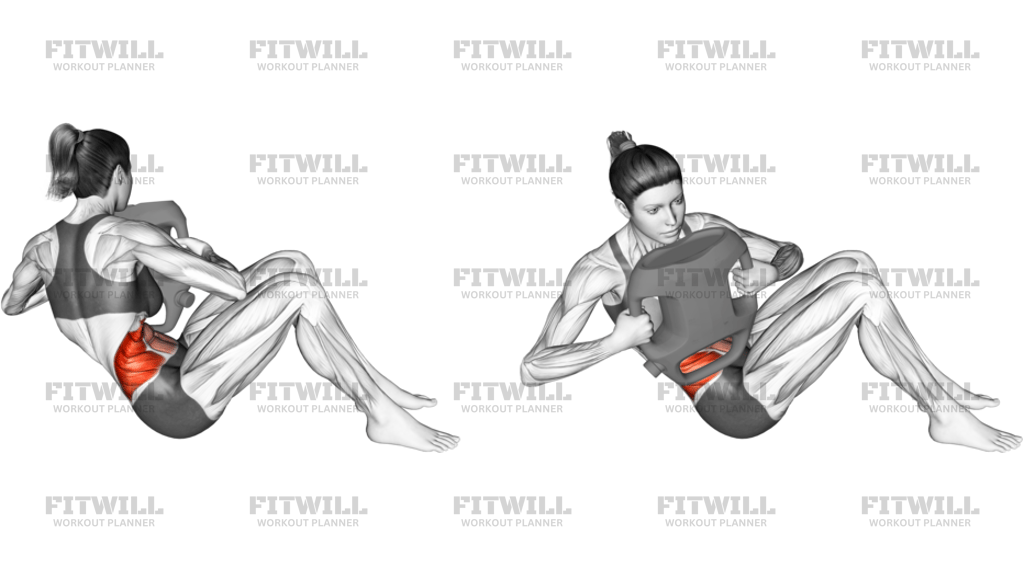
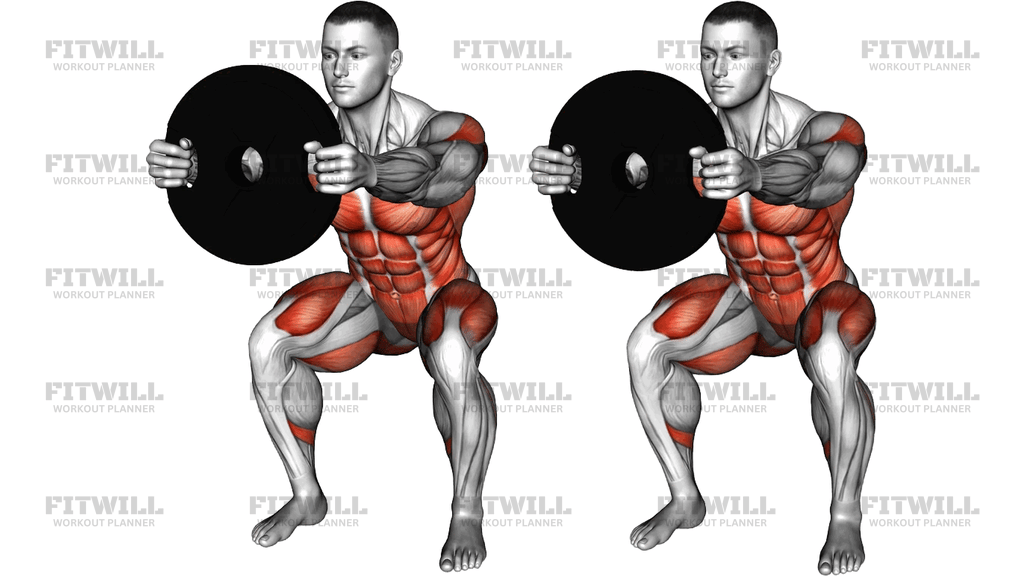
Weighted Plate Side Twist From Squat is a hybrid core exercise that combines an isometric squat hold with a weighted rotational movement. You hold a single weight plate with both hands at chest height, sink into a partial squat, and keep your lower body completely still while you rotate your arms and torso from side to side. Because your legs are busy holding the squat position, your core has to do the twisting work without any help from your hips, which makes the obliques work much harder than they would in a standing twist.
This movement trains the obliques along the sides of your waist, the deep core muscles that stabilize your spine, and the rectus abdominis at the front of your trunk. At the same time, the squat hold keeps constant tension on the quads, glutes, and hip stabilizers, so you get a leg endurance bonus while the focus stays on rotation. The plate also pulls slightly forward, forcing your shoulders and arms to work to keep it positioned in front of your chest throughout the set.
The setup matters more here than in most twisting exercises. Your stance width and squat depth decide how much your hips can cheat. Sit into a squat that is deep enough to feel your thighs working but not so deep that your balance becomes the limiting factor. Your feet stay flat and planted, your knees track over your toes, and your chest stays tall. If your heels lift or your knees collapse inward when you rotate, the squat is too deep or the plate is too heavy.
To execute the exercise well, think of the rotation coming from your ribcage and shoulders rather than from your arms swinging the plate. Sweep the plate in a smooth arc from one side to the other, pause briefly when it reaches the outside of your body, and resist the urge to let momentum throw it back across the middle. The slower you move the plate, the more your obliques have to control the weight on both ends of the arc.
This exercise suits lifters who want to build rotational strength and trunk control without loading the spine with a barbell, and it fits well into conditioning circuits, warm-ups for heavier squat sessions, or core finishers after leg days. Athletes in sports that involve swinging, throwing, or changing direction get especially good carryover because the drill trains exactly what those movements need: a stable lower body driving rotation through a strong midsection.
A few practical points keep the exercise safe. Keep the plate close enough to your chest that you can control it, keep your breathing steady instead of holding your breath through the twists, and stop the set when your squat position starts to break down. Rotational work under fatigue is where form slips, so it is better to do three clean sets than five sloppy ones.
[ Workout Log & Planner ]
Put your next workout in Fitwill
Keep your plan and training log ready when you are.


Instructions
- Stand with your feet roughly shoulder-width apart or slightly wider, toes turned out a small amount, and hold a weight plate with both hands, gripping its sides at the 3 and 9 o'clock positions.
- Raise the plate to chest height with your elbows bent and tucked toward your ribs, then hinge at your hips and bend your knees to lower into a partial squat with your weight over your midfoot and heels.
- Brace your abdominal muscles as if bracing for a light punch, keep your chest lifted, and make sure your knees stay stacked over your toes before any rotation begins.
- Keeping your hips, knees, and feet completely fixed, rotate your torso and arms to one side so the plate travels out toward that side of your body.
- Pause briefly at the end of the arc, then sweep the plate across the front of your chest to the opposite side at a speed you can fully control.
- Continue alternating sides for the desired number of repetitions, counting one twist to each side as one rep.
- Exhale as the plate sweeps across the middle of your body and inhale as it moves toward the outside of each arc.
- When you finish the set, stop rotating first, then drive through your heels to stand back up out of the squat before lowering the plate.
- Reset your stance and brace between sets so you never start a set already slouched or off-balance.
Tips & Tricks
- If your heels rise off the floor when you rotate, reduce your squat depth slightly — a stable quarter squat produces better oblique work than a deep squat you cannot hold.
- A common mistake is letting the arms do all the swinging while the torso stays square. Watch that your shoulders and ribcage actually turn with the plate, not just your elbows.
- Keep the plate at sternum height throughout. Letting it drift down toward your lap shortens the lever and removes tension from your core as the set goes on.
- Do not let your knees wobble inward each time the plate crosses the middle. Push them slightly outward as if spreading the floor to keep your squat solid.
- The pause at each side of the arc is where most of the oblique work happens. Skipping the pause and bouncing side to side turns the drill into a momentum exercise.
- Start with a light plate — 5 to 10 pounds is enough for most people — because the lever arm of the plate at arm's length multiplies the rotational load on your spine.
- If your lower back aches instead of your waist, you are likely arching or rounding as you twist. Squeeze your glutes slightly to lock your pelvis and rotate from the ribs up.
- Your grip and forearms will fatigue before your core on heavier plates. Chalk or a smaller-diameter plate can help you finish the set with your midsection, not your hands, as the limit.
Frequently Asked Questions
What muscles does the Weighted Plate Side Twist From Squat work?
The main movers are the obliques along the sides of your waist, supported by the deep core and rectus abdominis. Because you hold a squat the entire time, your quads, glutes, and hip stabilizers also work isometrically to keep you planted.
Why hold a squat during the twist instead of standing upright?
Squatting locks your hips in place, so your lower body cannot rotate to help swing the plate. That forces the obliques and trunk muscles to produce the entire rotation, which is much harder than a standing twist where the hips contribute.
How deep should the squat be during Weighted Plate Side Twist From Squat?
A partial squat where your thighs are roughly parallel to the floor or slightly above is plenty. The depth should be one you can hold steady for the entire set without your heels lifting or your knees caving inward.
How heavy should the plate be?
Start with a light plate, around 5 to 10 pounds, since holding it at arm's length creates a long lever that multiplies the rotational stress. Choose a weight you can twist with control for all reps without your squat position breaking down.
Is this exercise suitable for beginners?
Yes, as long as beginners start with a very light plate and a shallow squat. Learning to keep the hips still while the torso rotates is the key skill, and it is easier to master with a light load before progressing.
What is the most common mistake in this movement?
Swinging the plate with the arms and momentum while the torso barely rotates. Slow the tempo, pause at each side, and make sure your shoulders and ribcage turn with the plate so the obliques do the work.
What can I use if I don't have a weight plate?
A single dumbbell held vertically by one end, a kettlebell held by the horns at chest height, or a medicine ball all work well. Any object you can grip with both hands at chest height and control through the arc will do the job.
How many reps and sets should I do?
Twisting to each side counts as one rep, and 8 to 15 controlled reps for 2 to 4 sets is a solid working range. Stop the set when your squat hold or rotation control starts to slip rather than grinding out extra reps.
Is it safe to twist while holding a squat?
It is generally safe with a light load and controlled tempo, since the rotation happens through the upper body while the spine stays supported by a braced, stable lower body. Keep the plate close, move smoothly, and avoid fast, jerky twisting, especially if you are new to rotational training.