Resistance Band Seated Row
The Resistance Band Seated Row is a horizontal pulling exercise performed sitting on the floor with your legs extended and a resistance band looped around the soles of your feet. You hold one end of the band in each hand and pull it toward your lower ribs, squeezing your shoulder blades together before letting the band lengthen under control. It recreates the classic seated cable row using nothing more than a band, which makes it one of the most practical back exercises for home training or travel.
This movement primarily works the muscles of the upper and mid back, especially the rhomboids and mid traps, which are responsible for pulling the shoulder blades toward the spine. The lats assist on the pull, the rear shoulders help guide the elbows back, and the biceps work as the elbow flexors. Because you sit upright with legs extended, your lower back and core also stay engaged to keep your torso tall throughout the set.
Setup matters more with bands than with cables because the resistance comes from the band's stretch rather than a fixed pulley. Anchoring the band around both feet keeps the tension path level with your torso, and the amount of tension at the start depends on where you grip the band. Choking up closer to your feet increases the difficulty; holding the ends with looser arms makes the set easier. Take a moment to remove slack from the band before your first rep so you start from a stable, braced position.
To perform it well, sit tall on the floor with your legs extended in front of you and a soft bend in the knees. Loop the band around the arches of both feet, grip it firmly, and pull the handles toward your stomach, driving your elbows past your ribs. Avoid swinging your torso backward to move the band. The pull should come from the shoulder blades and arms, not momentum from the hips.
The Resistance Band Seated Row suits beginners building their first pulling strength, lifters who train at home without a cable machine, and anyone who spends long hours sitting and needs direct work for the muscles that pull the shoulders back. Because band tension increases as you pull, the hardest part of the rep is the squeeze at the end, which is exactly where rowing exercises build the most postural benefit. Keep repetitions slow and controlled, and scale the challenge by adjusting band thickness, grip position, or the number of sets rather than by jerking the weight back with your torso.
[ Workout Log & Planner ]
Put your next workout in Fitwill
Keep your plan and training log ready when you are.


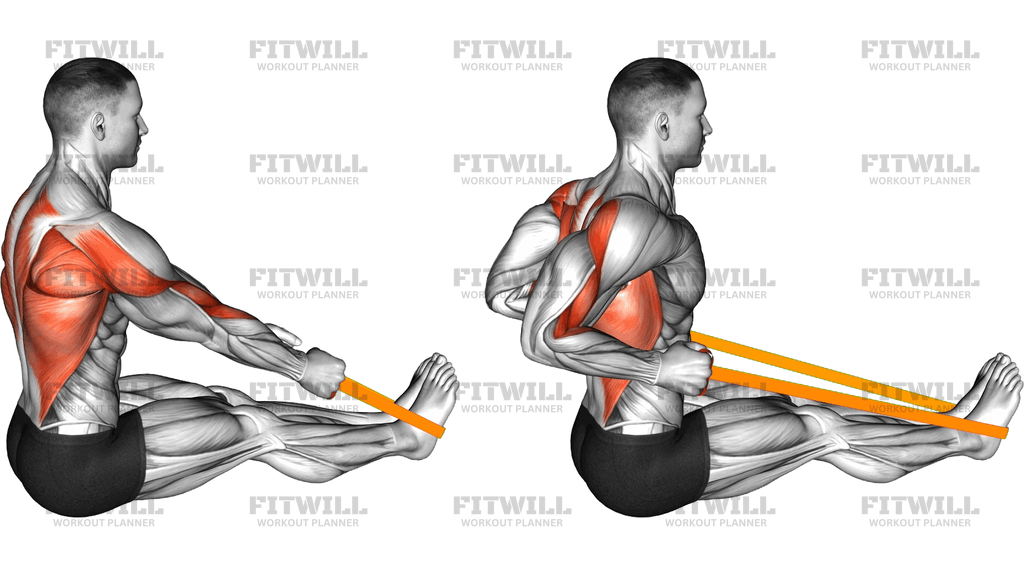
Instructions
- Sit on the floor with your legs extended straight in front of you and place the middle of the resistance band around the arches of both feet.
- Hold one end of the band in each hand with your palms facing each other or slightly down, and choose a grip point where the band is taut but not stretched tight when your arms are extended.
- Sit up tall with your chest open and shoulders back, then brace your abdominal muscles to keep your torso steady.
- Keeping your torso upright, pull the band toward your lower stomach by driving your elbows back past your ribs.
- At the end of the pull, squeeze your shoulder blades together and hold for a brief pause.
- Slowly let your arms extend forward again, resisting the band's pull until your arms are straight and your shoulders reach slightly toward your feet.
- Exhale as you pull the band in, and inhale as you return to the starting position.
- Keep your legs relaxed with a soft bend in the knees so the band stays secure on your feet throughout the set.
- Complete your repetitions, then release the tension from one hand at a time and remove the band from your feet.
Tips & Tricks
- If the band slips off your feet mid-set, loop it around the arches rather than the toes and point your toes slightly back toward your shins.
- A common mistake is leaning your torso backward as you pull, which turns the exercise into a back-and-hips movement. Keep your torso close to vertical and let your arms do the rowing.
- Do not let your shoulders shrug toward your ears at the end of the pull. Keep your upper traps relaxed and think about pulling your elbows back, not your hands up.
- If you cannot reach a full squeeze at your stomach, the band is too heavy. Switch to a lighter band or hold closer to the ends to reduce stretch tension.
- Control the return for two to three seconds on each rep. Letting the band snap your arms forward wastes the stretch phase and strains the shoulders.
- Your lower back can round forward when you reach to extend your arms, especially if your hamstrings are tight. Bend the knees slightly or sit on a small cushion to keep your spine tall.
- Grip the band with your whole hand rather than pinching it between your fingers, which keeps your forearms and grip from failing before your back does.
- Pause for one full second with your shoulder blades squeezed at every rep. Because band tension peaks there, this pause is where the rhomboids and mid traps get their best stimulus.
- If one arm drifts ahead of the other, slow the tempo and focus on pulling both hands to the same spot on either side of your navel.
Frequently Asked Questions
Which muscles does the Resistance Band Seated Row work?
The rhomboids and mid traps are the primary movers, with strong help from the lats, rear shoulders, and biceps. The lower back and core stay active to hold your seated posture.
How do I make the Resistance Band Seated Row harder without buying a heavier band?
Choke up on the band so there is less slack at the start of the pull, or use both a doubled loop of the band around your feet. Adding a one-to-two-second pause at the squeeze also increases the challenge.
Is the Resistance Band Seated Row good for beginners?
Yes. It teaches the basic horizontal pulling pattern with a low load, and the resistance is easy to adjust by changing your grip position or band thickness. Beginners should start with a light band and focus on squeezing the shoulder blades rather than pulling fast.
Why should I loop the band around my feet instead of anchoring it to a post?
Wrapping the band around the soles of both feet keeps the resistance path level with your torso and turns your legs into a secure anchor. It also makes the exercise fully portable so you need no wall, post, or machine.
Should my knees be straight or bent during the Resistance Band Seated Row?
Legs extended with a soft bend in the knees works for most people. If tight hamstrings pull your lower back into a rounded position, bend the knees more or elevate your hips on a folded mat so you can sit tall.
What is the most common mistake in this exercise?
Rocking the torso backward with each pull. This shifts the work from the upper back to momentum and the hips. Keep your chest up and nearly still, and use a lighter band if you cannot complete reps without leaning.
What can I use instead if I don't have a resistance band?
A seated cable row with a V-bar or straight bar is the closest gym alternative. At home, a towel looped around the feet with a rowing motion works in a pinch, though it offers far less resistance.
How many sets and reps should I do?
Two to four sets of 10 to 15 reps is a solid range for most lifters, since the band's peak tension at the squeeze rewards moderate repetitions. Rest about 60 seconds between sets.
Is it safe if I have shoulder discomfort when rowing?
Bands are generally gentle on the shoulders because the tension is smooth and self-limiting, but stop if you feel sharp pain. Shorten the range of motion, use a lighter band, and keep your elbows closer to your body rather than flaring them out.