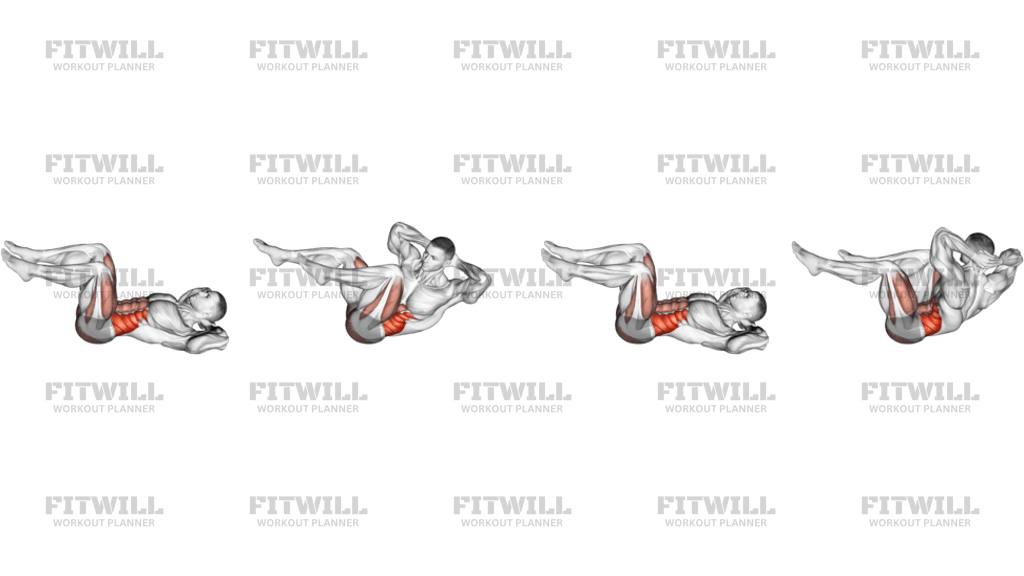
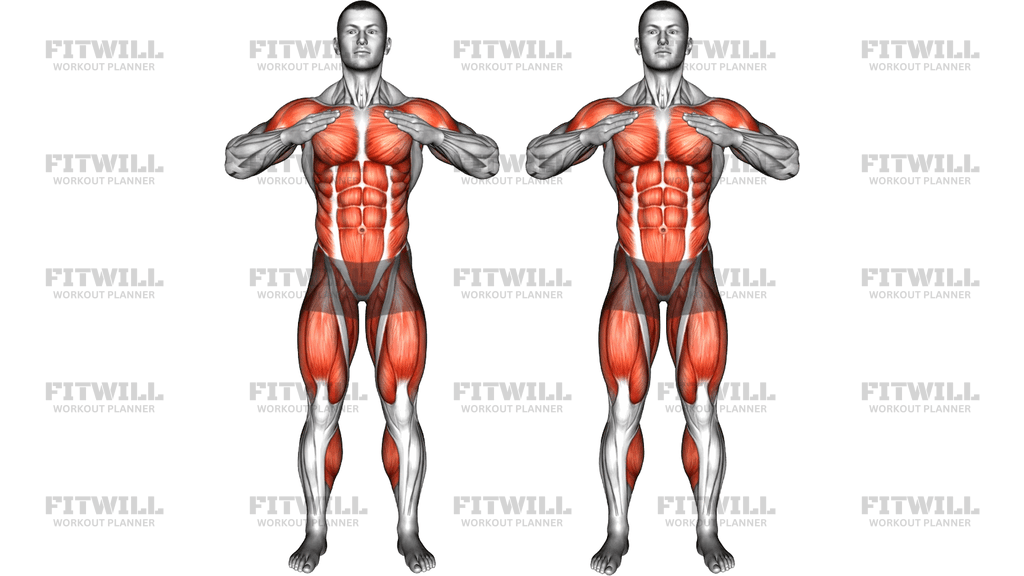
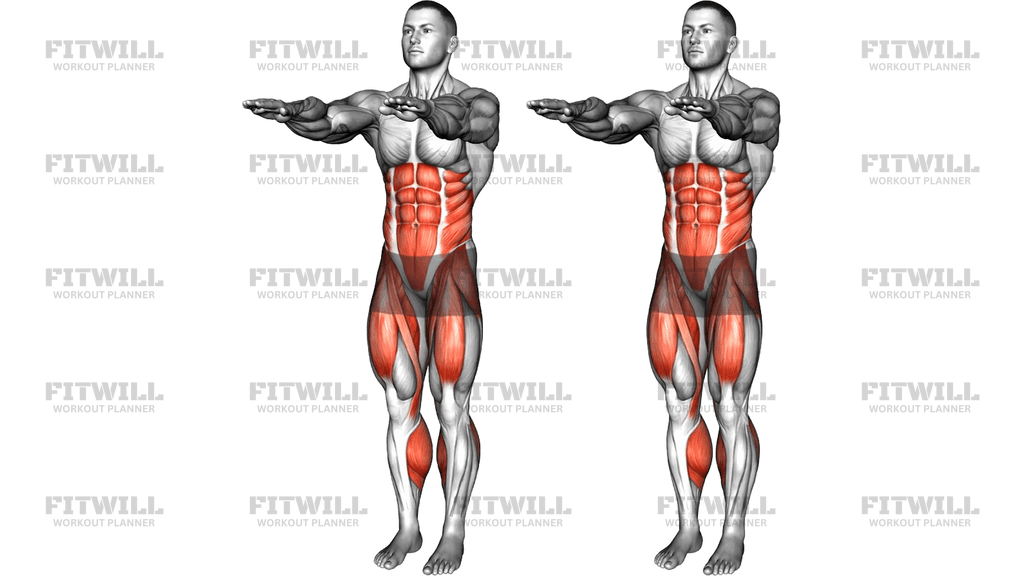
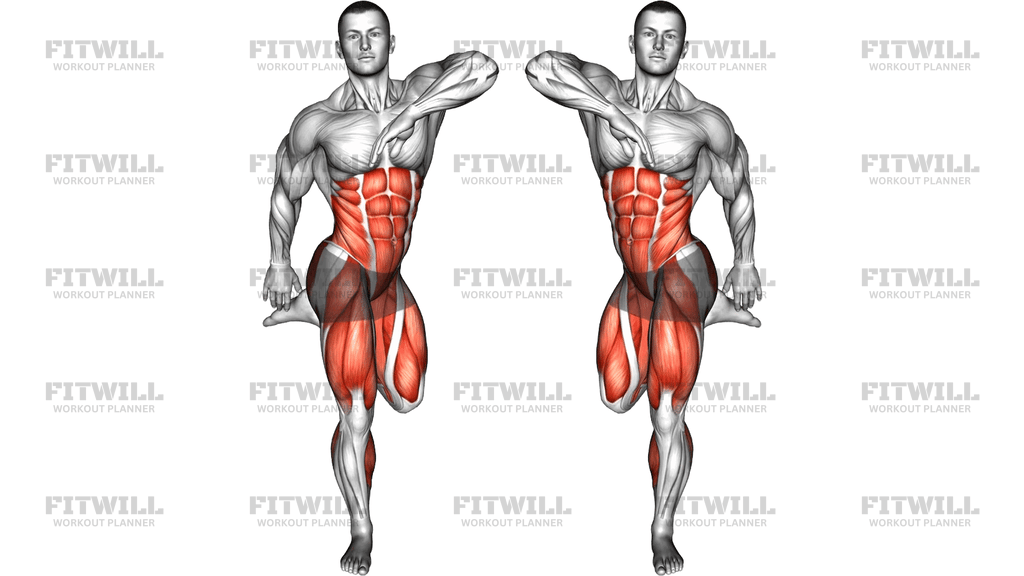
Standing Russian Twist
The Standing Russian Twist is a rotational core exercise performed on your feet with hands clasped in front of the chest and no equipment required. Instead of sitting on the floor like the traditional Russian twist, you stay upright with a wide, stable stance and rotate your torso from side to side, letting your arms sweep across your body as your ribcage turns. Because your feet stay planted, your trunk has to produce the rotation rather than borrowing momentum from the floor or a bench.
This exercise mainly trains the obliques, the muscles running along the sides of your waist that handle rotation and anti-rotation. Your deeper core muscles work to keep your spine stacked and controlled through each turn, while your hip flexors and lower back stabilizers support the trunk as it pivots. The legs also stay quietly busy the whole time, since a wide stance with soft knees is what keeps your base from wobbling as you rotate.
The standing setup matters more than most people expect. Feet wide and knees slightly bent lower your center of gravity and give your hips room to move slightly with the twist instead of forcing all of the rotation through the lumbar spine. Hands clasped at chest height create a single point of reference, so you can see and feel whether your torso is actually rotating or whether your arms are just swinging across a still body.
It is a practical choice for warm-ups, home workouts, and sport-focused training where you rotate on your feet — think swinging, throwing, or changing direction. It also works well as a low-fatigue finisher because it needs no setup time and no equipment. Beginners can learn it quickly, and more experienced lifters can make it harder by slowing the tempo, adding a pause at each side, or holding a light plate or medicine ball at the chest.
The main safety point is control. Rotating fast and loose with a rounded lower back is where this movement goes wrong. Keep your chest tall, your core braced, and rotate from the ribcage with your hips following naturally, staying in a range that feels smooth rather than forced.
[ Workout Log & Planner ]
Put your next workout in Fitwill
Keep your plan and training log ready when you are.


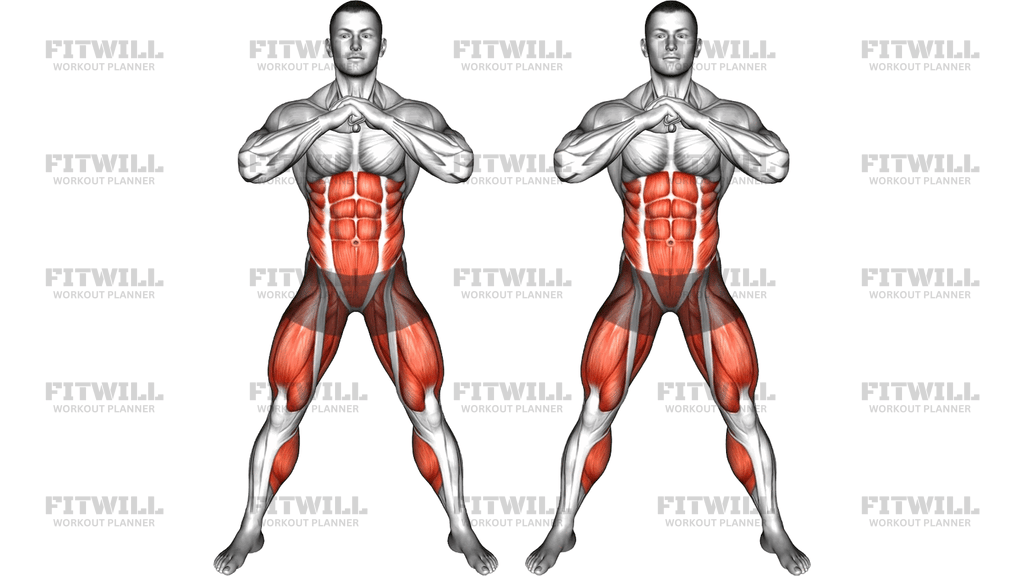
Instructions
- Stand with your feet roughly shoulder-width apart or slightly wider, toes turned out a little, and shift your weight evenly across both feet.
- Clasp your hands together in front of your chest with your elbows bent and pointing out to the sides, arms held away from your ribs.
- Soften your knees and hinge forward slightly from the hips so your torso is upright but not rigid, then brace your core as if bracing for a light push.
- Rotate your torso to one side by turning your ribcage, letting your clasped hands travel with your chest rather than leading the movement with your arms.
- Allow your back heel to lift slightly and your hips to rotate with you, so the twist spreads through your trunk instead of twisting only at the lower back.
- Continue until your chest and hands point toward one side, keeping your shoulders level and your head moving with your torso.
- Pause briefly at the end of the rotation, then sweep the torso all the way through center to the opposite side with the same controlled turn.
- Exhale as you rotate into each side and breathe steadily as you return through the middle.
- Alternate side to side for your target number of reps or time, keeping the tempo even on both directions.
- To finish, rotate back to center, unclasp your hands, and stand tall before stepping out of the stance.
Tips & Tricks
- A common mistake is flinging the arms side to side while the chest barely moves. Fix it by watching your hands: if they travel farther than your shoulders, you are swinging instead of rotating your torso.
- If you feel pinching in your lower back, you are likely twisting only at the waist with a stiff lower body. Let your heels and hips rotate with you so the movement is distributed through the trunk.
- Keep your knees softly bent for the entire set. Locked-out knees make the stance rigid and push rotational stress into the spine and knee joints.
- Slow the tempo down before you speed it up. A two-second rotation each way with a brief pause builds more control than fast, bouncy reps.
- Your head should turn with your shoulders, not stay fixed facing forward. Leading with your eyes toward the direction you are rotating keeps the neck in a comfortable position.
- If you struggle to feel your obliques, squeeze your abs lightly before starting and shorten the range until each turn is deliberate at both ends.
- When adding weight like a plate or medicine ball, hold it close to your chest first. Holding it at arm's length multiplies the load on your lower back and encourages sloppy reps.
- Stay balanced by keeping your weight even between both feet at the start of each rep. Leaning into one side too early turns the exercise into a side-bend instead of a twist.
Frequently Asked Questions
What muscles does the Standing Russian Twist work?
It primarily targets the obliques along the sides of your waist, with supporting work from the rectus abdominis, deep core stabilizers, hip flexors, and lower back muscles. Your legs and hips also contribute to keeping the stance stable.
Is the Standing Russian Twist good for beginners?
Yes, it is one of the easier rotational exercises to learn because it requires no equipment and the wide standing stance provides a stable base. Beginners should start with slow, unweighted reps and a comfortable range before adding speed or load.
How is the Standing Russian Twist different from the seated Russian twist?
The standing version keeps your feet on the floor, so your trunk has to generate the rotation instead of you balancing on your glutes. This makes it easier on the lower back for many people and more specific to rotating while on your feet.
Should my hips move during the Standing Russian Twist?
Yes, your hips should rotate naturally with your torso, and your back heel can lift slightly as you turn. Forcing your hips to stay frozen puts all the rotation through the lower back, which is where discomfort usually starts.
Can I add weight to the Standing Russian Twist?
You can hold a light plate, medicine ball, or dumbbell at chest height once your unweighted form is solid. Keep the load close to your body and reduce the range or speed if your balance or lower back suffers.
Why do my arms feel this exercise more than my abs?
That usually means your hands are leading the movement while your torso stays relatively still. Clasp your hands at chest height and focus on turning your ribcage so your shoulders and hands arrive at each side together.
How fast should I rotate during the Standing Russian Twist?
Start with a controlled tempo of about one to two seconds per side so you can stop the rotation at each end. Once control is consistent, you can add moderate speed, but avoid whipping the torso with a relaxed core.
How many reps and sets should I do?
A common starting point is two to three sets of 20 to 30 total alternating rotations, or 30 to 45 seconds per set. Because it is a low-load movement, it fits well in warm-ups or as a core finisher.
Is the Standing Russian Twist safe for people with lower back issues?
It is generally gentler on the back than seated versions because your stance is stable and the rotation can be kept controlled, but anyone with existing back pain should stay in a small, pain-free range and consult a professional before including rotation work.
What can I substitute if standing rotation is uncomfortable?
Try a Pallof press or a cable woodchop, which train the obliques with less end-range spinal rotation. Both keep your trunk braced against resistance while avoiding the twisting position that causes discomfort for some people.