Knee Tap Sky Reach
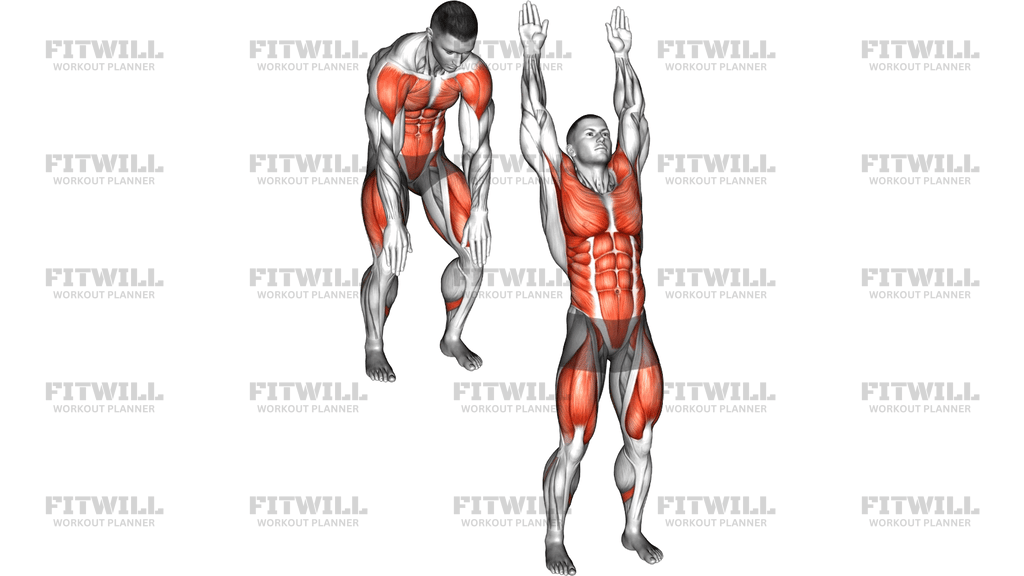
Knee Tap Sky Reach is a bodyweight movement that pairs a hip hinge with an overhead reach, taking you from a folded forward position with your fingertips tapping your knees to a tall standing posture with both arms stretched straight overhead. It is essentially a flowing rhythm: fold down, tap, drive up, reach. Because it uses no equipment and only your own bodyweight, it slots easily into warm-ups, mobility circuits, or low-impact conditioning work.
The movement trains the posterior chain through the hinge portion — the glutes and hamstrings control the fold and power the return to standing — while the overhead reach engages the shoulders and upper back and forces the core to hold you tall at the top. The transition between the two positions is where most of the value lives: your lower back and core have to coordinate with your hips so the spine stays long as you fold and finish standing without arching excessively.
Setup matters more than it looks. A stance about hip-width apart with soft knees gives your hips room to travel back, and starting the fold by pushing the hips behind your heels — rather than rounding your chest toward your thighs — keeps the work in the hips instead of straining the lower back. Hands should slide down the front of the thighs so the knees receive a light tap from the fingertips at the bottom, not a hard slap.
Execution is straightforward but benefits from intent. Hinge back until your fingers touch your knees, pause briefly, then drive your hips forward to stand tall, letting your arms swing or travel up so both hands finish overhead with palms facing each other or forward. Reach actively toward the ceiling for a beat before lowering back into the next repetition. Moving with control rather than bouncing gives you far more from each rep.
This exercise suits beginners learning the hip hinge pattern, older trainees who want a joint-friendly full-body flow, and anyone using it as a movement break or warm-up before lifting. It also works well in higher-rep circuits because the repeated transitions elevate the heart rate without impact. If you have tight hamstrings, you will feel the fold at the back of your thighs — that is expected, and bending the knees a little more is a fair adjustment rather than a compromise.
[ Workout Log & Planner ]
Put your next workout in Fitwill
Keep your plan and training log ready when you are.


Instructions
- Stand with your feet about hip-width apart, weight spread across the whole foot, and let your arms hang relaxed at your sides.
- Soften your knees slightly and brace your abdominal muscles as if preparing for a light push to the stomach.
- Push your hips back and hinge forward, letting your hands slide down the front of your thighs as your chest lowers toward the floor.
- At the bottom, tap both knees lightly with your fingertips while keeping your back long and your neck in line with your spine.
- Pause for a moment in the folded position so you are not relying on momentum to stand back up.
- Drive your hips forward and press through the floor to rise, keeping your chest leading the way up.
- As you reach standing, raise both arms straight overhead until your elbows are extended and your hands reach actively toward the ceiling.
- Hold the tall overhead position for a beat, finishing with your ribs stacked over your pelvis rather than your lower back arched.
- Lower your arms back to your sides with control, take a breath in as you fold for the next rep, and exhale as you stand and reach.
Tips & Tricks
- If your fingertips slap your knees hard, you are dropping too fast — slow the descent so the tap is a light touch you can genuinely control.
- The common mistake is rounding the lower back to reach the knees. If you cannot tap without rounding, bend the knees more or shorten the range instead of curling your spine.
- Keep your weight in the middle of your feet. Shifting onto your toes as you fold is a sign your hips are not traveling back far enough.
- Think of the bottom position as a hip hinge, not a squat — your chest lowers because your hips move backward, not because your knees bend deeply.
- At the top, reach through your palms and spread your fingers rather than just lifting your arms; active reaching engages the shoulders and upper back properly.
- Avoid thrusting the hips forward and leaning back at the finish. Squeeze the glutes to stand tall while your ribs stay stacked over your pelvis.
- Match your breathing to the rhythm — inhale as you fold down, exhale as you stand and reach — so you do not hold your breath through the transition.
- Move at a steady tempo of about two seconds down and one second up. Rushing turns the exercise into uncontrolled bending and reduces the work your hips and core do.
Frequently Asked Questions
What muscles does the Knee Tap Sky Reach work?
The hinge and stand portion primarily works the glutes and hamstrings, supported by the lower back. The overhead reach brings in the shoulders and upper back, while the core stabilizes you through the whole transition.
Is the Knee Tap Sky Reach suitable for beginners?
Yes. It uses only bodyweight and a natural range of motion, making it a good first exposure to the hip hinge pattern. Beginners can bend the knees more to shorten the fold until flexibility improves.
Should I tap my knees or the floor during the Knee Tap Sky Reach?
As the name indicates, the target is a light fingertip tap on the knees at the bottom of the fold. Reaching further toward the floor is unnecessary and usually causes the lower back to round.
Why do my hamstrings feel tight at the bottom of the Knee Tap Sky Reach?
The hip hinge lengthens the hamstrings significantly, so mild tension there is normal. Soften the knees a little more or reduce how far you fold, and the stretch should stay comfortable rather than straining.
How many reps of the Knee Tap Sky Reach should I do?
For a warm-up, 8 to 12 slow repetitions work well. In a conditioning circuit you can go higher, around 15 to 20 reps, as long as the fold and reach stay controlled.
Can I use the Knee Tap Sky Reach as a warm-up before weight training?
It is a solid warm-up choice, especially before deadlifts, squats, or overhead pressing, because it rehearses the hinge pattern and takes the shoulders through a full overhead range with no load.
What is the most common mistake in the Knee Tap Sky Reach?
Rounding the spine to make the knee tap instead of hinging at the hips. The fix is to push the hips back first and let the hands slide down the thighs, only folding as far as a long back allows.
What can I substitute for the Knee Tap Sky Reach if I want a similar movement?
A plain bodyweight good morning or a hinge-and-reach without the tap covers the same pattern. Adding a light wall touch at the top instead of the free reach is another easy variation.
Is it safe for my lower back to fold forward in the Knee Tap Sky Reach?
When you hinge from the hips with a braced core and a long spine, the fold is a normal, well-tolerated movement. Keep the range comfortable, avoid bouncing, and stop if you feel sharp pain rather than simple muscle stretch.