Rotation Back Swing
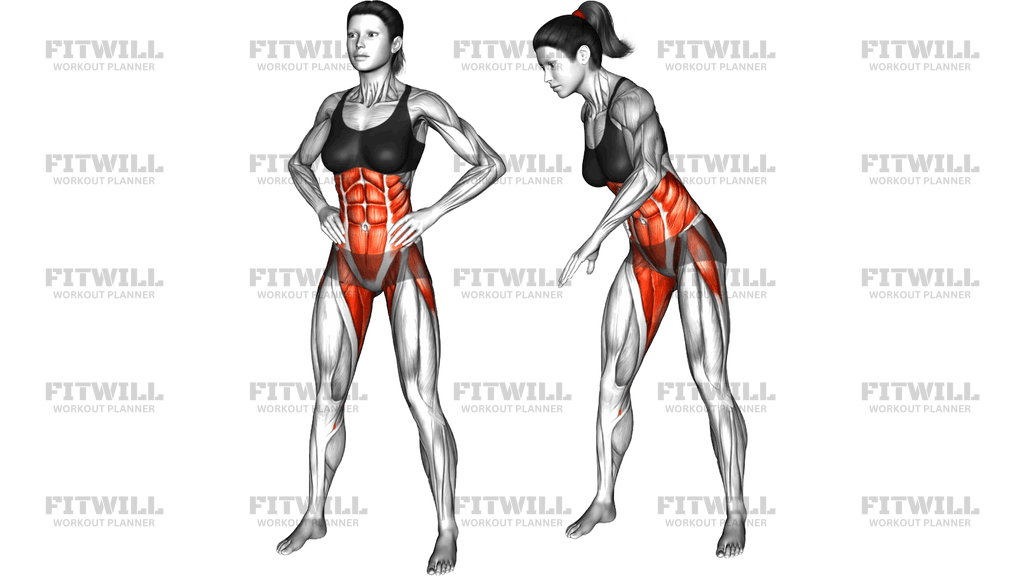
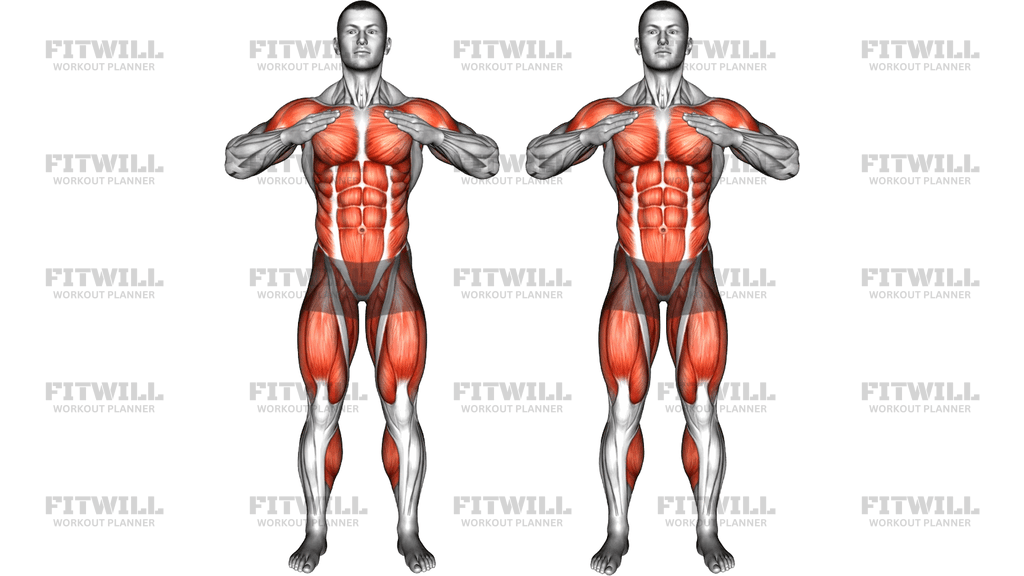
Rotation Back Swing is a standing bodyweight rotation drill that takes your trunk through a full rotational arc from one side to the other, mimicking the wind-up and follow-through pattern of a swinging motion. You stand with a wide, stable base, bring your hands together in front of your chest, and rotate your upper body as far as feels comfortable to one side, then sweep through the center to the other side while your feet stay planted. The movement lives in your waist, not your arms.
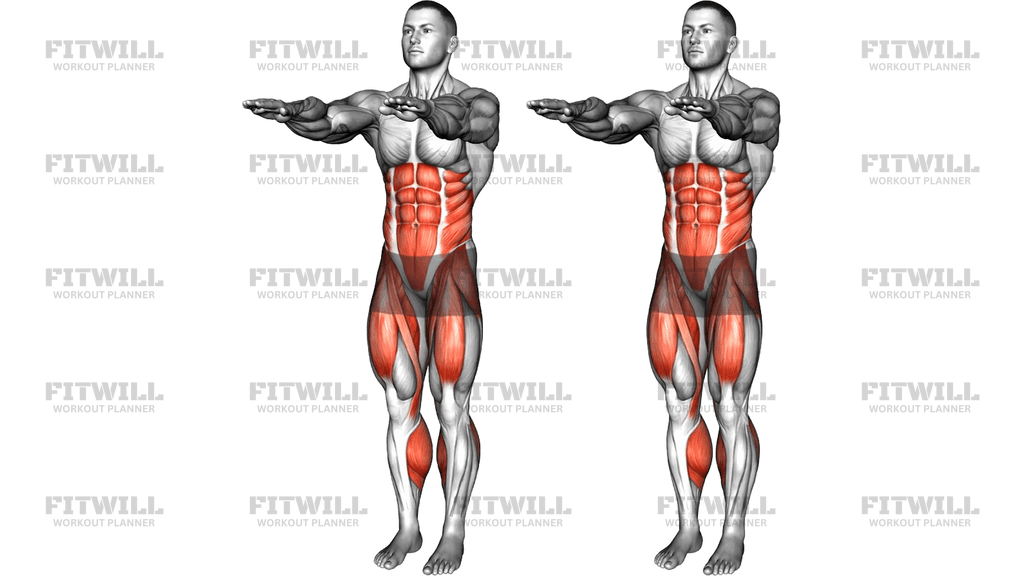
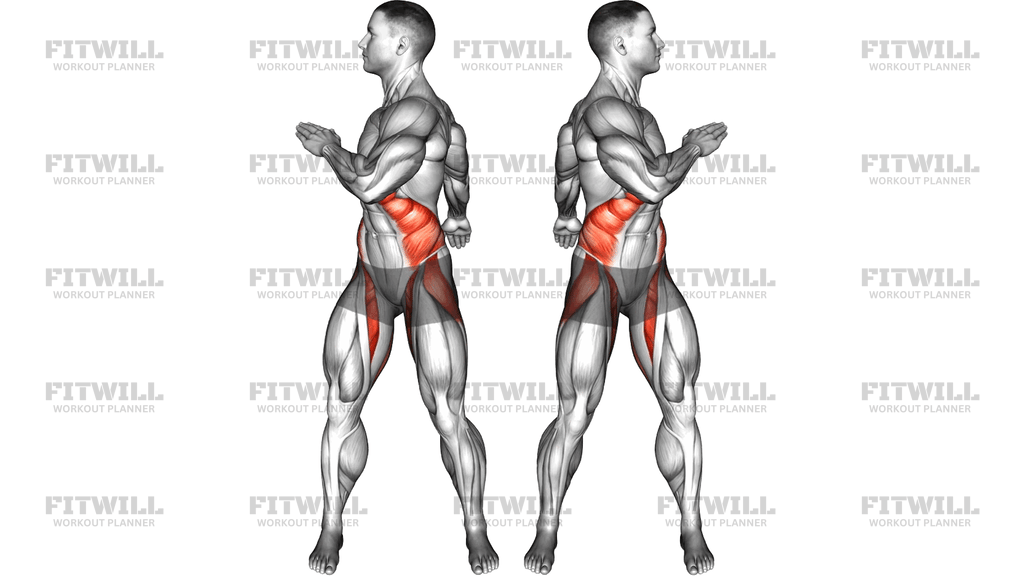
The highlighted working area in this exercise is the obliques, the layered muscles running along the sides of your waist that drive trunk rotation. Your rectus abdominis helps brace the front of your torso, your deep core stabilizes the spine through the turn, and the muscles around your hips and outer thighs work to keep your lower body quiet while everything above the belt rotates. Because your feet stay fixed, your hips and inner thighs also get a gentle dynamic stretch as the turn deepens.
This is a particularly useful drill for anyone whose sport involves swinging or rotational power: golf, tennis, baseball, hockey, and racket sports all draw on the same coil-and-release pattern. It also suits general gym-goers who want a mobile, controlled way to warm up the trunk before heavier lifting, or to build rotational awareness without any equipment. Because there is no external load, you can focus entirely on quality of movement rather than fighting a weight.
Setup matters more than it looks. A stance slightly wider than shoulder width gives your hips room to rotate without your knees collapsing inward, and a soft bend in the knees protects your lower back from twisting under tension. Pressing the palms together in front of the chest creates a fixed lever, which forces the rotation to come from the ribcage and waist instead of the arms swinging independently. Keep your head moving with your chest so your cervical spine is not left twisted behind your shoulders.
To execute it well, rotate at a deliberate pace, letting the ribcage turn as far as your midsection allows while your hips stay mostly forward. Pause briefly at the far end of each turn, then sweep smoothly through the middle to the opposite side without letting momentum whip your lower back. Breathe steadily throughout, exhaling as you rotate. If you feel the movement turning into a fast side-to-side fling, slow down — control is the whole point.
Common use cases include pre-round or pre-practice warm-ups for rotational athletes, trunk activation before core training, and low-impact conditioning for people who want to keep their waist mobile. Start with modest range and moderate speed, and only extend the turn as your mobility allows. If twisting causes discomfort in your spine or hips, reduce the range rather than pushing through it.
[ Workout Log & Planner ]
Put your next workout in Fitwill
Keep your plan and training log ready when you are.


Instructions
- Stand with your feet slightly wider than shoulder width, toes pointing forward, and allow a soft bend in both knees so your legs are not locked.
- Bring your hands together in front of your chest with your elbows bent and pointing outward, pressing your palms lightly against each other to create a stable lever.
- Draw your shoulder blades down, stack your ribs over your hips, and lightly brace your abdominal wall so your lower back is supported before you start turning.
- Rotate your ribcage and shoulders to one side as far as your waist comfortably allows, keeping your hips and feet facing forward and your head turning with your chest.
- Pause briefly at the end of the turn, feeling the tension along the side of your waist rather than in your lower back.
- Sweep smoothly back through the center and continue rotating to the opposite side, maintaining the same controlled pace in both directions.
- Keep your arms fixed relative to your torso throughout — the hands should travel with the chest, not swing on their own.
- Exhale as you rotate into each turn and inhale as you pass back through the center.
- Complete your target number of alternating rotations, then stop with your torso facing forward before releasing your hands and stepping out of the stance.
- Rest briefly between sets, shake out your hips, and reset your stance before the next set so every rep starts from a square, balanced position.
Tips & Tricks
- The most common mistake is letting the arms swing side to side on their own while the ribcage barely turns. Keep the palms pressed together and lead with your sternum so the waist does the rotating.
- Do not let your heels lift or your hips rotate fully with your shoulders. A small amount of hip turn is natural, but if your feet pivot, you lose the rotational demand on the obliques.
- Avoid twisting with straight, locked legs. Locked knees force the rotation into the lower back and knees instead of the hips and waist.
- If your range is limited, shorten the turn and gradually build depth over sessions rather than yanking toward a full rotation.
- Watch for the head lagging behind the shoulders. Keep your eyes tracking with your chest so the neck is not cranked into an extreme twist.
- The far end of each turn is where form usually breaks down. Pause there for a beat instead of bouncing, which keeps the movement in the muscles rather than in passive joints.
- Use this as a warm-up before rotational or swinging sports, but keep the pace moderate — turning fast and loose before you are warm is a recipe for a strained oblique.
- If you feel a pinching sensation at the front of your hip during the turn, widen your stance slightly or reduce the depth of rotation until the movement feels smooth.
- A useful cue for tempo: two seconds into the turn, one-second hold, two seconds across the middle. This prevents the exercise from collapsing into a quick side-to-side fling.
Frequently Asked Questions
Which muscles does the Rotation Back Swing work?
The primary muscles are the internal and external obliques along the sides of your waist, which drive the trunk rotation. Your rectus abdominis, deep core, and the muscles around the hips and lower back assist by stabilizing and controlling the turn.
Is the Rotation Back Swing suitable for beginners?
Yes. Because it uses only your body weight and requires no equipment, it is an accessible way to learn rotational control. Beginners should start with a smaller range of motion and a slower tempo before extending the turn.
Why are my hands pressed together in front of my chest during this exercise?
Pressing the palms together fixes your arms to your ribcage, turning your upper body into a single rotating unit. Without that connection, your arms tend to swing independently and your obliques stop doing the work.
Should my feet stay completely still during the Rotation Back Swing?
Your feet should remain planted and mostly forward-facing, with only a small natural shift in the hips as you rotate. If your heels or toes are pivoting significantly, your stance is usually too narrow or you are over-rotating.
How many repetitions should I do?
Eight to twelve rotations to each side is a practical starting point, either as a warm-up or for two to three sets. If your waist fatigues and your form gets loose, stop the set rather than grinding out sloppy reps.
What is the most common mistake with the Rotation Back Swing?
Turning it into a fast arm swing. The rotation must come from the ribcage and waist with the hands moving as part of the torso; otherwise you get momentum without much muscle work and extra stress on the lower back.
Is this exercise useful for golf or tennis?
Yes. It rehearses the coil-and-rotate pattern that both sports rely on, making it a popular warm-up before swinging practice. It builds rotational mobility and coordination in the exact range those sports use.
Can I do the Rotation Back Swing if I have lower back sensitivity?
Reduce the range of rotation, keep a soft bend in your knees, and move slowly so the turn stays in your waist rather than your lumbar spine. If twisting causes pain, stop and consult a qualified professional before continuing.
What can I use if I want a progression from the Rotation Back Swing?
Adding light resistance, such as holding a small medicine ball or plate at chest height, increases the rotational demand. Only progress once you can control the bodyweight version with a full, smooth turn and a stable lower body.