Lying Leg Stretched Tap Toe To Knee Opening Knee T
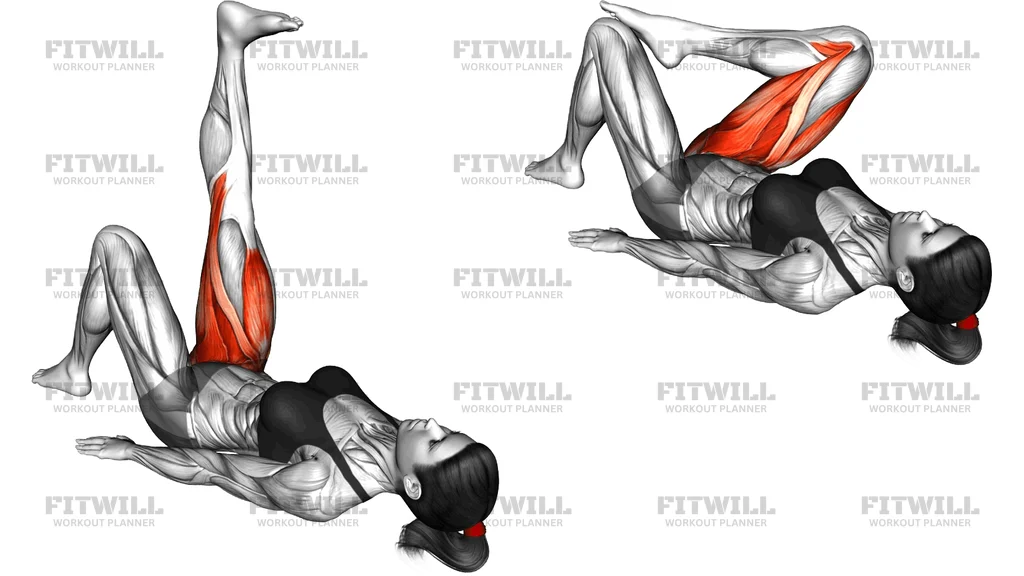
The Lying Leg Stretched Tap Toe To Knee Opening Knee T is a floor-based hip mobility drill that combines a straight-leg raised position with a controlled toe tap and outward knee opening. You lie on your back, extend one leg straight up toward the ceiling, then bend that knee and guide the toe down to tap the opposite knee before letting the joint open out to the side. It is a simple sequence, but it takes the hip through flexion, internal rotation toward the tap, and external rotation and abduction as the knee opens, all with the pelvis supported by the floor.
This drill is especially useful for anyone whose hips feel stiff from long sitting or from repetitive training like running and cycling. Because one foot stays planted and your upper body is fully supported, it is easy to control the range and notice exactly where each hip starts to resist. It fits well as a warm-up before squats, lunges, or deadlifts, and it works just as well as a cooldown or an evening unwinding routine.
The main work happens in the inner thigh and around the hip joint itself. The adductors lengthen and shorten as the knee travels from vertical down to the tap and back out to the side, while the deep hip rotators and glutes control the opening phase. The abdominal muscles have a quieter but important job: they keep your pelvis from rolling to one side as the leg moves away from midline.
The setup matters more than it looks. With one leg pointed at the ceiling and the other foot flat on the floor, your pelvis has a stable tripod, and that stability is what lets the moving hip rotate cleanly instead of dragging your lower back into the motion. If you rush and the pelvis tilts, you lose the targeted feel in the hip and shift stress into the lumbar area.
To execute it well, move as if the toe is tracing a slow arc: from straight up, the knee bends and the toe descends to kiss the opposite knee, then the knee swings open to the side without the foot ever dragging on the floor. The return is the same path in reverse. Keeping the tempo slow, roughly two to three seconds per phase, makes the difference between a genuine hip-opening drill and a leg just flopping around.
Stay within a range where you feel a comfortable draw through the inner thigh and outer hip, never a pinch at the front of the joint or strain in the knee. Both hips are trained one side at a time, so always match your reps left to right rather than letting your more mobile side set the standard.
[ Workout Log & Planner ]
Put your next workout in Fitwill
Keep your plan and training log ready when you are.


Instructions
- Lie on your back on an exercise mat with your arms relaxed at your sides, palms facing down.
- Bend both knees and place your feet flat on the floor, then extend your right leg straight up toward the ceiling with the knee soft and the foot flexed.
- Keep your left foot planted and press it gently into the floor; brace your abdominal muscles lightly to settle your pelvis in a neutral position.
- From the vertical position, bend the raised knee and slowly guide your toe down until it taps the inner side of the opposite knee.
- From the tap, open the knee out to the side, letting the hip externally rotate while the toe stays pointed toward the ceiling and the foot stays off the floor.
- Pause for a breath at the open position, feeling the stretch through the inner thigh and the outside of the hip.
- Reverse the path: bring the knee back to the center, tap the toe to the opposite knee again, then straighten the leg back up to vertical.
- Exhale as the knee opens and inhale as the leg returns to the stretched vertical position.
- Complete your reps on one side, then switch legs and repeat with the left leg raised.
- When finished on both sides, lower the leg with control, bend both knees, and rest briefly before standing up.
Tips & Tricks
- The most common fault is the pelvis rolling toward the moving leg; pin your opposite shoulder blade and keep the planted foot heavy to stop it.
- If your lower back arches off the mat when the knee opens, tilt your tailbone slightly toward the floor and reduce how far the knee swings out.
- Keep the raised knee slightly bent rather than locked; a hard-locked knee makes the toe-to-knee tap feel sharp at the back of the knee.
- Aim the tap at the inner side of the standing knee, not the middle of the shin, so the hip rotates along the intended arc.
- If the hip pinches at the front during the opening phase, make the opening angle smaller and gradually widen it over several sessions.
- Use your hand to lightly support the outside of the knee on the open position if your range is limited; guide rather than push.
- Do not let the moving foot drop to the floor as the knee opens; holding it off the ground is what keeps the outer hip working through the range.
- Keep the tempo around two to three seconds per phase; the tap should look deliberate, like the toe is drawing an arc in the air.
- Match your reps exactly between sides and start with the stiffer hip so the flexible side does not quietly set your range.
Frequently Asked Questions
What muscles does the Lying Leg Stretched Tap Toe To Knee Opening Knee T work?
It primarily targets the adductors of the inner thigh, along with the hip flexors and the deep rotators and glutes that control the knee opening. The abdominal muscles work lightly to keep the pelvis steady.
Is this a strength exercise or a stretch?
It is mainly a mobility and stretch drill with a strength element, since you actively control the leg through the arc rather than holding a passive stretch.
Do I need any equipment for the Lying Leg Stretched Tap Toe To Knee Opening Knee T?
No equipment is required beyond an exercise mat or a carpeted floor to cushion your back and head. Your body weight provides all the resistance.
Why does the toe tap the opposite knee instead of the floor?
Tapping the opposite knee gives you a precise target that keeps the hip rotating along a controlled arc instead of drifting wherever gravity pulls. It also makes it easy to compare left and right symmetry.
How many reps should I do per side?
Eight to twelve slow repetitions per side works well, either as a warm-up before lower body training or as a standalone hip mobility set.
Can beginners do this drill?
Yes, it is very beginner friendly because you are lying down and the floor limits how far the leg can travel. Start with a smaller knee opening and only progress the range as it feels comfortable.
What is the most common mistake in the Lying Leg Stretched Tap Toe To Knee Opening Knee T?
Letting the pelvis roll toward the moving leg, which turns a hip opener into a lower back twist. Keep the planted foot pressing down and the opposite shoulder flat against the mat.
Can I use this before squatting or deadlifting?
Yes, it makes a good warm-up because it takes the hips through flexion, rotation, and abduction without fatigue. Follow it with a couple of lighter sets of your main lift to complete the warm-up.
How is this different from a figure-four stretch?
A figure-four stretch is a static hold with the ankle resting on the opposite thigh, while this drill moves dynamically from a vertical leg through a toe tap and an open knee, so you train the range actively rather than holding it.
What should I do if my knee hurts during the movement?
Reduce the range of the tap and the knee opening, and keep the moving knee more bent. If discomfort in the knee or hip continues, stop the drill and have it assessed by a qualified professional.