Dumbbell Single Leg Deadlift
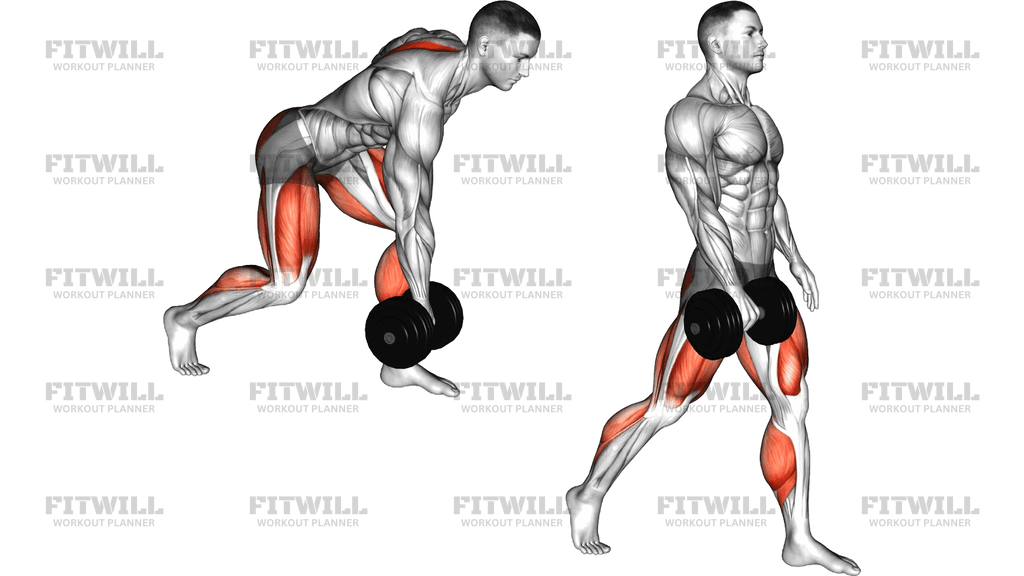
The Dumbbell Single Leg Deadlift is a hinge performed on one leg, with a dumbbell held in one hand while the non-working leg extends behind you as a counterbalance. Unlike a standard deadlift, the single-leg version removes half your base of support, which turns a familiar hip hinge into a balance and stability challenge as well as a strength movement. The highlight in the working hip and hamstring shows exactly where the load concentrates when the hinge is done correctly.
This movement earns its place in nearly any program because it trains the glutes and hamstrings in a way bilateral deadlifts cannot. Each leg works independently, which exposes and corrects left-to-right strength differences, and the standing hip has to resist rotation and side-to-side collapse the entire time. The lower back works hard to hold your torso neutral, and the muscles around the ankle and foot constantly adjust to keep you over your support foot.
The setup matters more here than in most hinge variations. Because one dumbbell is typically held on the same side as the working leg or opposite it, the loading changes how you must counterbalance your rear leg. Your weight should sit firmly over the midfoot of the standing leg, the rear leg stays active and reaching back rather than limp, and the head, hips, and rear foot should form one long line at the bottom. Get those pieces right and the movement feels smooth; get them wrong and you will wobble, round over, or feel it in your spine instead of your hip.
Execution is a push, not a reach. Think about driving the hips of your free-leg side backward while your torso lowers as a consequence, letting the dumbbell travel straight down close to your standing leg. Stop when you feel a strong stretch through the hamstring of the working leg, usually somewhere between shin height and just below the knee depending on your mobility, then drive your hips forward and squeeze the glute to stand tall.
Use the Dumbbell Single Leg Deadlift as an accessory after your main lifts, as a warm-up activation before squatting or sprinting, or as a primary lower-body movement when you want heavy hip work with lighter total load on the spine. Start with a weight you could comfortably lift for a two-legged deadlift and expect to begin lighter than that, because balance will be the limiting factor long before strength is. Control beats load on this one every time.
[ Workout Log & Planner ]
Put your next workout in Fitwill
Keep your plan and training log ready when you are.


Instructions
- Stand tall holding one dumbbell in one hand at your side, feet hip-width apart, and shift your weight fully onto one leg so the toes of your free foot just brush the floor behind you.
- Set your standing foot flat and grounded, toes spread, and keep a soft but not bent knee, stacked over the ankle.
- Brace your core as if preparing for a light punch to the stomach, pull your shoulders back and down, and set your eyes on a fixed point on the floor a few feet ahead of you.
- Hinge by pushing the hip of your free-leg side straight back, letting your torso tilt forward while your free leg swings back behind you as a counterweight.
- Allow the dumbbell to lower straight down, staying close to your standing shin, with your shoulders squared to the floor rather than twisting toward or away from the weight.
- Descend until you feel a firm stretch in the hamstring of your standing leg, with your back flat, hips level, and your head, torso, and rear leg roughly forming one straight line.
- Drive through the midfoot of your standing leg and push your hips forward to return upright, squeezing the glute hard at the top without leaning back or hyperextending.
- Exhale on the way up and inhale at the top before the next rep; keep the breath steady rather than holding it throughout the set.
- Complete all reps on one side, then switch the dumbbell to the other hand and work the opposite leg, resetting your balance fully between reps if needed.
Tips & Tricks
- If you wobble forward onto your toes, your hips are likely drifting back past your heel. Keep your weight over the midfoot and think about pushing your hips back on a horizontal line rather than sitting down.
- The most common mistake is rounding the lower back to reach lower. Stop descending the moment your flat back position breaks, even if the dumbbell only reaches knee height; depth will improve as your hamstring flexibility does.
- Keep the dumbbell close to your leg. When it drifts forward away from your body, the lever arm lengthens and your lower back takes the strain instead of your hip.
- If you twist toward the loaded side, try holding the dumbbell in the hand opposite your working leg, which often balances the rotation and makes the hinge feel cleaner.
- Your rear leg should be an active extension of your torso, squeezing back with the glute of that side. A limp trailing leg makes balance much harder and shortens your hinge.
- Keep your hips square to the floor. If the hip of your free-leg side rotates open, cue yourself to point both hip bones at the ground and reach longer with the back foot instead of higher.
- Practice the pattern barefoot or with a very light weight first, holding the free-leg position for a few seconds at the bottom, before adding meaningful load.
- Do not rush the return. Standing up too fast usually means the back takes over; make the top of each rep a deliberate glute squeeze with both hips level.
- Hold onto a rack or wall with your free hand for your first few sessions if balance is the bottleneck, then progress to holding a light weight only when you can hinge without support.
Frequently Asked Questions
What muscles does the Dumbbell Single Leg Deadlift work?
The glutes and hamstrings of the standing leg do most of the work, with the lower back supporting a neutral spine throughout the hinge. The ankle stabilizers and core also work hard to keep you balanced over one foot.
Should I hold the dumbbell on the same side as my working leg or the opposite side?
Both are valid. Holding it in the opposite hand counterbalances the rear leg and often feels smoother for beginners, while the same-side hold slightly increases the demand on balance and hip stability. Start with the opposite-hand grip and experiment once your form is consistent.
Is the Dumbbell Single Leg Deadlift suitable for beginners?
Yes, but start with no weight or a very light dumbbell and treat it as a balance drill first. Many beginners find the hinge itself easy but need several sessions to control the single-leg stance before loading meaningfully.
How far down should the dumbbell go at the bottom?
Only as far as your hamstring flexibility and back position allow, typically to shin level or just below the knee. Depth is individual, and touching the floor is not the goal; a flat back and a strong hamstring stretch are.
Why do I keep losing my balance on this exercise?
Usually your weight is too far forward on the standing foot, or your rear leg is hanging passively instead of reaching actively back. Fix your gaze on a fixed spot, keep weight over the midfoot, and extend the free leg like a counterweight.
Can I use a kettlebell or barbell instead of a dumbbell?
A kettlebell works well because the handle sits below the bell and keeps the weight close to your leg. A barbell is possible but demands more balance and setup precision, so it is better saved for when the dumbbell version is solid.
How does the Dumbbell Single Leg Deadlift differ from a regular Dumbbell Deadlift?
The two-legged version lets you move much heavier total load, while the single-leg version shifts each hip to work alone and adds a large balance and anti-rotation component. They complement each other rather than replace one another.
How many sets and reps should I do?
Two to four sets of six to ten controlled reps per leg works well for strength, or eight to twelve per leg for stability focus. Because balance fatigues quickly, keep the rest periods generous enough to reset between sides.
Is it safe for my lower back?
When performed with a braced, neutral spine and a weight you can control, it is a well-tolerated hinge for most people. If you feel strain in your lower back rather than your hamstrings and glutes, reduce the load, shorten the range, and check that the dumbbell is staying close to your standing leg.