Deep Squat Turn
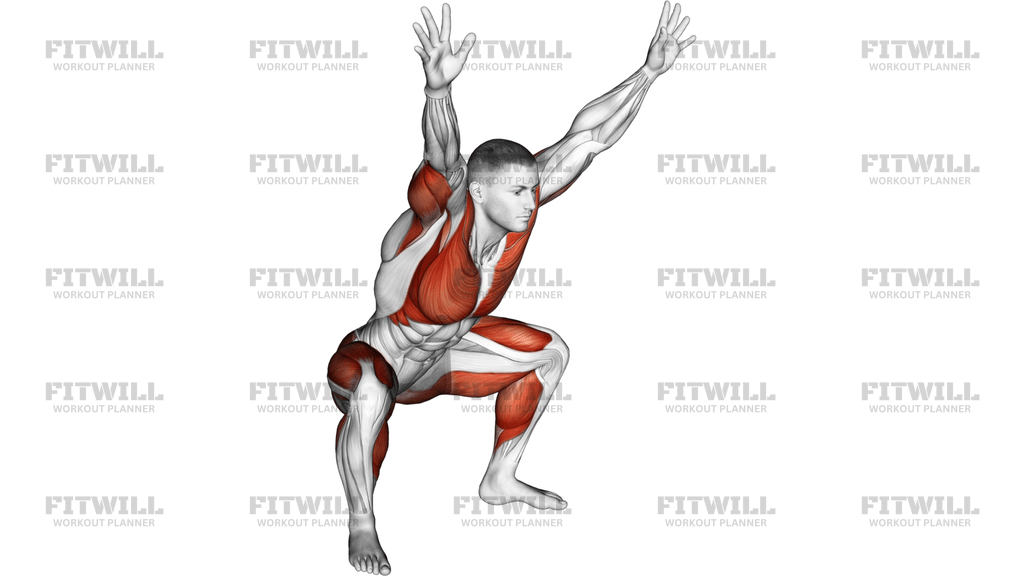
The Deep Squat Turn is a bodyweight mobility drill that combines a full-depth squat with rotational movement of the upper body. You settle into the deepest squat your hips and ankles allow, press your palms together at chest height in a prayer position, and wedge your elbows against the insides of your knees. From there, you turn your torso from side to side while keeping the elbow-knee connection intact. The position places a steady stretch on the inner thighs and hip rotators while the turning motion adds rotation through the mid back and core.
This drill is especially useful for anyone whose squat depth is limited by tight adductors or stiff ankles. Because the elbows actively push the knees out, you get a gentle, self-regulated stretch in the inner thighs at the exact bottom position you are trying to improve. The prayer press also gives your arms something to do, which helps you keep the chest tall instead of collapsing forward over your knees.
The stance is what makes or breaks this exercise. Feet should be a little wider than shoulder width with the toes turned out comfortably, roughly fifteen to thirty degrees. Your weight should sit across the whole foot with the heels down, not shifted onto the toes. If your heels lift off the floor, place a rolled towel or a thin pair of plates under them rather than forcing the range. A stable, balanced base lets the rotation come from the torso instead of from wobbling at the ankles.
To execute it well, sink fully, lift the chest, and press the elbows outward against the knees before you start turning. Rotate by leading with the chest and shoulder, not by cranking your head around. Each turn should feel like it deepens the stretch on the opposite inner thigh slightly. Pause briefly at each side, return through center, and keep the movement smooth and unhurried. Breathing matters here: exhale as you turn into each side, which tends to release tension and lets you settle a little lower.
The Deep Squat Turn fits naturally into a lower body warm-up before squats, lunges, or deadlifts, and it also works well as a standalone mobility break for people who sit for long hours. It is a common holding position in yoga-style practice, where the deep squat itself is valued for hip and ankle mobility. Athletes in sports that require cutting, changing direction, or deep hip positions will also find the inner-thigh range it develops carries over well to their sport.
Keep the movement pain-free and controlled. Knees should track over or between the toes, never driven inward, and you should feel the work in the hips and thighs rather than any pinching in the knee joint itself. If depth is limited today, work at the range you have and let it improve gradually with consistent practice rather than forcing the bottom position.
[ Workout Log & Planner ]
Put your next workout in Fitwill
Keep your plan and training log ready when you are.


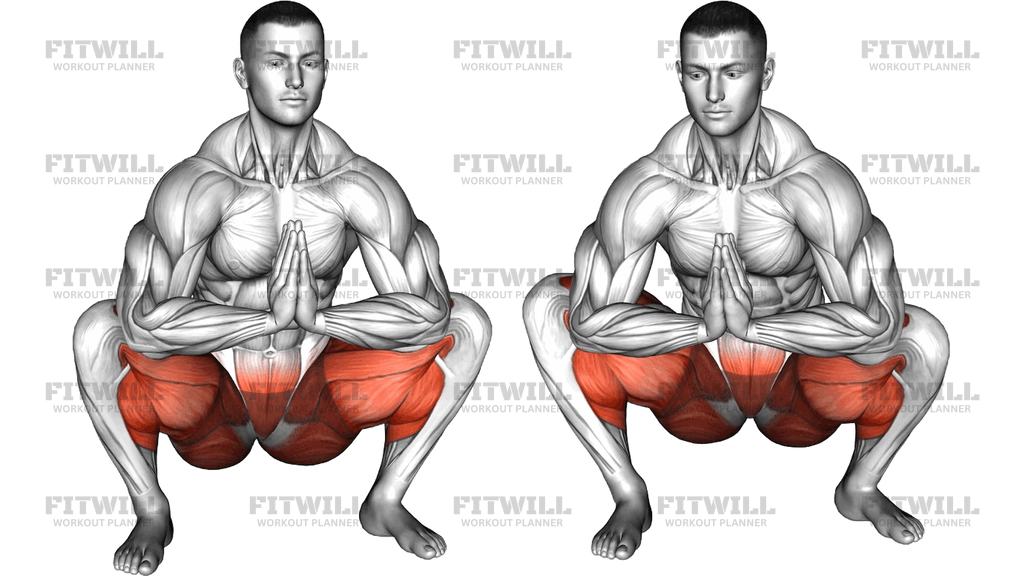
Instructions
- Stand with your feet slightly wider than shoulder width and turn your toes out fifteen to thirty degrees so the knees can travel comfortably outward.
- Squat down as deep as you can, keeping your heels in contact with the floor; place a rolled towel or thin plates under your heels if they tend to lift.
- Press your palms together at chest height with your fingers pointing up and your thumbs near the sternum, forming a prayer position.
- Drive your elbows against the insides of your knees so the arms and legs press into each other, and keep this contact for the whole set.
- Lift your chest, lengthen your spine, and brace your abdominal muscles so your lower back is long rather than rounded at the bottom.
- Turn your torso to one side by leading with the chest and shoulder, keeping the palms pressed together and the same-side elbow glued to the knee.
- Pause for one to two seconds at the end of the turn, feeling the stretch across the opposite inner thigh, then rotate back through center to the other side.
- Breathe steadily throughout: inhale at center and exhale as you turn into each side, letting the exhale help you settle slightly deeper.
- Complete the desired number of alternating turns or hold the squat for time, then stand up by driving through the mid-foot and squeezing the glutes.
- Shake out your legs, reset your stance, and repeat for additional sets if you are using this as a warm-up.
Tips & Tricks
- If your heels rise at the bottom, elevate them slightly instead of rocking forward onto the toes; a forward-shifted weight steals the stretch from the hips and loads the knees.
- The most common fault is letting the knees cave inward once the arms get tired. Renew the outward elbow press on every rep rather than letting the knees drift toward each other.
- A collapsing chest turns this into a hunched squat hold. Press the prayer hands higher, near the sternum, to keep the ribcage lifted.
- Do not crank the turn from the neck. The rotation should come from the upper back and chest while the eyes follow gently.
- Rounding the lower back at the bottom is common when the hips run out of range. Stop at the depth where your spine can stay long and work there.
- Avoid bouncing or pulsing in the bottom position. Slow, settled turns give the adductors time to release; bouncing tends to make them guard instead.
- If balance is shaky, hold a squat rack upright or doorframe with one hand for the first few sessions, then progress to the unsupported prayer position.
- Try a single long hold with small side-to-side turns if the full turns feel rushed. The knee-elbow connection matters more than how far you rotate.
- Warm ankles make this far easier. A few calf rocks or ankle circles before you drop into the squat will improve your depth without extra forcing.
Frequently Asked Questions
What muscles does the Deep Squat Turn target?
The main focus is the adductors along the inner thigh, which are stretched hard in the wide, deep squat position. The glutes, quads, and hip rotators work to hold the bottom position, while the obliques and upper back drive the turning motion.
Why do I press my elbows against my knees in the Deep Squat Turn?
The elbow press keeps the knees pushed outward, which maintains a stretch on the inner thighs and gives the hips room to sit deep. It also creates a stable frame so the rotation comes from the torso instead of the knees collapsing.
My heels lift off the floor when I squat deep. Is that a problem?
It is very common and usually comes down to limited ankle mobility. Place a rolled towel or a thin pair of plates under your heels so you can keep your weight balanced while your ankle range improves over time.
Is the Deep Squat Turn suitable for beginners?
Yes, as long as you work within your current depth and use a heel elevation or support if needed. Beginners often benefit from holding the bottom position first and adding the turns once they feel stable.
How is the Deep Squat Turn different from just holding a deep squat?
The static hold stretches the hips in one fixed position, while the turning component adds rotation through the mid back and core and shifts the inner-thigh stretch from side to side. This makes it a more complete warm-up for squatting and rotational movements.
How many turns should I do per set?
Five to ten slow alternating turns per set works well, or hold the squat for twenty to forty seconds with gentle side-to-side movement. Stop the set when the elbow-knee press becomes hard to maintain.
Can I use the Deep Squat Turn before barbell squats?
Yes, it is an effective warm-up drill for barbell squatting because it opens the adductors and ankles in the same depth and stance you will use under the bar. Do it after a general warm-up and before your first loading sets.
Is it safe for my knees?
When the knees track outward over the toes and the heels stay down, the position is generally well tolerated. If you feel pinching or pain inside the knee rather than a stretch in the hips, reduce your depth and rebuild the position gradually.
What can I substitute if I cannot get into a deep squat at all?
Try the same prayer position in a partial squat with your hands on a rack for support, or perform a wall squat with a band pulling the knees out. As your hip and ankle mobility improves, progressively lower your depth toward the full version.