Half Jumping Jack (Version 2)
The Half Jumping Jack is a variation of the classic jumping jack where the arms stop at shoulder height instead of swinging all the way overhead. From a standing position with your feet together and arms at your sides, you jump your feet out wide while raising your arms straight out to the sides until they sit roughly parallel to the floor, then jump back to the closed position. Because the arms travel only half the distance, the movement is a little quicker per rep and places less demand on the shoulder joints through the overhead range.
This version is a solid fit for warm-ups, conditioning circuits, and fat-loss intervals. It raises your heart rate fast, loosens up the hips and shoulders, and teaches your body to coordinate an upper-body and lower-body rhythm at the same time. The lateral arm raise component gives the side shoulders and upper chest some light, repetitive work, while the jumps hit the quads, glutes, inner thighs, and calves with every landing.
Setup matters more than most people think. Stand tall with your feet together, knees soft, and arms hanging naturally at your sides. Keep your ribcage stacked over your pelvis and your gaze forward. If your feet start wide or your arms are already lifted, the rhythm of the movement falls apart and the jumps become noisy and heavy. A clean start position is what lets you snap open and close with light, springy landings.
To execute well, think of the arms and legs sharing one beat. The moment your feet leave the floor, your arms should be sweeping out; by the time your feet land wide, your arms should already be at shoulder height. On the return jump, the arms drop back to your sides as the feet come together. Land on the balls of your feet with your knees slightly bent to absorb impact, and keep the movement brisk but not rushed — a controlled, even tempo beats flailing quickly every time.
You will see this exercise used as a warm-up finisher before lower-body lifting, as an active rest move in circuit training, and as a low-skill cardio option for home workouts where jumping overhead is uncomfortable or the ceiling is low. Because no equipment is needed and the pattern is simple, it scales easily: go slower and land softer as a beginner, or speed up the cadence and lengthen your work intervals as your conditioning improves.
A few practical points will keep it safe and effective. Stay on the balls of your feet rather than landing flat-footed, keep your knees tracking over your toes when your legs go wide, and avoid letting your lower back arch as your arms lift. If jumping bothers your knees, ankles, or hips, substitute the jump with a quick step-out to each side and move the arms the same way — you keep most of the benefit with far less impact.
Fitwill
Log Workouts, Track Progress & Build Strength.
Achieve more with Fitwill: explore over 9600 exercises with images and videos, access built-in and custom workouts, perfect for both gym and home sessions, and see real results.
Start your journey. Download today!




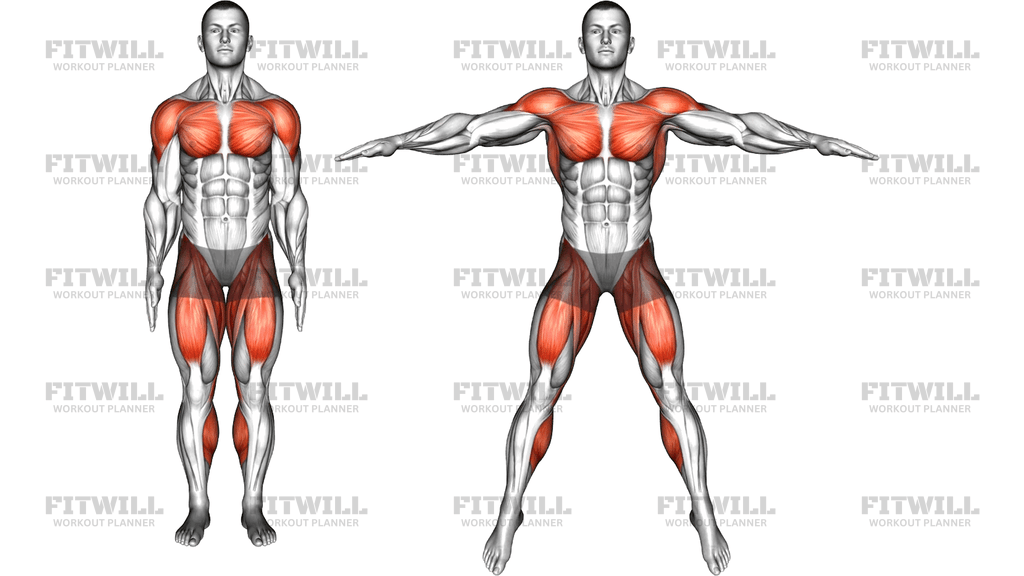
Instructions
- Stand upright with your feet together and your arms relaxed at your sides, shoulders pulled lightly back and your gaze straight ahead.
- Soften your knees and shift your weight onto the balls of your feet so you are ready to move instantly.
- Brace your core gently and keep your ribcage stacked over your hips before the first jump.
- Jump your feet out wide to about shoulder-and-a-half width while raising both arms straight out to the sides.
- End the open position with your arms at shoulder height, roughly parallel to the floor, palms facing down and knees slightly bent.
- Jump your feet back together and let your arms lower back to your sides in the same beat, landing softly on the balls of your feet.
- Keep your knees tracking in line with your toes every time your legs go wide, and keep the landings quiet.
- Breathe in a steady rhythm — inhale on one position, exhale on the other — rather than holding your breath.
- Maintain a consistent tempo across all reps, and reset your stance and posture if your feet drift or your rhythm breaks.
- Finish the set by stepping your feet together and letting your breathing settle before your next exercise.
Tips & Tricks
- The most common mistake is raising the arms all the way overhead — in the Half Jumping Jack they stop at shoulder height, forming a T with your torso.
- If your landings are loud, you are landing flat-footed; stay on the balls of your feet and let your calves and knees absorb each jump.
- Avoid letting your legs go wider than a comfortable stance — if your knees collapse inward on the open jump, narrow the spread slightly and cue knees out.
- Do not let your shoulders shrug as the arms lift; keep the traps relaxed so the work stays in the side shoulders.
- Timing is everything: if your arms arrive after your feet land, slow the whole movement down by 20 percent and rebuild the rhythm.
- Keep your palms facing down or slightly forward at shoulder height — turning the palms up and lifting higher turns it into a different exercise.
- On soft flooring or hard concrete, shorten the jump rather than the range; a small, quick hop is enough to open and close the legs.
- If your lower back arches when the arms rise, brace your core more firmly and stop the arms just shy of full shoulder height.
- Warm up your ankles and calves with a few bodyweight calf raises before long sets, since they take repeated landings in this movement.
Frequently Asked Questions
What muscles does the Half Jumping Jack work?
The side shoulders drive the arm raise, with support from the upper chest, while the jumps work the quads, glutes, inner thighs, and calves. Your core stays active throughout to hold an upright posture.
How is the Half Jumping Jack different from a regular Jumping Jack?
The only real difference is the arm path: instead of swinging overhead, the arms stop at shoulder height, forming a T shape. This makes each rep slightly faster and reduces overhead shoulder motion.
Is the Half Jumping Jack good for beginners?
Yes, it is one of the simplest cardio patterns to learn because the rhythm is identical to a standard jumping jack. Beginners should start with short sets of 15 to 20 seconds and focus on soft, quiet landings.
Why should my arms stop at shoulder height instead of going overhead?
Stopping at shoulder height keeps the arm motion in a comfortable lateral raise range and lets you move faster. It is also a useful option if overhead reaching feels awkward or pinches at the shoulders.
What is the most common mistake in the Half Jumping Jack?
Raising the arms fully overhead out of habit, or landing flat-footed with stiff knees. Fix the first by pausing for a beat at the open position to check the T shape, and fix the second by staying on the balls of your feet.
How wide should my legs go on the open jump?
Aim for a stance about one and a half times shoulder width — wide enough to feel your glutes and inner thighs work, but not so wide that your knees twist inward or your landing gets heavy.
Can I do the Half Jumping Jack without jumping?
Yes. Step one foot out to the side while raising the arms, bring it back, then alternate sides. This low-impact version keeps the same arm path and timing with much less stress on the knees and ankles.
How many reps should I do?
For a warm-up, 20 to 30 seconds at an easy tempo is enough. For conditioning, work in intervals of 30 to 60 seconds and rest until your breathing comes back down before the next round.
Is the Half Jumping Jack safe if I have knee problems?
The repeated landings put load on the knees, so if you have an existing knee issue, use the step-out variation or check with a qualified professional first. Keeping landings soft and knees tracking over toes reduces stress either way.