Barbell Forward Backward Lunge
The Barbell Forward Backward Lunge is a single-leg strength exercise performed with a barbell resting across the back of your shoulders, the same placement you would use for a back squat. Instead of staying planted, you step forward into a lunge, drive back to standing, then step backward into a reverse lunge with the same leg before switching sides. That forward-then-backward sequence is what makes this variation different from a standard lunge: your working leg handles both a deceleration-forward step and a controlled reverse step within one rep.
The forward lunge portion places heavy demand on the quadriceps because the front knee absorbs and controls your body weight plus the bar as you lower. The reverse lunge shifts slightly more emphasis toward the glutes and hamstrings while typically being easier on the front knee. Training both directions in the same set gives you a fuller stimulus for the thighs and hips than either version alone, and the adductors work to keep the lead knee tracking straight throughout.
Because the bar sits on your upper back, your entire trunk has to stay rigid while you balance on one leg at the bottom of each lunge. The core, especially the deep trunk muscles and lower back, works isometrically to stop the bar from tipping you forward or sideways. Smaller stabilizers around the hip, knee, and ankle of the support leg are also challenged, which is part of why this exercise feels harder than the loaded weight suggests.
Setup matters more here than in most lunges. The bar should sit securely on your traps, not your neck, with your elbows pulled down and your chest tall. If the bar is loose or your posture rounds, every step becomes a fight against the load instead of a clean lunge. Take your steps deliberately and give yourself enough space so a forward step never puts you near a rack or wall.
This exercise suits intermediate lifters who already own the bodyweight forward and reverse lunge and can handle a barbell back squat with good position. It fits well as a main lower-body builder on leg day, or as a secondary unilateral movement after squats. Athletes in running and jumping sports get extra value from it, since lunging in two directions trains the braking and pushing actions those sports rely on.
Keep the loads moderate at first. Balance is usually the limiting factor, and a rep where the front knee collapses inward or the torso pitches forward does more harm than a lighter, cleaner set. Stop the set when your form on the backward step starts to look worse than your forward step, and add weight only when every rep still looks identical.
[ Workout Log & Planner ]
Put your next workout in Fitwill
Keep your plan and training log ready when you are.


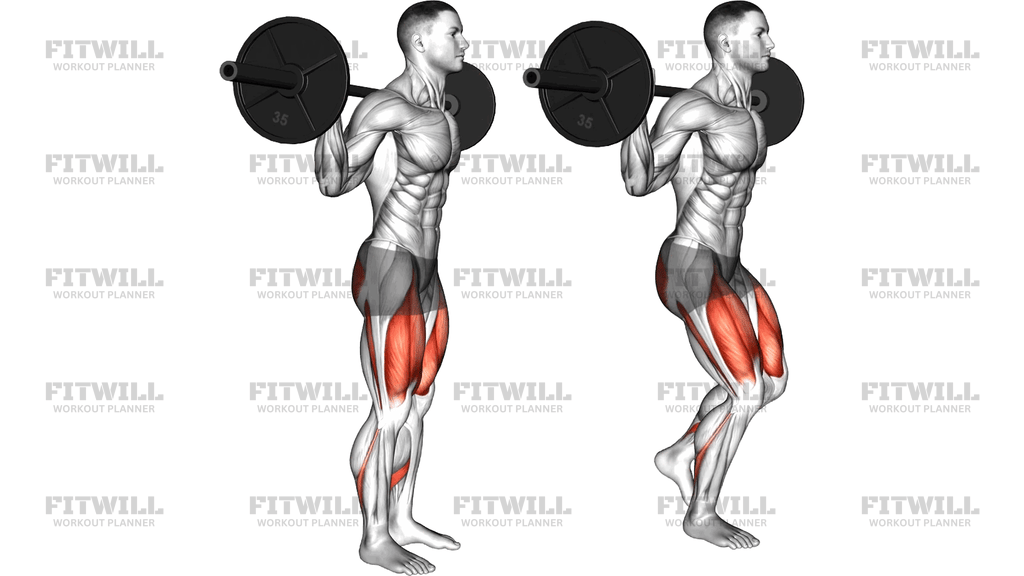
Instructions
- Set a barbell in a rack at about upper-chest height, step under it, and rest it across the top of your traps with your hands gripping the bar just outside your shoulders.
- Unrack the bar, take one or two steps back, and stand tall with your feet hip-width apart, chest up, and eyes forward.
- Brace your core as if bracing for a light punch, and pull your elbows down so the bar is locked securely on your back.
- Shift your weight onto one leg, then step that same leg forward about two to two-and-a-half feet, planting your whole front foot flat.
- Lower straight down until your front thigh is roughly parallel to the floor and your back knee is near the ground, keeping your front shin close to vertical and your torso upright.
- Push through the heel and midfoot of your front leg to stand, bringing the rear foot back beside the standing leg.
- Without pausing, step the same leg backward into a reverse lunge, dropping until the back knee is just above the floor while the front knee stays stacked over the ankle.
- Exhale and drive through the front foot to return to a full standing position, which completes one rep for that leg.
- Finish all reps on one side or alternate legs per rep, resetting your stance and brace fully between reps.
- When finished, walk the bar back into the rack with the same upright posture you used to unrack it.
Tips & Tricks
- Keep the bar pressed into your traps rather than letting it float on your shoulders — a loose bar shifts forward the moment your torso leans during the forward step.
- Your forward step distance controls knee stress: too short and the knee travels past the toes under load, too long and the back hip pinches. Aim for a shin that stays close to vertical at the bottom.
- On the reverse lunge, think about pushing the floor away with your front foot instead of pushing your hips back; this keeps your torso from folding over the front leg.
- Common mistake: letting the front knee cave inward as you stand. Cue your knee to track over the middle of your foot, and consciously squeeze the glute of the working leg on the way up.
- If you wobble at the bottom, pause for a half-second in the stand-up position between the forward and backward lunges instead of rushing the transition.
- Keep your gaze on a fixed point at eye level. Looking down at your feet is one of the fastest ways to lose balance with a bar on your back.
- The backward step is usually the weaker half of the rep — if your reverse lunge form deteriorates before your forward lunge does, that is your sign to end the set.
- Breathe in at the top before each step, and exhale on the push back to standing; holding your breath through two lunges in a row makes your midsection much less stable.
- Use rubber flooring or clear space so a planted heel does not slip, especially on the forward step where your front foot takes the full braking force.
Frequently Asked Questions
What muscles does the Barbell Forward Backward Lunge work?
The quadriceps of the lead leg do most of the work, especially on the forward lunge. The glutes and hamstrings take on a larger share during the reverse lunge, while the adductors, calves, and core stabilize every rep.
Why lunge both forward and backward instead of doing separate forward and reverse lunge sets?
Combining both directions in one rep trains the same leg to decelerate and then push in two different patterns, which stresses the quads and glutes slightly differently and builds balance in a way single-direction lunges do not.
Is the Barbell Forward Backward Lunge suitable for beginners?
It is better suited to lifters who can already perform controlled bodyweight lunges and a barbell back squat. Beginners should master split squats and bodyweight forward and reverse lunges first, since balance with a bar on the back is the main limiting factor.
Should I complete all reps on one leg or alternate legs?
Either works. Doing all reps on one side before switching is easier to track for strength progress, while alternating legs rep by rep keeps the workload even and gives your working leg a brief rest between lunges.
How do I stop the bar from feeling unstable during the lunge?
Grip the bar firmly, pull your elbows down and slightly back, and keep your chest tall so the bar rests on your traps rather than rolling toward your neck. Most bar instability comes from a rounded upper back, not from the bar placement itself.
My front knee hurts on the forward step but not the reverse step — what should I change?
Lengthen your forward step slightly so your shin stays closer to vertical, and make sure the knee tracks over the middle of the foot rather than caving inward. If the forward lunge still bothers your knee, you can train the reverse lunge portion on its own, which places less stress on the front knee.
How heavy should I go on the Barbell Forward Backward Lunge?
Start noticeably lighter than your back squat weight, often around 25 to 50 percent of it, because one leg carries the full load and balance is part of the challenge. Add weight only when both the forward and backward reps look identical and stable.
What can I use instead of a barbell for this exercise?
Dumbbells held at your sides are the most direct substitute and are easier on balance and upper-back fatigue. A Smith machine also works if you want the bar path fixed while you learn the footwork.
Where should this exercise go in my leg workout?
It works well as your first or second exercise on a leg day focused on thighs, or right after squats as a unilateral builder. Doing it last, when your legs are heavily fatigued, makes the balance demands much harder to meet.
How can I tell the difference between good depth and bad form at the bottom?
At a good depth, your front thigh is roughly parallel to the floor, your heel stays down, and your torso is upright. If your front knee travels far past your toes, your heel lifts, or your torso tips forward noticeably, reduce the depth or the weight.