Landmine Squat With Linebacker Attachment
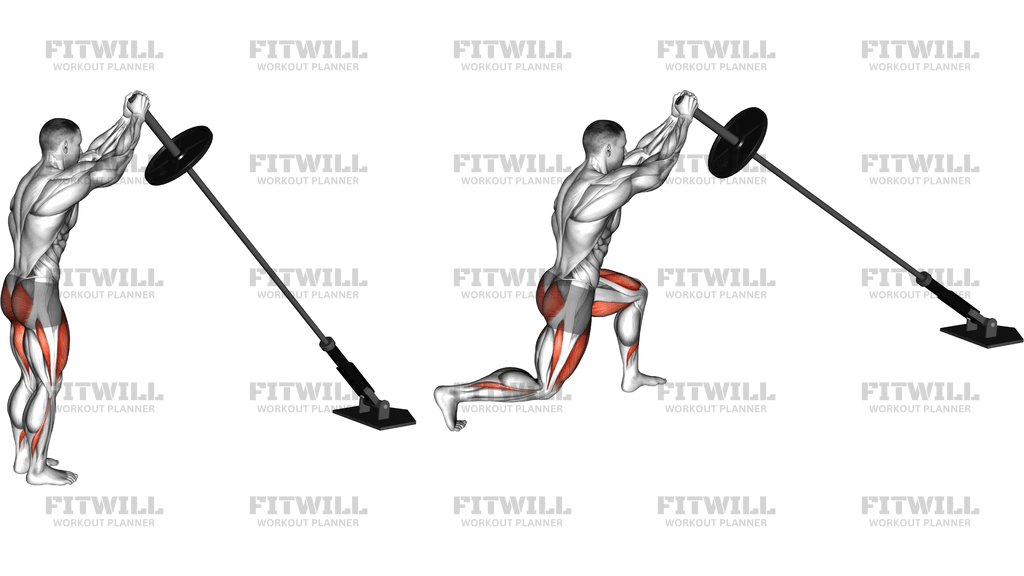
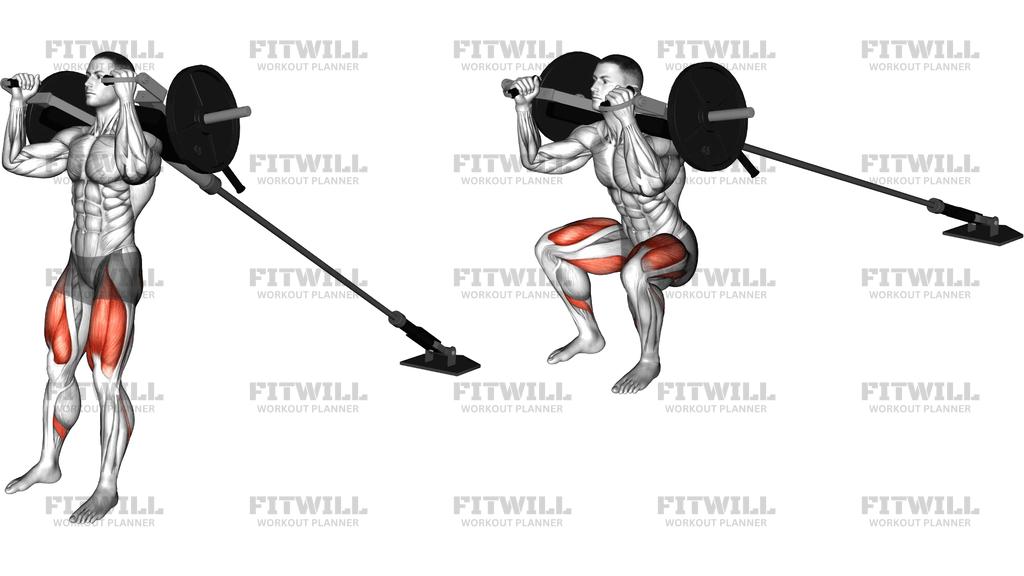
The Landmine Squat With Linebacker Attachment is a barbell squat variation where one end of the bar is anchored in a landmine attachment on the floor and the other end rests across your upper back through a linebacker pad with side handles. Because the anchored end sits low and behind you, the bar travels on a fixed diagonal arc rather than straight down, which changes how the load presses into your body compared to a traditional back squat.
The most noticeable difference is the forward and downward pull of the bar. As you descend, the anchored bar drives slightly down and back into your shoulders, encouraging a more upright torso and a naturally deeper knee bend. That makes this version particularly friendly for lifters who struggle to stay tall in a back squat, as well as for anyone with shoulder mobility limitations who finds a standard barbell position uncomfortable — the linebacker handles give you somewhere neutral to hold your arms.
Muscularly, the quads do the bulk of the work, since the upright torso and arcing bar path keep constant tension on the front of the thighs through the whole descent and drive. The glutes and hamstrings contribute strongly to hip extension on the way up, and the core works isometrically to keep your ribs stacked over your pelvis while the bar pushes you forward. The adductors and calves help stabilize the knees and ankles throughout.
Setup matters more here than in most squat variations. The landmine anchor needs to be secure, the loaded end should sit behind your head rather than above it, and your feet need to be positioned far enough forward along the bar's arc that the descent feels like sitting down rather than being pushed over. Getting your foot position right relative to the anchor is what separates a smooth, quad-dominant squat from an awkward lean.
This variation slots well into hypertrophy blocks as a main squat or secondary squat movement, and it is also a common stepping stone for lifters rebuilding from back or shoulder discomfort who still want heavy, loaded leg work. Because the bar path is guided by the anchor, balance demands are lower than with free-weight squats, so you can concentrate on depth and drive without fighting the bar.
Work within a range you can own: descend until your thighs reach at least parallel if mobility allows, keep your heels planted, and never let the bar roll off your shoulders at the bottom. Start lighter than you think you need, since the leverage of the long bar makes the weight feel different from a regular back squat at the same load.
[ Workout Log & Planner ]
Put your next workout in Fitwill
Keep your plan and training log ready when you are.


Instructions
- Set one end of a barbell securely in a landmine attachment or corner anchor on the floor, and slide the linebacker pad with its side handles onto the free end of the bar.
- Stand facing away from the anchor with the loaded end of the bar resting across your upper back and shoulders, and grip both handles of the linebacker attachment with your elbows pointing down.
- Walk your feet forward until your body is slightly in front of the bar, then set your stance about shoulder-width apart with toes turned out 10 to 20 degrees.
- Brace your core as if bracing for a light punch, lift your chest, and tuck your ribs down over your pelvis.
- Inhale, then push your hips back and bend your knees together, letting the bar travel down and back along its arc toward the anchor.
- Keep your heels flat and your knees tracking over your toes as you lower until your thighs are at least parallel to the floor.
- Drive the floor away through your mid-foot and heels to stand back up, pushing your hips through to a full lockout without leaning back.
- Exhale as you complete each rep, and keep your grip firm on the handles the entire time so the pad cannot shift on your shoulders.
- Finish the set by walking the bar back down its arc in a controlled way and lowering the loaded end toward the anchor plates before releasing your grip.
Tips & Tricks
- Position your feet far enough from the anchor that the bar presses down and back, not straight down — if you feel tipped forward onto your toes, step forward an inch or two.
- If the bar drifts off your mid-back as you fatigue, your brace has collapsed; reset your ribs and core before continuing rather than muscling the next rep.
- Do not let your knees cave inward as you rise out of the hole — the deep knee bend this variation encourages makes knee tracking worth watching on every rep.
- Keep your elbows down and grip the handles loosely-to-firmly; shrugging your shoulders up toward the bar turns it into an upper-trap exercise and makes the pad unstable.
- Because the long bar amplifies speed, control the descent for two to three seconds instead of dropping fast into the bottom.
- Load plates on the shoulder end only as the name implies, but check that the anchored end cannot slip — a sliding landmine end turns a safe setup into a hazardous one.
- If your heels lift at depth, try a slightly wider stance or small heel elevation rather than shortening the range, which cuts the quad tension this exercise is built for.
- Treat the first set of every session as a calibration set; the leverage of the anchored bar makes loads feel heavier or lighter depending on your distance from the anchor.
Frequently Asked Questions
Which muscles does the Landmine Squat With Linebacker Attachment work?
The quads are the primary movers, with strong contributions from the glutes and hamstrings as you stand back up. Your core works isometrically to resist the forward pull of the anchored bar.
Is the Landmine Squat With Linebacker Attachment good for beginners?
Yes, it is one of the more beginner-friendly loaded squats because the anchored bar creates a fixed path and reduces balance demands. Start with just the bar to learn the arc before adding plates.
Why does the bar push me forward during this squat?
Because the anchored end sits low on the floor behind you, the bar travels on a diagonal arc that drives down and back into your shoulders as you descend. This is intentional and is what keeps your torso upright and loads the quads heavily.
How should my feet be positioned relative to the landmine anchor?
Stand facing away from the anchor with your feet slightly forward of the bar so the descent feels like sitting down between your hips. If you feel pitched onto your toes, step forward; if the bar feels like it is pulling you backward, step back an inch.
Can I do this exercise if a regular back squat bothers my shoulders?
Often yes, since the linebacker attachment places your arms in a neutral, lower position instead of the extreme external rotation a straight bar demands. Still, work within a range that feels comfortable and stop if sharp pain appears.
What is the most common mistake with the Landmine Squat With Linebacker Attachment?
Standing too close to the anchor, which makes the bar push you forward onto your toes and rounds the lower back at the bottom. Correct it by stepping your feet forward until your shins stay near vertical and your heels stay flat.
How deep should I squat with the landmine bar on my back?
Aim to bring your thighs at least parallel to the floor if your hips, knees, and ankles allow it. The arcing bar keeps tension on the quads throughout, so a controlled partial squat is still productive while you build depth.
What can I use instead of a linebacker attachment?
A landmine harness, a pad gripped at the chest, or holding the bar sleeve itself across your upper back are common substitutes. The handles simply give your arms a comfortable place to hold and keep the pad from shifting.
Is the Landmine Squat With Linebacker Attachment safe for the lower back?
The guided bar path and upright torso angle tend to reduce lower back strain compared to free-weight back squats, but the load still compresses the spine. Keep your core braced, avoid rounding at the bottom, and choose loads you can control for full sets.
How does this compare to a regular barbell back squat for building legs?
It shifts more emphasis to the quads and allows a more upright, often deeper squat, while the back squat allows heavier absolute loads. Many lifters use both, with the landmine version as a secondary or accessory squat.