Open Up Crab Walk
The Open Up Crab Walk is a bodyweight locomotion drill that combines the classic crab position with an outward-opening knee drive as you step. You sit on the floor, place your hands behind you, lift your hips so your torso and thighs form a roughly straight line, and then walk sideways, letting each knee fall open toward the outside as you step. The "open up" element is what separates this from a standard crab walk: instead of simply shuffling, you actively rotate the leg outward at the hip on every step, which forces the outer hip and glute muscles to control the movement while the front of the hips and chest stay stretched in an open position.
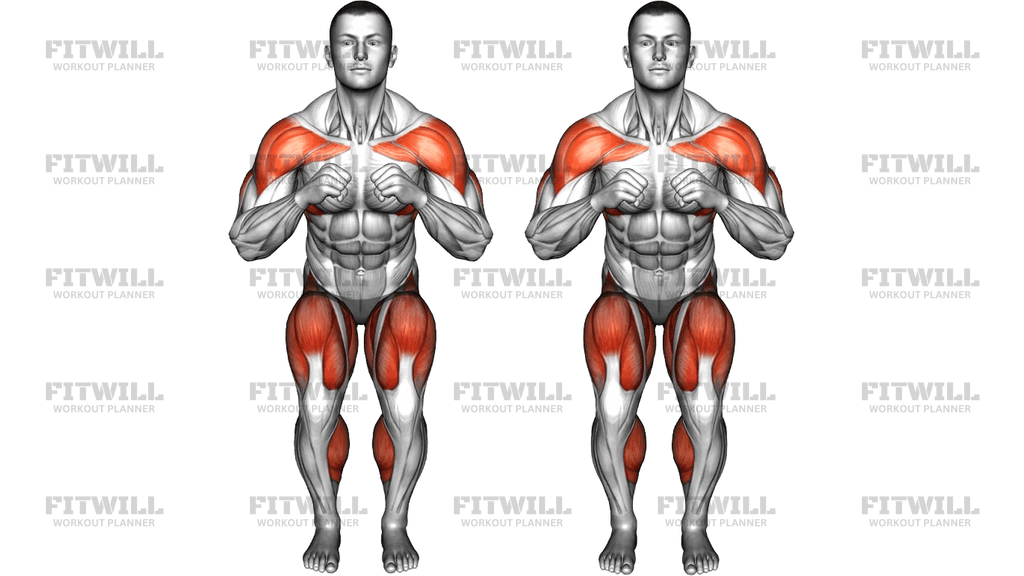
This drill earns its place in warm-ups and corrective circuits because it loads two things most people neglect at the same time: hip external rotation strength and shoulder stability in extension. The crab position places your shoulders behind your torso, working the front delts and chest in a lengthened position while the triceps and upper back support your weight. Meanwhile, the opening knee action challenges the glute medius and deep hip rotators, the same muscles that stabilize your pelvis during walking, running, and squatting.
The setup matters more than in most floor drills. If your hands are too close to your body or your hips sag, your shoulders take on excessive load and the opening action at the hips turns into a lower-back compensation. Set your hands shoulder-width apart with fingers pointing toward your feet or slightly outward, and keep your hips high enough that your body reads as a table, not a hammock. From there, small controlled steps sideways with the knee opening outward will do far more than big rushing strides.
You will feel this working in the outer hips and glutes first, then in the quads as they hold the bent-knee support position, and finally in the shoulders and triceps, which carry a surprising amount of your bodyweight throughout. The front of the shoulders and chest also gets a useful opening stretch, which makes this a popular drill for people who spend long hours sitting.
Use the Open Up Crab Walk as a warm-up before lower-body training, as part of a movement-break routine, or as a conditioning finisher when performed for distance or time. Start with short distances, 10 to 20 feet per direction, and prioritize smooth hip opening over speed. If your wrists or shoulders complain, reduce the time in position rather than pushing through, and keep the movement on a mat or smooth surface to protect your palms.
[ Workout Log & Planner ]
Put your next workout in Fitwill
Keep your plan and training log ready when you are.


Instructions
- Sit on the floor with your knees bent and feet flat on the ground, roughly hip-width apart.
- Place your hands on the floor behind you, shoulder-width apart, fingers pointing toward your feet or turned slightly outward.
- Drive through your hands and feet to lift your hips until your torso and thighs form a straight, supported line; keep your head neutral and eyes forward.
- Brace your core and squeeze your glutes to hold the hips high before you take any step.
- Step sideways by lifting one foot, letting the knee open outward toward the side, and planting the foot in the new position.
- Follow with the opposite foot, again opening the knee outward as it steps through, keeping your hips level and lifted the entire time.
- Continue walking in one direction for your chosen distance, then reverse direction to work both sides evenly.
- Exhale as you lift and step, inhale as you plant and settle, keeping the breath steady rather than holding it.
- When you finish, lower your hips back to the floor under control, sit down gently, and shake out your wrists and shoulders before the next set.
Tips & Tricks
- The most common fault is letting the hips drop toward the floor as fatigue builds; once your hips sag, the work shifts to your lower back, so end the set or rest before form breaks.
- If your knees refuse to open outward, your stance is probably too narrow; set your feet slightly wider than hip width so the hip has room to rotate externally on each step.
- Keep your weight biased toward your legs, not your arms; pushing too much load into the shoulders turns the drill into a shoulder endurance test and the hip opening becomes lazy.
- Point your fingers toward your feet or slightly out rather than forward; this reduces wrist strain and gives your shoulders a more stable base in the crab position.
- Take small steps; long strides in this position usually cause the pelvis to tilt and the lower back to arch, especially on the opening step.
- Warm up your wrists first with a few circles and gentle stretches, since they support your bodyweight for the entire set.
- Move your hand and foot on the same side together when stepping; this keeps the torso square and stops you from twisting sideways as you travel.
- Perform the drill on a mat or smooth grass; rough flooring chews up your palms and makes you rush the steps.
Frequently Asked Questions
What muscles does the Open Up Crab Walk work?
The primary work comes from the glutes and outer hip muscles, which control the opening knee action, with strong support from the quads, triceps, shoulders, and core. Your chest and front shoulders also work in a lengthened position as they help hold you up.
Is the Open Up Crab Walk good for beginners?
Yes, as long as you start with short distances and keep your hips high. If the full movement feels unstable, practice simply holding the crab position with hips lifted for 10 to 15 seconds before adding the walking and knee-opening steps.
Why does the knee have to open outward in this variation?
The outward knee drive is the defining feature; it trains hip external rotation and the glute muscles that stabilize your pelvis during walking and squatting. A regular crab walk skips this and works the hips in a much more one-dimensional way.
My hips drop and my lower back aches halfway through. What am I doing wrong?
Your hip extensors are fatiguing and your lower back is compensating. Reduce the distance per set, lift your hips higher at the start of each step, and consciously squeeze your glutes; stop the set as soon as the sag appears.
Can I substitute the Open Up Crab Walk with something else?
A standard crab walk works the same support muscles but with less hip rotation, while lateral band walks target the outer hips without the shoulder component. Combining those two comes closest to matching the full effect.
How far or how long should I walk per set?
Start with 10 to 20 feet in each direction, or about 20 to 30 seconds of continuous stepping. Quality of the hip opening matters far more than distance, so progress by adding distance or rounds only when your hips stay high throughout.
Do my wrists take a lot of load in this exercise?
They support part of your bodyweight the entire time, so warm them up and keep more of your weight over your feet. If you have a wrist injury or limited wrist extension, this drill may not be comfortable and a lateral band walk is a safer choice.
Should the Open Up Crab Walk be done fast or slow?
Slow and deliberate wins here; rushing the steps flattens the hip opening and drops your hips. Treat it as a controlled drill, and only add speed once every step still shows a clear, smooth outward knee drive.
Where does this fit in a workout?
It works best as a warm-up drill before squats, lunges, or running, when you want the hips and shoulders primed. It can also serve as a light conditioning finisher when performed for longer distances with short rests.