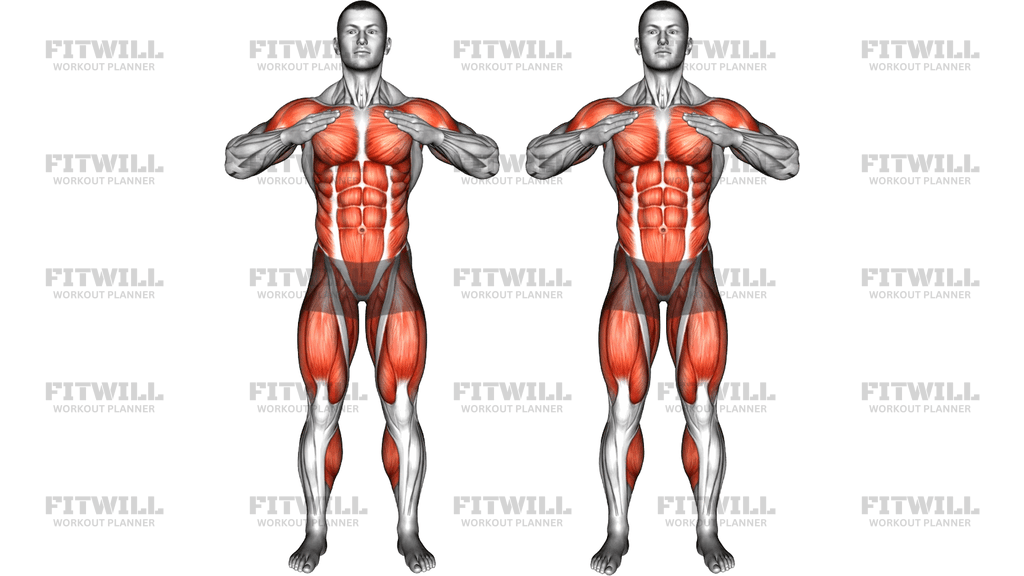
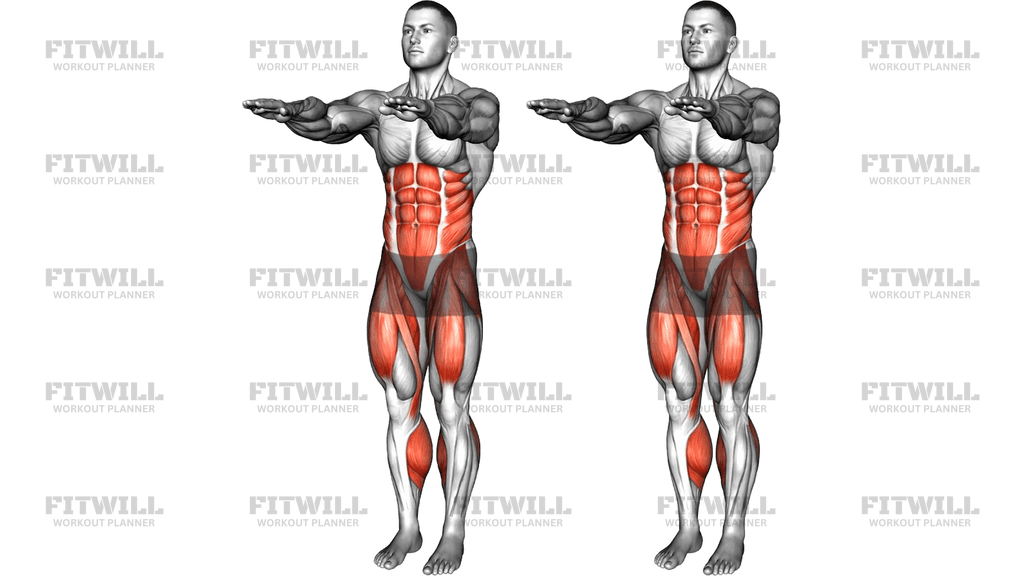
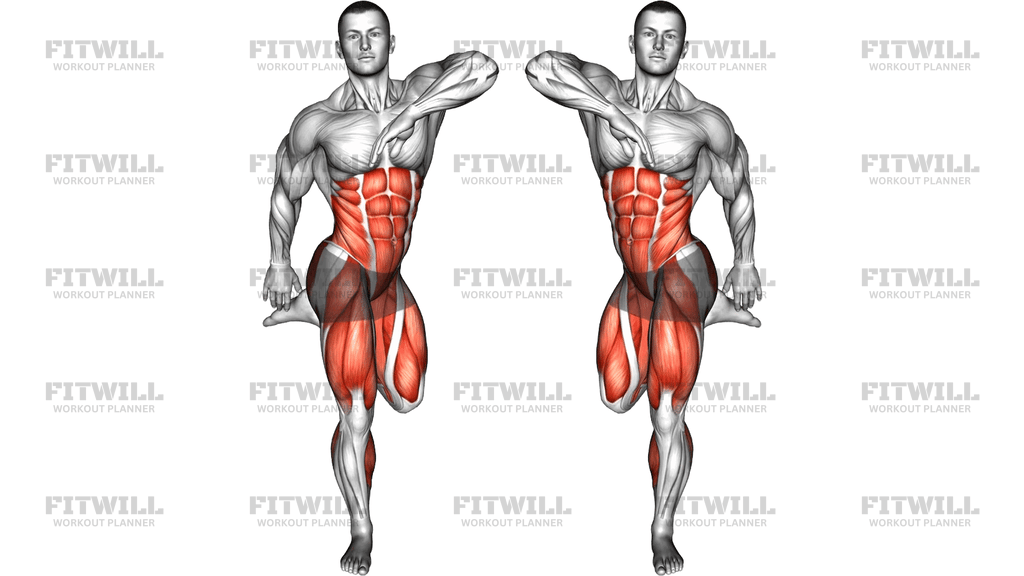
Alternate Side Step Jump Side Bend
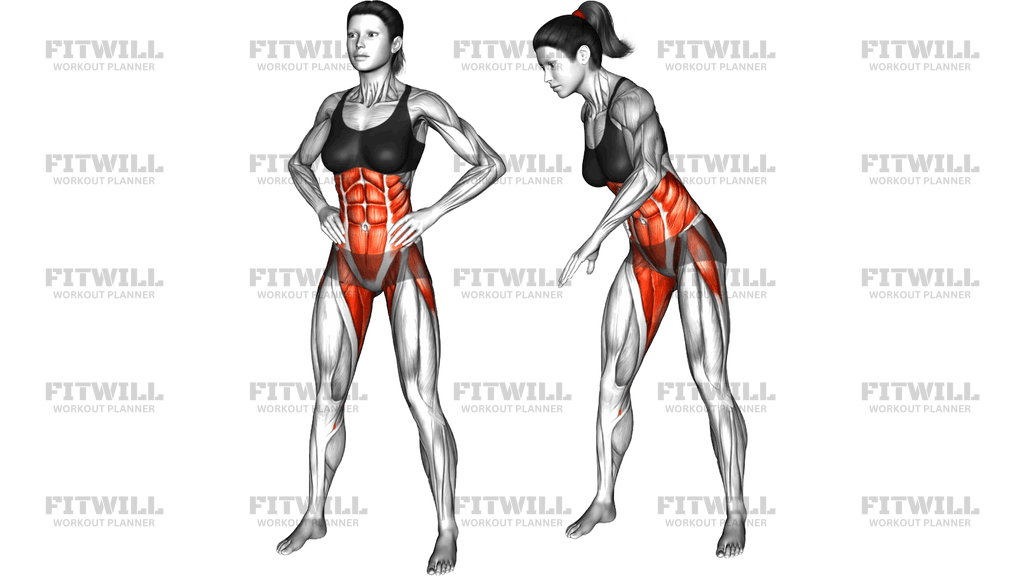
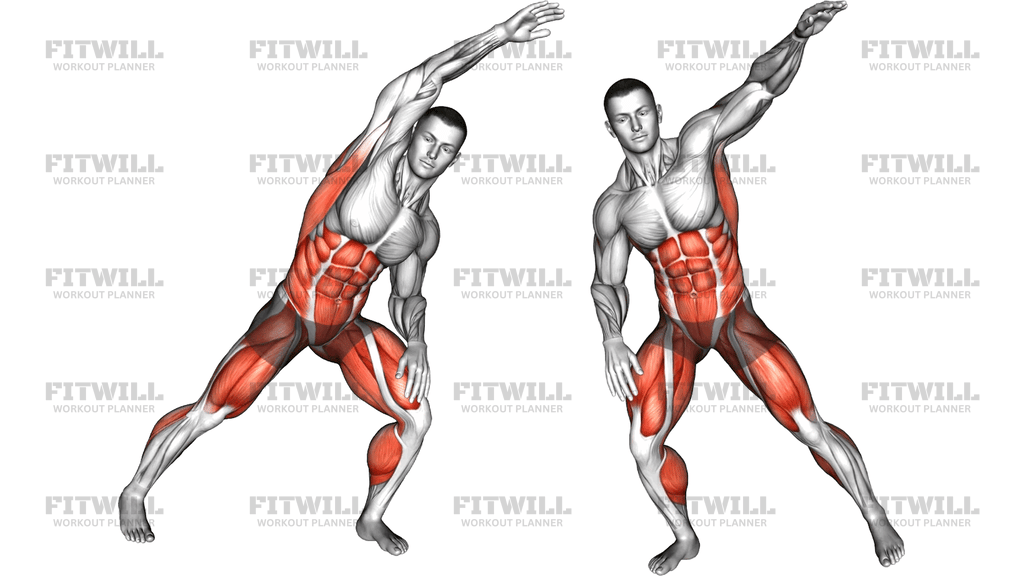
The Alternate Side Step Jump Side Bend combines a lateral jumping step with an overhead-reaching side bend, so every rep trains your legs, heart, and waist at the same time. You jump your feet out to one side, bend that knee while the opposite leg stays long, and reach one arm up and over your head as your torso leans away from the bent knee. Then you spring back through the middle and repeat on the other side, alternating continuously. Because the side bend is synchronized with the jump, your obliques have to control your torso while your legs absorb and produce force.
This is one of the few bodyweight movements that hits the lateral chain hard without any equipment. Most floor ab work trains flexion and rotation, but the side bend under a dynamic step loads the obliques, quadratus lumborum, and hip abductors in the frontal plane, which is exactly how those muscles work when you change direction, carry something on one side, or stabilize during single-leg activity. The jumping element also raises your heart rate quickly, making it a good conditioning choice.
The setup matters more than people expect. You need clear space to each side, a stable surface with grip for your feet, and a stance that starts about hip-width. If your landing area is cluttered or slick, the lateral jump becomes risky, so take a moment to check the floor before you start. Shoes with a flat, grippy sole work better than heavily cushioned runners for lateral hops.
To execute well, think of the movement as one fluid line from the reaching hand down to the straight leg. The arm that goes overhead should be long and relaxed, the side bend comes from your waist rather than your shoulder, and the bent-knee leg should track over the toes without the knee collapsing inward. Keep the reps rhythmic rather than rushed, and land softly on the ball of the foot with a bent knee every time.
This movement suits people who already move comfortably and want a conditioning drill that doubles as oblique work. It fits well into warm-ups for field sports, circuit training, and home workouts where no equipment is available. If jumping is not appropriate for your knees or surface, you can step laterally instead of hopping while keeping the same reach and bend, which preserves most of the trunk benefit at a lower intensity.
[ Workout Log & Planner ]
Put your next workout in Fitwill
Keep your plan and training log ready when you are.


Instructions
- Stand tall with your feet hip-width apart, arms hanging relaxed at your sides, and a clear, non-slip area to your left and right.
- Brace your core lightly and soften your knees so you are ready to move laterally in either direction.
- Hop your feet out to the right and land with your right knee bent, your left leg extended long to the side, and your weight over the right foot.
- As you land, sweep your left arm up and over your head and bend your torso to the right, feeling a stretch along the left side of your waist.
- Let your right hand drift down toward your right knee or thigh while your eyes stay forward and your chest stays open.
- Push off the right foot to spring back through the middle and immediately hop out to the left, reversing the shape with the right arm reaching overhead.
- Keep alternating sides at a steady rhythm, landing softly on the ball of each foot with the knee bent to absorb impact.
- Exhale on each jump and side bend, then inhale as you pass back through the center.
- Complete your set, then step your feet together and stand tall to reset before starting the next round.
Tips & Tricks
- The most common mistake is bending from the shoulder or ribcage instead of the waist; keep the reaching arm in line with your ear so the hinge happens at the trunk.
- Avoid letting the bent knee dive inward on landing; think of spreading the floor with your foot so the knee tracks over the toes.
- Do not rush the alternation. A controlled tempo with a real bend at the bottom trains the obliques far better than fast, shallow hops.
- Keep some bend in the straight leg. Locking it out while side bending loads the lower back and the outside of the knee unnecessarily.
- If you find yourself losing balance, narrow the jump distance first before slowing the tempo; most balance problems come from stepping too wide.
- Stay tall through the chest as you bend. Collapsing forward turns a side bend into a slouched lean and takes tension off the obliques.
- Land quietly. A loud, heavy landing means your knees and hips are not absorbing force, so lower the height and speed of the jump.
- On soft or uneven outdoor ground, switch to a step-and-bend version; lateral hops on unstable surfaces raise the risk of an ankle roll.
- Warm up the hips with a few slow side lunges first, since cold adductors often feel tight in the wide landing stance.
Frequently Asked Questions
What muscles does the Alternate Side Step Jump Side Bend work?
The main drivers are the obliques and deep core muscles, which bend and stabilize your torso on each rep. The quads, glutes, inner thighs, and calves power the lateral jump and control the landing.
Is the Alternate Side Step Jump Side Bend suitable for beginners?
Beginners can do it, but it is wise to start with a step to the side instead of a jump and focus on the reach-and-bend pattern. Once the lateral movement feels stable, add the hop back in.
How wide should my stance be during the Alternate Side Step Jump Side Bend?
Start from a hip-width stance and jump only far enough that one knee can bend comfortably while the other leg stays long. If you land so wide that your knee caves inward or you lose balance, shorten the jump.
Should my straight leg stay locked during the side bend?
No, keep a slight bend in the straight leg and your weight distributed through the whole foot. A fully locked knee while leaning sideways puts unnecessary stress on the joint and lower back.
How can I tell if I am bending from my waist instead of my shoulder?
Keep the reaching arm extended in line with your ear throughout the bend. If your ear moves toward your shoulder or your chest twists forward, the bend has migrated into the shoulder and upper back.
What can I use instead of the Alternate Side Step Jump Side Bend if I cannot jump?
Step laterally into the same bent-knee position and perform the identical overhead reach and side bend without leaving the floor. Standing side bends or slow side lunges with a reach also train the same lateral pattern.
How many repetitions should I do of the Alternate Side Step Jump Side Bend?
Since it is a continuous alternating movement, count each side touch as one rep and work in blocks of 20 to 40 total, or go by time with 20 to 30 second bouts. Stop when your landings get loud or your side bend becomes shallow.
Why do my inner thighs feel sore after this exercise?
The wide landing stance loads the adductors as they control and decelerate your legs on every hop. That soreness is normal for a movement performed in the frontal plane and should ease as you adapt.
Is it safe to do the Alternate Side Step Jump Side Bend on a hard floor?
A firm, non-slip surface is fine as long as you land softly with bent knees and wear supportive shoes. Avoid slick tile, uneven pavement, or cluttered areas where a lateral hop could cause a slip.