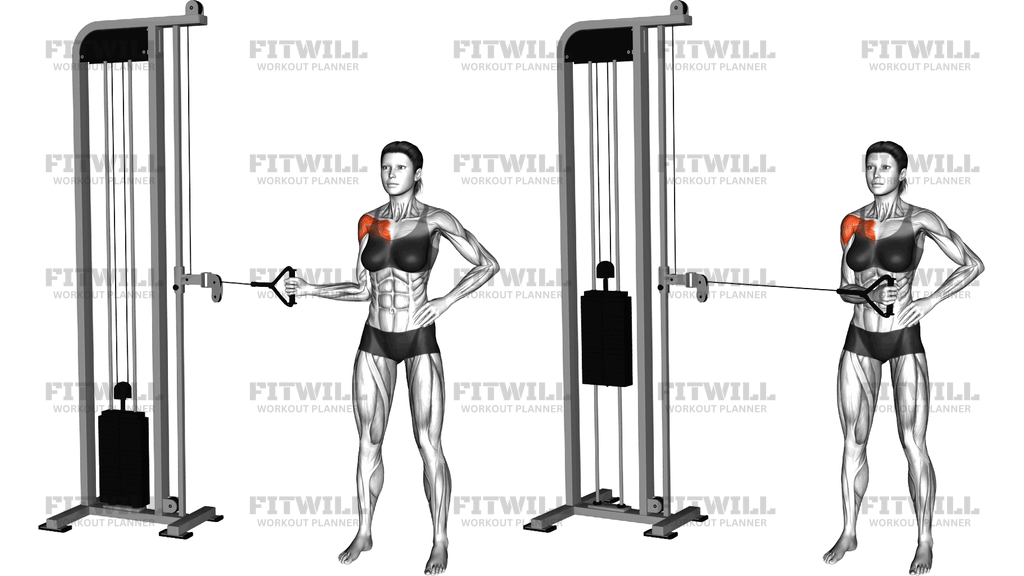
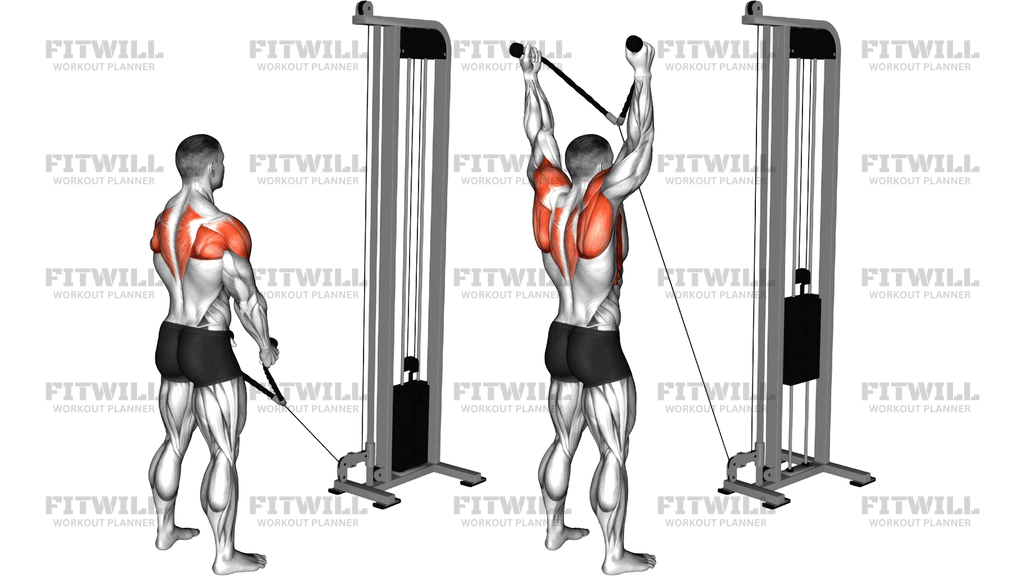
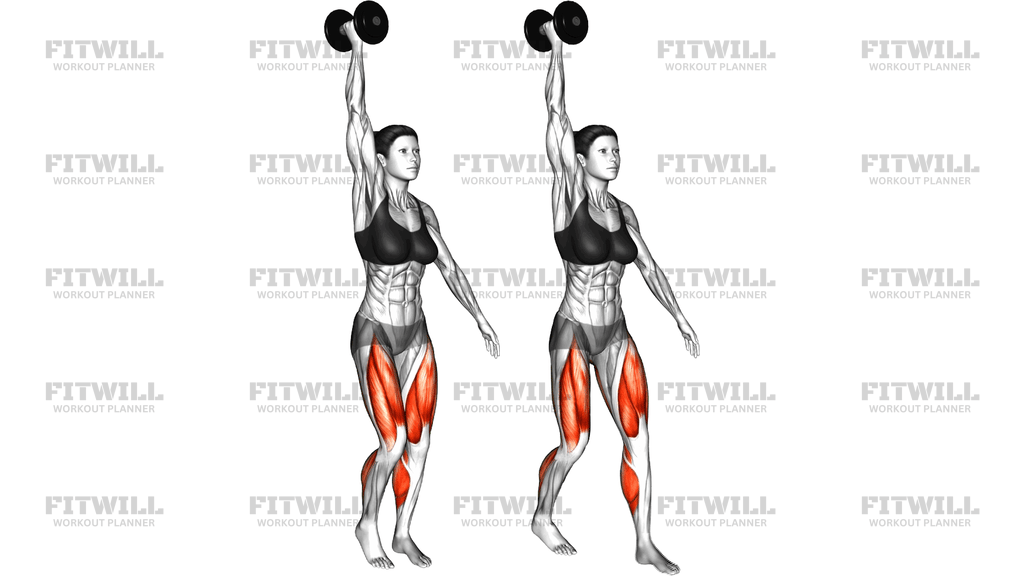
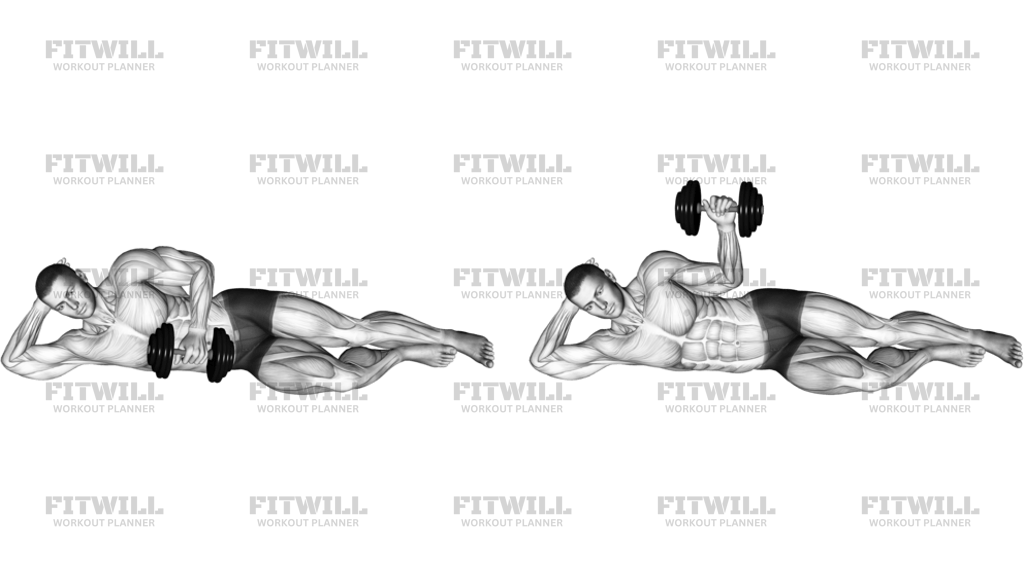
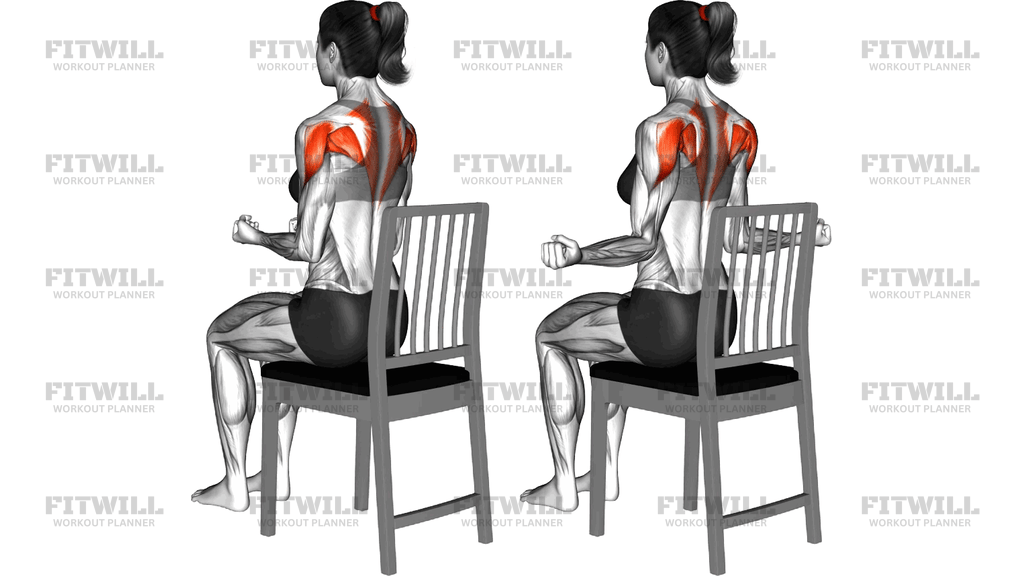
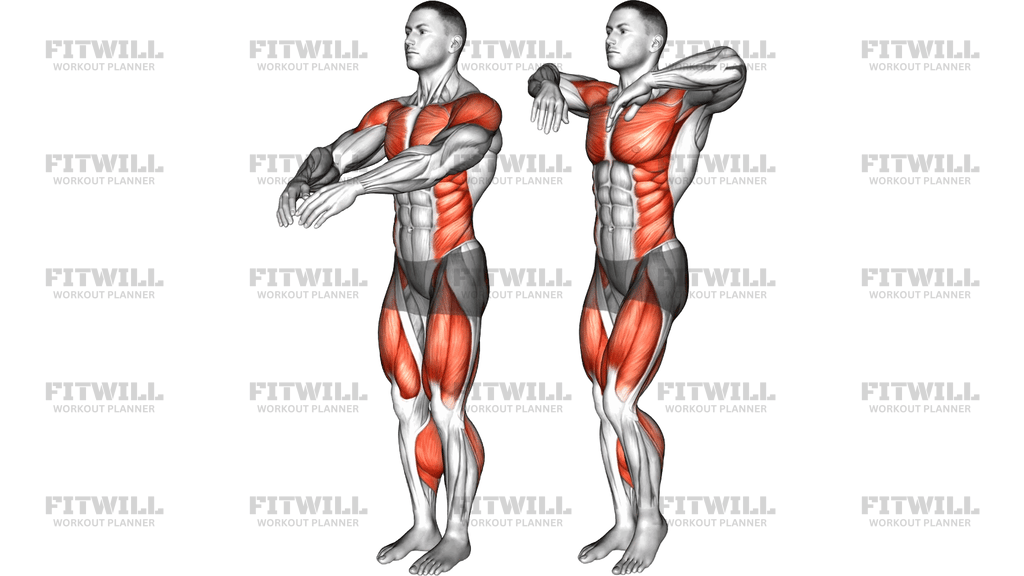
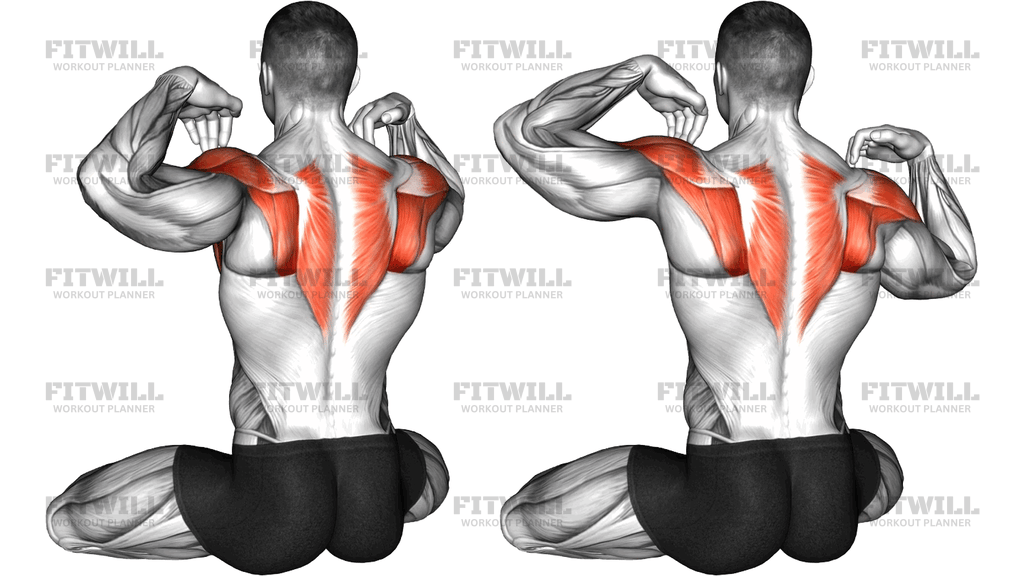
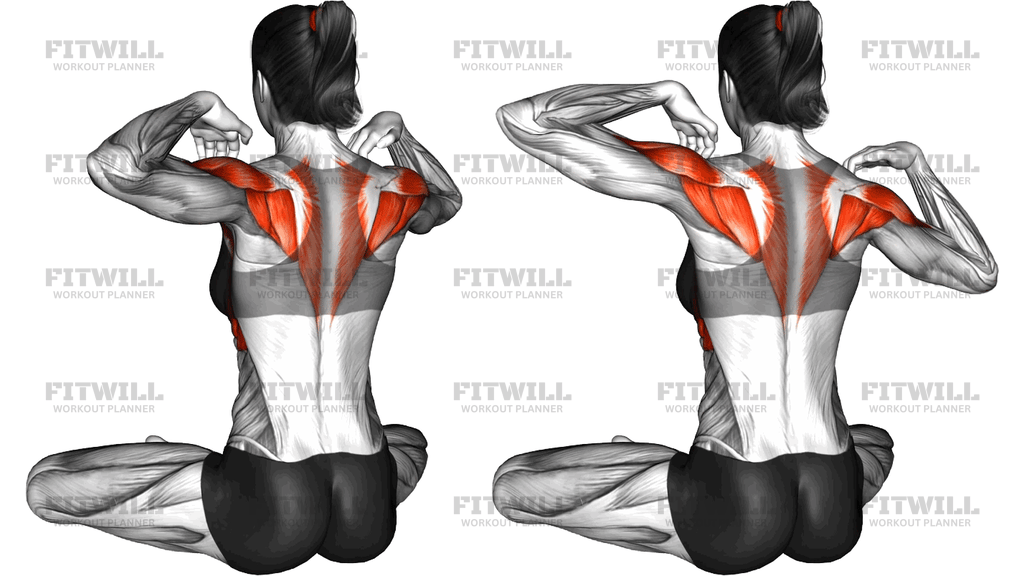
Standing Shoulder Medial And Lateral Rotation
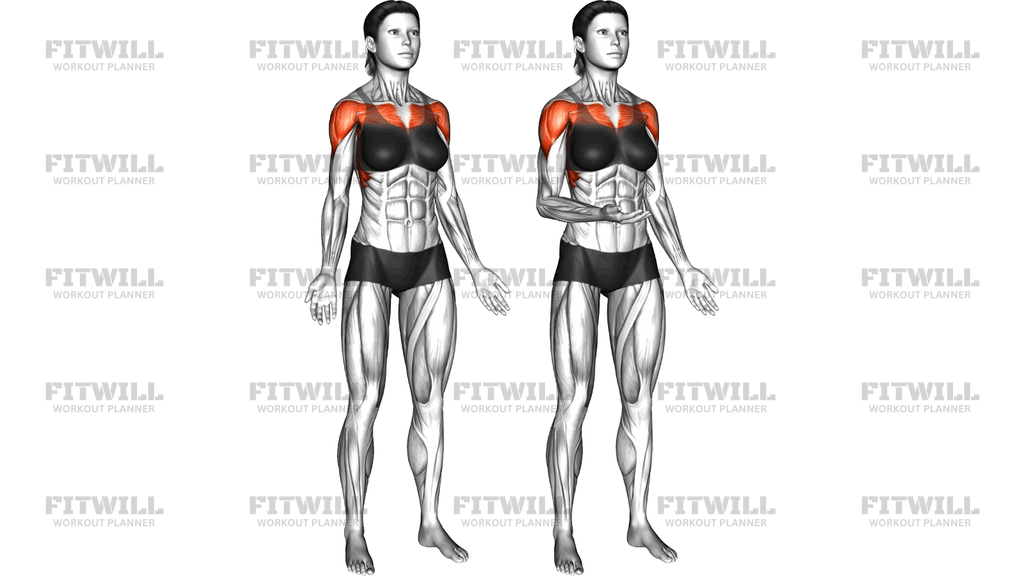
The Standing Shoulder Medial And Lateral Rotation is a bodyweight mobility and activation drill that takes your shoulder joint through its two primary rotational patterns. Standing tall with one elbow bent to roughly 90 degrees at your side, you rotate the forearm inward across your stomach for medial rotation, then swing it outward and back for lateral rotation. Because there is no external load, all of the control comes from the small rotator cuff muscles at the back and front of the shoulder, highlighted in the demonstration by the working arm's smooth, deliberate arc.
This movement is especially useful as a warm-up before pressing, pulling, or overhead work, and it is a staple for anyone rebuilding shoulder control after long periods of desk work or limited activity. The rotator cuff muscles — the infraspinatus and teres minor on the external side, and the subscapularis on the internal side — are rarely challenged directly in standard gym exercises, yet they stabilize the humeral head in every upper-body movement you perform. Training both directions in one drill keeps the joint balanced rather than biasing one side.
Setup matters more than it looks. Because the arm is unloaded, it is easy to cheat by swinging the forearm, shrugging the shoulder toward the ear, or leaning the torso to help the arm along. Keep the elbow pinned lightly against your ribs, the wrist neutral, and the shoulder blade relaxed and down. That fixed elbow position forces the rotation to come from the shoulder joint itself, which is exactly the point of the drill.
To execute it well, stand with feet about hip-width apart, soften the knees, and brace the trunk lightly. Bend one elbow to 90 degrees and rotate the forearm slowly across your body until the hand approaches the opposite hip, then reverse direction and rotate outward as far as you can without the elbow drifting forward or the torso twisting. The end ranges should feel like a gentle stretch, never a pinch at the front or back of the shoulder.
Common use cases include prehabilitation routines, rehabilitation progressions prescribed for rotational control, warm-up circuits for throwers and racket-sport players, and simple daily maintenance for stiff shoulders. Since each side can be worked independently, it is also a convenient way to compare left-to-right range and smoothness, which often reveals an asymmetry worth addressing.
Keep the pace slow — two to three seconds in each direction — and stay in a pain-free range. If you feel pinching rather than muscular effort, reduce the range slightly or let the elbow float a few centimeters away from the ribs. A few controlled sets of ten rotations per side are usually enough; this drill works through quality of motion, not volume or load.
[ Workout Log & Planner ]
Put your next workout in Fitwill
Keep your plan and training log ready when you are.


Instructions
- Stand upright with your feet hip-width apart, knees soft, and arms relaxed at your sides.
- Bend one elbow to 90 degrees so the forearm points forward and the palm faces inward, keeping the upper arm lightly touching your ribs.
- Roll the shoulder blade down and back, keep your chest open, and brace your trunk gently without holding your breath.
- For medial rotation, sweep the forearm slowly across the front of your body until your hand nears the opposite hip, letting the palm turn upward.
- For lateral rotation, reverse the motion and rotate the forearm outward and away from your body as far as the shoulder allows while the elbow stays at your side.
- Pause briefly at each end range without forcing the joint or letting the shoulder shrug upward.
- Continue alternating between the inward and outward arc, keeping the tempo slow and the elbow angle fixed at 90 degrees throughout.
- Breathe steadily, exhaling as the arm rotates and inhaling as it returns through the middle of the range.
- Complete the desired repetitions on one side, then switch arms and match the count, noting any difference in range or control between sides.
Tips & Tricks
- The most common mistake is letting the elbow drift away from the ribs during lateral rotation — this turns the drill into a partial arm raise and unloads the rotator cuff. Imagine a coin balanced on the elbow and keep it level.
- Do not rush the switch between directions. A brief pause at the inward end range, where the subscapularis works, makes the medial rotation half far more effective.
- If you feel a pinch at the front of the shoulder during the inward sweep, rotate only to the point just before the pinch rather than forcing the hand to the opposite hip.
- Keep the wrist in line with the forearm. Flipping or flicking the hand hides the true end range of the shoulder joint.
- Check your reflection or film from the front: if your torso rotates to help the arm, narrow the range slightly until the trunk stays square.
- Both shoulders often differ in range. Start with your stiffer side and match the repetitions, not the range, on the more mobile side.
- Use this drill before pressing or pulling sessions — a controlled set of ten rotations per side primes the cuff without fatiguing it.
- If standing balance or posture is an issue, place your back and heels lightly against a wall to keep the torso honest and eliminate leaning.
Frequently Asked Questions
What muscles does the Standing Shoulder Medial And Lateral Rotation work?
It primarily targets the rotator cuff — the infraspinatus and teres minor during the outward rotation and the subscapularis during the inward rotation. The rear deltoids assist with control, but the load is intentionally light since the drill is about joint function, not strength maxing.
Why does the elbow stay bent at 90 degrees in this exercise?
The fixed 90-degree bend shortens the lever so the rotation happens at the shoulder joint rather than through momentum from a long arm. It also makes it obvious if the elbow drifts, which is the most common form breakdown.
Is the Standing Shoulder Medial And Lateral Rotation suitable for beginners?
Yes, the bodyweight version is one of the safest ways to learn rotational shoulder control. Beginners should focus on a slow tempo and a comfortable range, adding resistance bands only once the motion feels smooth and symmetrical.
Should I feel a stretch during the lateral rotation phase?
A mild stretch at the back of the shoulder at the outward end range is normal. Sharp pain, pinching at the front, or clicking with discomfort means you should reduce the range and keep the elbow lightly against your ribs.
How many repetitions should I do per side?
Ten to fifteen controlled rotations per side, taking two to three seconds each way, works well as a warm-up or activation set. Quality of the arc matters far more than the total count.
Can I do this exercise before bench press or overhead lifting?
Absolutely — it is an ideal pre-lifting drill because it wakes up the cuff without pre-fatiguing the big pressing muscles. One or two light sets per side is enough before a heavy session.
What is a good substitution if standing rotation bothers my shoulder?
Try the same rotation pattern lying on your side or back with the elbow supported, which removes gravity-assisted cheating and often feels more comfortable. A resistance band anchored at elbow height can also be used for a supported external rotation.
Why do I keep shrugging my shoulder during the rotation?
The upper trap takes over when the cuff muscles tire or when the range is forced beyond what the joint allows. Drop the shoulder blade down before each set, shorten the range slightly, and slow the tempo so the rotation stays in the shoulder itself.
How is this different from doing shoulder rotations with a resistance band?
The bodyweight version trains range of motion and movement quality with zero joint compression, while banded versions add rotational strength through the range. Most people benefit from mastering the unloaded Standing Shoulder Medial And Lateral Rotation first, then progressing to band resistance.