Double Palm Tap Russian Twist
The Double Palm Tap Russian Twist is a bodyweight rotational core exercise performed from a seated V-sit position. Instead of holding a weight or plate, you press your palms together in front of your chest and use both hands to tap the floor on either side of your hips, rotating from the trunk with each tap. The kneeling-bent-knee position shown here — feet flat on the floor, torso leaning back to roughly 45 degrees — makes it one of the most accessible ways to train rotation without loading the spine with external weight.
The main targets are the obliques, the layered muscles running along the sides of your waist that drive trunk rotation and resist it. Your rectus abdominis works isometrically to hold the leaned-back position, while the deep core musculature stabilizes the spine through every tap. Because the hands stay empty, the demand scales naturally with your torso angle and lean depth rather than with equipment, which makes this version ideal for beginners learning the twist pattern, for warm-ups before heavier rotational work, and for higher-rep conditioning circuits.
Setup matters more than most people realize. Your balance point sits just behind your sit bones, and how far you lean back determines both the difficulty and the stress on your lower back. Feet stay flat and grounded in this variation, which anchors the lower body and forces the rotation to come from the waist rather than from swinging the legs. Pressing the palms together keeps the arms quiet and long so the tap is driven by the trunk, not by reaching with the shoulders.
To execute it well, think of rotating ribcage-over-pelvis rather than swinging your arms side to side. Each tap should be deliberate: the palms touch the floor beside your hip, your chest follows your hands, and your head stays in line with your spine. The movement path is a controlled arc across the midline — touch one side, rotate through center without stopping, touch the other. Rushing turns it into a flailing arm exercise; slowing it down keeps tension on the waist muscles the entire time.
A few practical points will keep this safe and effective. Keep your chest tall and your lower back from rounding into a C-shape as you fatigue — if your posture collapses, sit up slightly or end the set. Exhale on each tap to help the core stay braced, and keep your neck relaxed instead of craning to watch your hands. If you feel the work in your hip flexors or lower back rather than your waist, reduce your lean angle and shorten the range until the obliques are doing the job.
[ Workout Log & Planner ]
Put your next workout in Fitwill
Keep your plan and training log ready when you are.


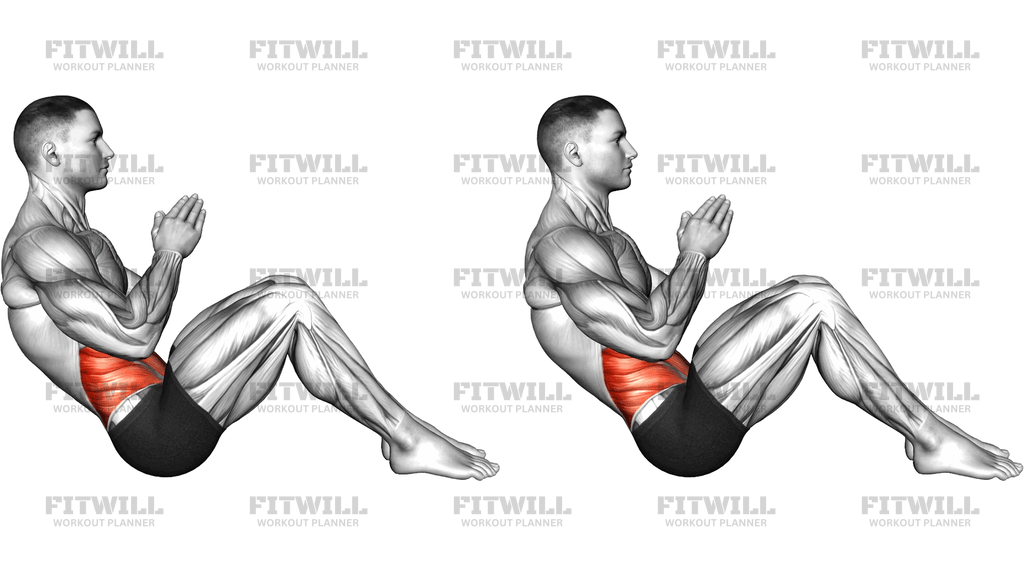
Instructions
- Sit on an exercise mat with your knees bent and feet flat on the floor, hip-width apart, heels planted about a foot in front of your hips.
- Lean your torso back to roughly 45 degrees until you feel your abdominals engage, keeping your chest tall and your sit bones as your balance point.
- Press your palms together in front of your chest with elbows bent and tucked toward your sides, arms forming a single quiet unit.
- Brace your core as if bracing for a light poke to the stomach, and hold a steady breath — do not hold your breath.
- Rotate your torso to the right from the waist, letting your joined palms travel with your chest until both hands tap the floor beside your right hip.
- Pause for a beat on the tap, keeping your shoulders down and your head in line with your spine rather than dropping toward the floor.
- Rotate through center without pausing and tap the floor beside your left hip, keeping the arc smooth and the speed identical in both directions.
- Exhale as you tap on each side and inhale lightly as you rotate back through the middle.
- Continue alternating left and right taps for your target number of reps or time, then sit upright, release the palms, and shake out your waist before the next set.
Tips & Tricks
- If your feet keep lifting or your legs start rocking side to side, your rotation is coming from momentum — press your heels down and shrink the arc until only your trunk moves.
- The most common mistake is letting the arms do the tapping while the chest barely turns. Watch that your shirt collar and shoulders rotate with your hands.
- Do not slouch into a rounded lower back as the set gets hard. Sit a few degrees more upright instead; you will lose some difficulty but keep the work on the abs rather than the spine.
- Keep the taps light. Slamming the palm into the floor jars the shoulder and usually signals you are dropping rather than rotating.
- Your gaze should follow your hands slightly but stay soft — cranking the neck around to watch each tap creates tension that has nothing to do with the obliques.
- To make it harder without adding weight, lift your heels an inch off the floor or lean back another few degrees. To make it easier, bring your knees closer to your chest.
- Pause briefly at each tap instead of bouncing. The one-second stop is where the obliques actually work; the bouncing is where they rest.
- If one side feels tighter or weaker, do not favor it — match reps to the stiffer side so the difference closes instead of grows.
Frequently Asked Questions
Which muscles does the Double Palm Tap Russian Twist work?
The obliques on the sides of your waist are the primary movers, with the rectus abdominis and deep core stabilizing your leaned-back torso. The hip flexors also help hold your trunk and leg position throughout the set.
Why tap with both palms pressed together instead of holding a weight?
Pressing the palms together links your arms into one unit so the rotation comes from your trunk rather than from swinging a loose object. It also makes the exercise self-scaling: difficulty comes from your lean angle, not from equipment, which suits beginners and high-rep circuits.
Should my feet stay on the floor during the Double Palm Tap Russian Twist?
Yes, in this version the feet stay flat and planted. Keeping the feet grounded anchors your lower body and forces the rotation to come from your waist, which is exactly what makes it a good learning version of the twist.
How far back should I lean?
Start around 45 degrees — far enough that your abs are clearly engaged but not so far that your lower back rounds. If you feel strain in your lower back or your posture collapses, sit up a few degrees.
Is this exercise safe for people with lower back issues?
Repeated trunk rotation under tension is not comfortable for everyone, especially with a rounded back or excessive lean. If you have a history of back problems, sit more upright, use a smaller arc, and stop if you feel pain rather than muscular effort — and check with a professional if unsure.
What is the most common mistake in the Double Palm Tap Russian Twist?
Speeding up and turning it into an arm swing. If your chest and shoulders are not rotating with your hands, your obliques are barely involved — slow down, pause at each tap, and let your ribcage lead the movement.
How many reps should I do?
Count each tap as one rep. For learning the pattern, 2-3 sets of 10-16 controlled taps works well; for conditioning, 30-45 seconds of steady alternating taps is a common approach.
What can I use if I want to progress past the bodyweight version?
Hold a medicine ball, dumbbell, or plate at your chest and perform the same rotation, or lift your feet off the floor to remove your base of support. Progress only when you can keep your chest rotating with your hands and your lower back neutral.
My hip flexors cramp during this exercise — what should I change?
Cramping usually means your torso angle is too aggressive for your current strength. Sit up slightly, keep your feet flat and heels pressed down, and shorten the arc until the tension shifts back into your waist.