Triangles (Advanced)
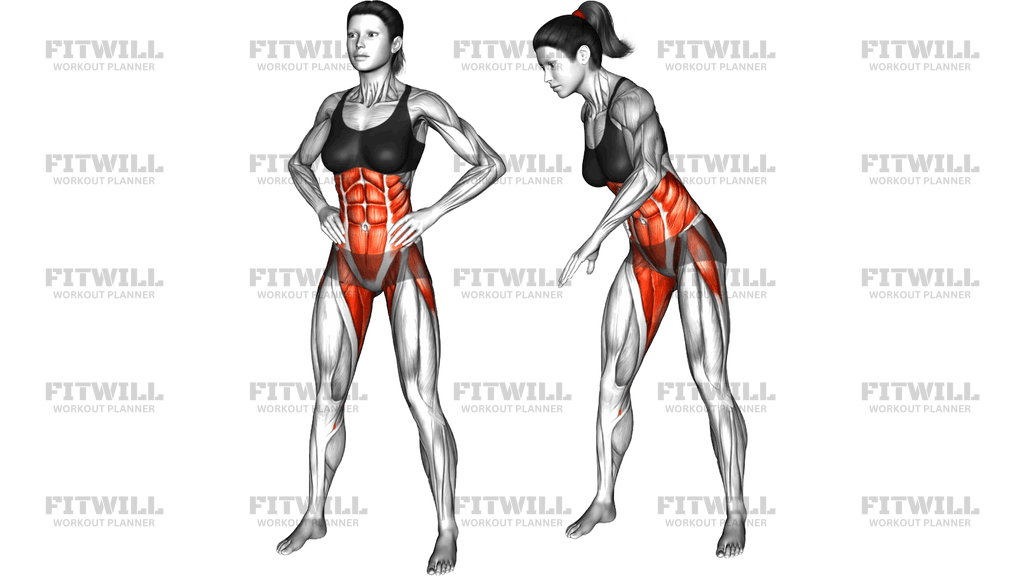
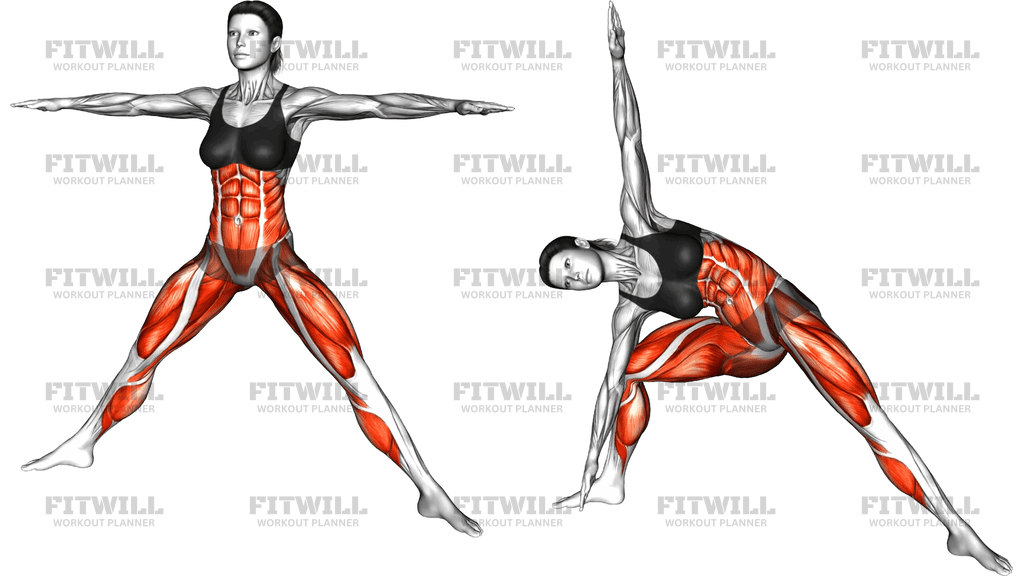
Triangles (Advanced) is a standing side-bending movement performed from a very wide stance, where you reach one arm up toward the ceiling and fold sideways over a straight front leg until your lower hand travels down toward your foot. Unlike a basic standing side bend, the advanced version keeps both legs straight and rotated, which forces the spine to side-flex through its true range instead of letting the hips or knees do the work. The result is a deep challenge for the obliques and deep core, combined with a strong stretch through the inner thighs and hamstrings of the lead leg.
This movement is useful for anyone whose side-flexion strength and hip mobility have fallen behind their other qualities. Desk workers often lose the ability to move laterally altogether, and lifters who train squats, hinges, and presses in one plane rarely load side bending in any meaningful way. Triangles (Advanced) fills that gap with nothing but floor space, making it a staple in yoga-informed strength warm-ups, martial arts and racquet sport preparation, and general mobility work.
The wide, straddle-style stance is what separates this from easier variations. Both feet point forward or slightly turned out, legs stay long and straight, and the arms form a straight line at shoulder height before the fold begins. Because the base is so wide and the knees stay locked in extension, the hamstrings and adductors must lengthen under load while the obliques on the folding side contract eccentrically to control the descent. That combination is exactly why the advanced version demands more than the bent-knee or low-lunge triangle variations.
To execute it well, think of the fold as a sideways hinge, not a forward collapse. The chest rotates toward the ceiling as you descend, the top shoulder stacks over the bottom one, and both arms stay in one long line so the spine lengthens even as it bends. The lower hand should reach toward the shin, ankle, or foot depending on your available range, and the head stays in line with the spine rather than dropping toward the floor. Hold briefly at the bottom or move in and out slowly, then repeat on the other side for balanced work.
Because the setup places real demands on the hamstrings, inner thighs, and lower back, progress gradually. If you cannot fold with a flat, long spine, shorten the stance or place your lower hand on a block, chair, or bench rather than forcing the hand to the floor. Stop short of any pinching sensation in the hip or low back, and treat smooth, symmetrical range on both sides as the real marker of progress.
Fitwill
Log Workouts, Track Progress & Build Strength.
Achieve more with Fitwill: explore over 9600 exercises with images and videos, access built-in and custom workouts, perfect for both gym and home sessions, and see real results.
Start your journey. Download today!




Instructions
- Stand on a non-slip surface with your feet roughly three to four feet apart in a straddle stance, toes pointing forward or turned out just slightly.
- Extend both arms straight out to the sides at shoulder height, palms down, and press the tops of your thighs back so the kneecaps face forward and the legs stay straight.
- Turn your torso slightly and hinge your hips sideways over one leg, keeping that front knee fully extended and the whole foot grounded.
- Begin side-flexing the spine, reaching the hand on the same side as your front leg down toward that foot while the opposite arm stays in line and drifts toward the ceiling.
- Rotate your chest and gaze toward the ceiling as you descend, keeping both shoulders stacked in one vertical line rather than letting the top shoulder roll forward.
- Reach your lower hand to wherever your range honestly allows — shin, ankle, or foot — without bending the front knee or collapsing the torso forward.
- Hold the bottom position for one to three breaths, breathing into the ribs and keeping the legs actively pressing into the floor.
- Rise back up by driving through the outer edge of the back foot and contracting the obliques, lifting the torso back to the tall, arms-wide starting position.
- Exhale as you fold down, inhale as you return, and keep the breath steady throughout rather than holding it under tension.
- Complete your repetitions on one side, then reset the stance evenly and perform the same number on the opposite side.
Tips & Tricks
- The most common mistake is collapsing the chest toward the floor instead of side-bending — cue yourself to point the top armpit at the ceiling so the fold stays lateral.
- If the front knee drifts inward as you fold, externally rotate that leg slightly by pressing the big-toe base into the floor; the adductor stretch gets deeper, not looser.
- Reaching for the floor at any cost rounds the spine and kills the oblique work — put a yoga block or low chair under the lower hand instead of shortening the movement.
- Keep weight distributed across both feet; dumping everything onto the front heel turns the fold into a lunge and removes tension from the back leg.
- If your hamstrings shake or the front knee feels strained, bend the knee a few degrees until control returns — locked-leg range is earned, not forced.
- Move down over two to three seconds rather than dropping; the eccentric control is where most of the oblique and hip benefit lives.
- Do not let the head hang — keep the neck long and look up at the top hand so the spine stays one continuous line.
- Warm up with a shorter-stance or bent-knee triangle variation first; going straight into the full wide-stance version with cold hamstrings is a recipe for a strained groin.
- Match your range side to side; if one side folds noticeably further, work to the tighter side's range so the pelvis does not learn to twist.
Frequently Asked Questions
Which muscles does Triangles (Advanced) work the most?
The obliques and deep side-of-trunk muscles drive the side flexion, while the inner thighs and hamstrings of the wide stance lengthen and stabilize under load. The glutes and hip stabilizers on the standing leg also work hard to keep the pelvis level.
Is Triangles (Advanced) suitable for beginners?
It is best treated as a progression — beginners should start with a narrower stance, a slight bend in the front knee, or the lower hand supported on a block or chair. Once a flat-spine fold feels controlled at that height, gradually widen the stance toward the full version.
How far should my lower hand reach in Triangles (Advanced)?
To the shin, ankle, or foot — wherever you can keep both legs straight, the chest rotated open, and the spine long. Forcing the palm to the floor usually rounds the back and replaces the oblique work with passive hanging on the ligaments.
Why does my front hamstring cramp during Triangles (Advanced)?
The straight front leg loads the hamstring at long length while it stabilizes the knee, which can trigger cramping in tight or untrained tissue. Ease the range slightly, keep the thigh pressing back, and build tolerance over a few weeks rather than pushing through the cramp.
Can I do Triangles (Advanced) if I feel pinching in my hip?
A pinch at the front of the hip usually means the fold has drifted into rotation or you have gone past your available range. Reduce the depth, keep the chest open toward the ceiling, and if pinching persists at shallow range, switch to the supported or narrower-stance version.
How is Triangles (Advanced) different from a standing side bend?
A standing side bend uses a narrow base and free legs, so most of the movement comes from the trunk. In Triangles (Advanced) the wide, straight-leg stance anchors the pelvis, so the spine must genuinely side-flex and the inner thighs and hamstrings are stretched at the same time.
Should I hold Triangles (Advanced) or move in and out of it?
Both work — hold the bottom position for two to three slow breaths when using it as a flexibility finisher, or move in and out over slow counts for two to three sets of six to eight reps per side when using it as active strength and mobility work.
How wide should my stance be for Triangles (Advanced)?
Wide enough that folding sideways over one straight leg is a real challenge but not so wide that your hamstrings pull your pelvis into a tuck. Roughly three to four feet apart is a practical starting point; adjust until you can keep both legs straight with a flat, long spine.
What can I substitute if Triangles (Advanced) is too difficult right now?
Use a narrower-stance triangle with the front knee slightly bent, or rest the lower hand on a yoga block, bench, or chair. Standing side bends and lateral lunges also build the oblique and inner-thigh capacity this movement demands.
Is it safe to do Triangles (Advanced) with lower back issues?
Side flexion under a long-lever stance can aggravate some backs, so anyone with a current or recurring issue should get clearance from a qualified professional first. If cleared, start with supported hands and shallow range, and stop at the first sign of sharp or radiating symptoms.