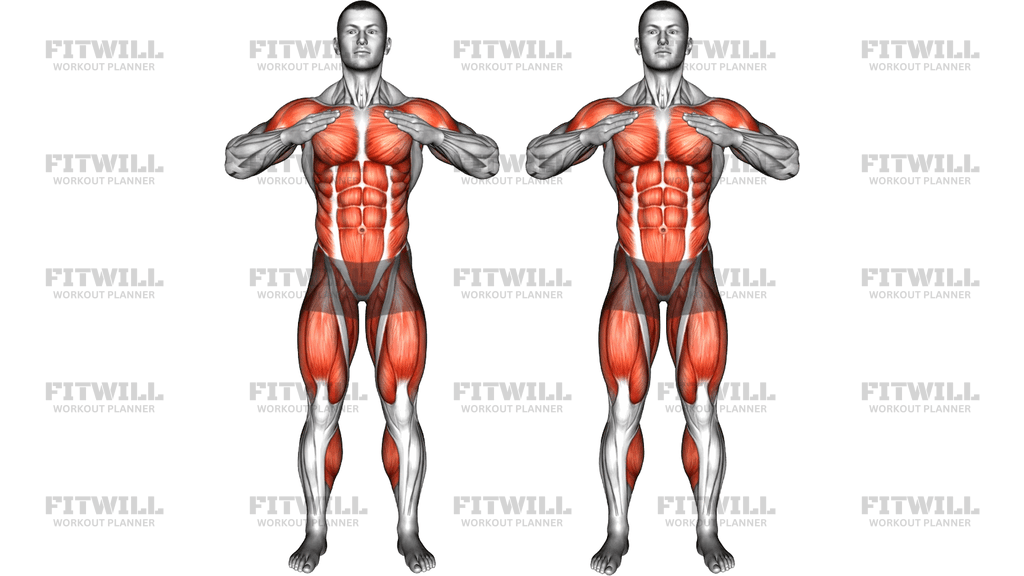
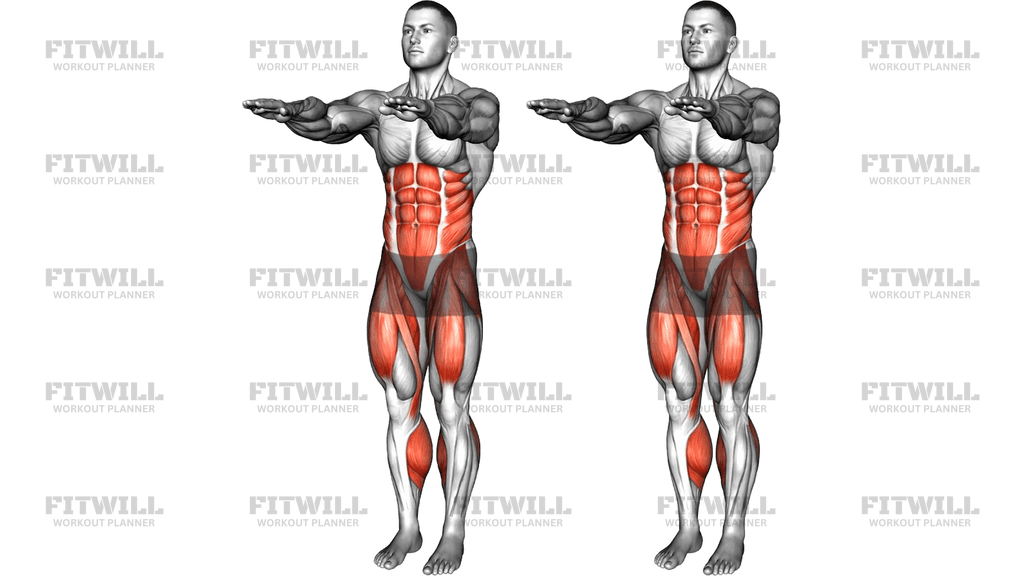
Standing Ab Twist Wall Touch
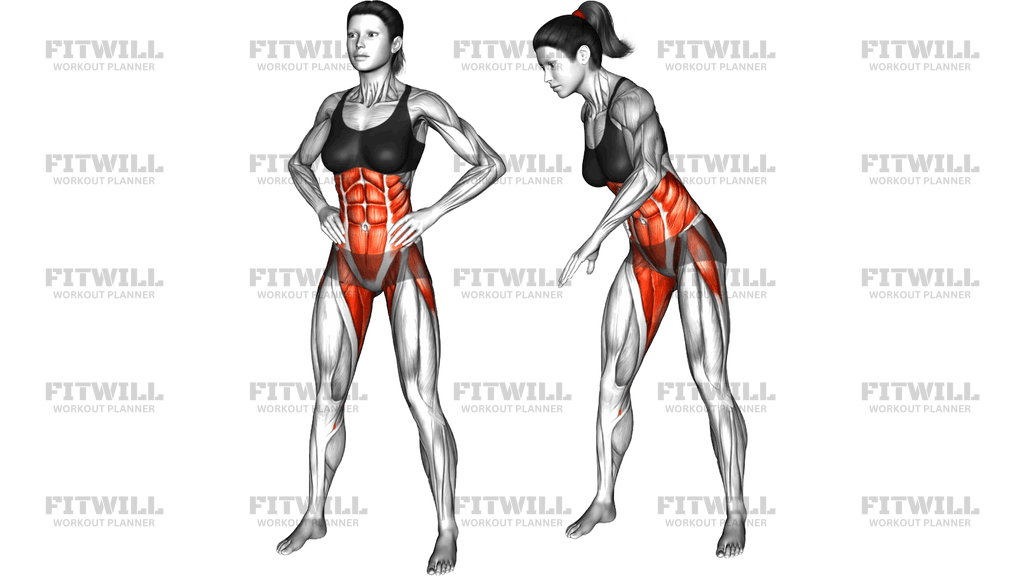
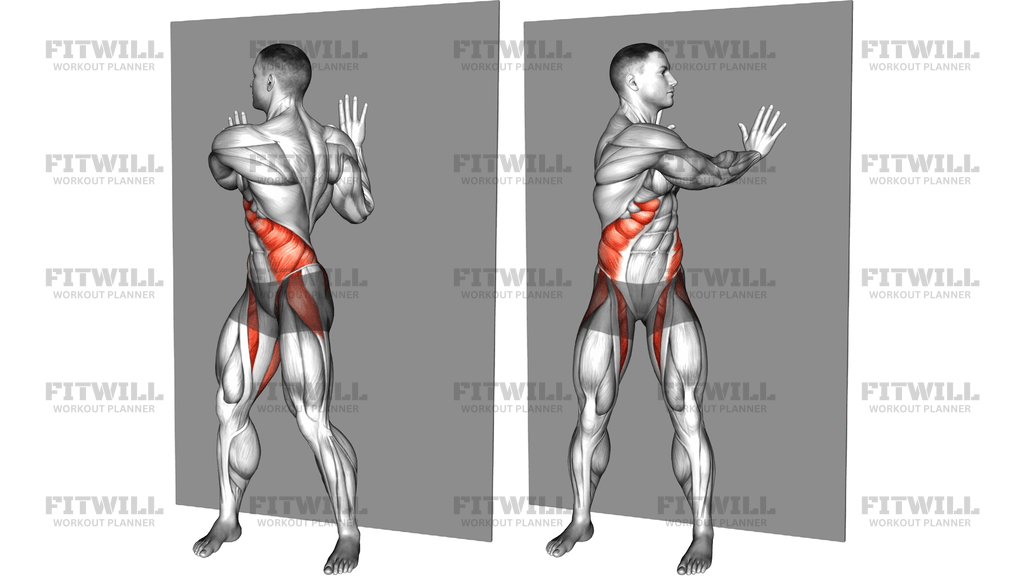
The Standing Ab Twist Wall Touch is a bodyweight rotational drill where you stand upright and sweep your torso from side to side, reaching your hands toward a wall on each side of you. The wall serves two purposes: it gives you a clear target for the end of every repetition, and it gives you instant feedback on whether you are actually rotating through your trunk instead of just swinging your arms. Because there is no load involved, the exercise works as a controlled rotation drill rather than a max-effort ab exercise, which makes it easy to slot into warm-ups, core circuits, or active recovery days.
The main work is done by the obliques, the layered muscles running along the sides of your waist that handle trunk rotation and anti-rotation. Your rectus abdominis assists as the twist deepens, your hip flexors and inner thigh muscles stabilize the lower body as your weight shifts slightly from foot to foot, and the muscles of the lower back work to keep your spine from collapsing into the movement. It is a good example of a rotational exercise that trains the waist without any equipment beyond clear floor space and a wall.
This movement suits a wide range of trainees. Beginners can use it to learn what a genuine trunk rotation feels like before progressing to weighted twists or cable rotations. Athletes in rotational sports such as tennis, golf, baseball, and martial arts can use it as a low-fatigued rehearsal of the twisting pattern they rely on. It is also a practical choice for people who train at home or in a small hotel gym, since the only requirements are a wall and enough room to turn safely with extended arms.
The setup matters more than it might seem. Stand far enough from the wall that you have to rotate your whole torso to reach it, not just lean or stretch an arm sideways. Your feet stay planted, hips facing forward, and all of the turning should come from your ribcage and waist. If your hips swivel with every rep or your feet pivot off the floor, you lose the isolation on the obliques and turn the drill into a loose full-body swing.
To execute it well, keep your arms relaxed at roughly chest height and rotate deliberately, letting the twist come from the waist up. Touch the wall lightly rather than slapping it, pause for a beat, then rotate all the way to the opposite side. Move at a tempo you can control from start to finish, and keep your knees soft so your legs can absorb the small weight shifts. Two or three sets of ten to twenty controlled touches per side is a sensible working range.
The main safety point is to avoid whipping your torso back and forth for speed. Fast, uncontrolled rotation under momentum is where most people strain their lower back or simply stop getting anything out of the exercise. Keep the pace moderate, respect your current rotational mobility, and let the wall contact be a soft tap rather than a collision.
[ Workout Log & Planner ]
Put your next workout in Fitwill
Keep your plan and training log ready when you are.


Instructions
- Stand upright an arm's length or slightly more from a clear wall, with open space on both sides so you can rotate fully in each direction.
- Bend your elbows slightly and raise your arms to about chest height, hands open with palms facing the direction of the wall.
- Set your feet roughly hip-width apart and plant them flat, toes pointing forward, with a soft bend in the knees.
- Brace your midsection lightly, keep your chest tall, and fix your hips facing forward so the rotation comes from the waist up.
- Rotate your torso to one side by turning your ribcage and shoulders, sweeping both hands toward the wall until your fingertips make light contact.
- Pause briefly at the wall contact, then rotate smoothly across the front to the opposite side and touch the wall there.
- Keep the weight shift subtle between feet as you twist, letting your legs stay grounded and stable throughout.
- Exhale as you rotate into each touch and inhale as you return through center.
- Complete all reps or alternate sides per repetition, keeping the tempo even and controlled from the first touch to the last.
- When finished, lower your arms, take a step back from the wall, and reset your stance before the next set.
Tips & Tricks
- The most common mistake is swinging the arms across the body while the trunk barely moves. Watch whether your chest turns with your hands; if not, slow down and shrink the range until the rotation comes from your waist.
- If your feet pivot or your hips swivel with each rep, you are losing oblique work. Think of your lower body as rooted while everything above the belt turns.
- Touching the wall too hard usually means you are throwing yourself into the rotation with momentum. Aim for a soft fingertip contact that you could reverse from instantly.
- Keep your arms at chest height rather than overhead. Reaching high shifts the work toward the shoulders and lower back and away from the waist.
- If your lower back aches during or after the set, reduce how far you rotate and re-brace before each rep. Deep end-range twisting is earned gradually, not forced.
- Staggering your feet slightly can make the rotation feel smoother if your hip mobility is limited, but return to a square stance as it improves.
- Use this drill before weighted rotations or heavy compound lifts as a warm-up; a couple of easy sets prime the obliques without fatiguing them.
- Keep your head traveling with your shoulders rather than fixing your gaze forward. Letting the eyes follow the turn keeps the neck out of a strained position.
- Breathe out on each rotation instead of holding your breath; many people unconsciously clamp down when concentrating on the wall target.
Frequently Asked Questions
Which muscles does the Standing Ab Twist Wall Touch work?
The obliques along the sides of your waist do most of the work, with the rectus abdominis assisting as you rotate. Your hip flexors and inner thigh muscles also work to stabilize your legs as your weight shifts slightly between feet.
How far should I stand from the wall for the Standing Ab Twist Wall Touch?
Stand roughly an arm's length away so that reaching the wall requires a genuine rotation of your torso rather than a sideways lean or a long arm stretch. If you can touch the wall without turning your chest, step back a little farther.
Is the Standing Ab Twist Wall Touch good for beginners?
Yes, it is one of the gentler ways to train rotation because there is no external load and the wall provides a clear target and stopping point. Beginners should start with a shorter range and a slower tempo before extending the twist.
Why do my arms get tired before my abs in this exercise?
That usually means you are swinging your arms across your body instead of rotating your trunk. Focus on turning your ribcage and shoulders together so the hands simply follow the rotation, and the work will shift back to your waist.
Should my hips stay still during the Standing Ab Twist Wall Touch?
Ideally your hips stay square and your feet stay planted, with the rotation coming from the waist up. A small, natural weight shift between feet is fine, but if your whole lower body swivels, the obliques stop doing the driving.
Can I replace the Standing Ab Twist Wall Touch with a weighted rotational exercise?
You can, but treat it as a progression rather than a swap. Moving to a medicine ball twist or cable rotation is best done after you can consistently rotate from the trunk with control in this bodyweight version.
How many reps of the Standing Ab Twist Wall Touch should I do?
Two or three sets of ten to twenty controlled touches per side works well, whether as a warm-up or as part of a core circuit. Prioritize smooth, deliberate rotation over reaching a high rep count.
Is it safe to twist quickly to build speed?
Avoid whipping through the reps for speed, since fast rotation driven by momentum is the most likely way to irritate your lower back. If you need faster rotational work for a sport, build it gradually from this controlled version rather than rushing it here.
Will the Standing Ab Twist Wall Touch reduce fat around my waist?
No exercise reliably removes fat from a specific area, and this one is no exception. It strengthens and conditions the muscles of your waist, while changes in body composition come from your overall diet and training.