Cross Mountain Climber Kick Against Wall
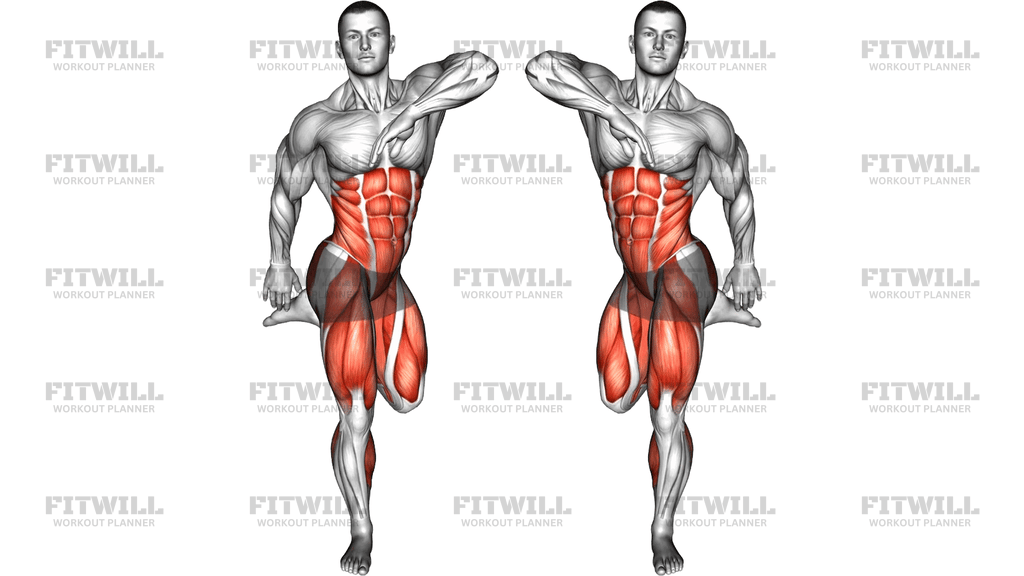
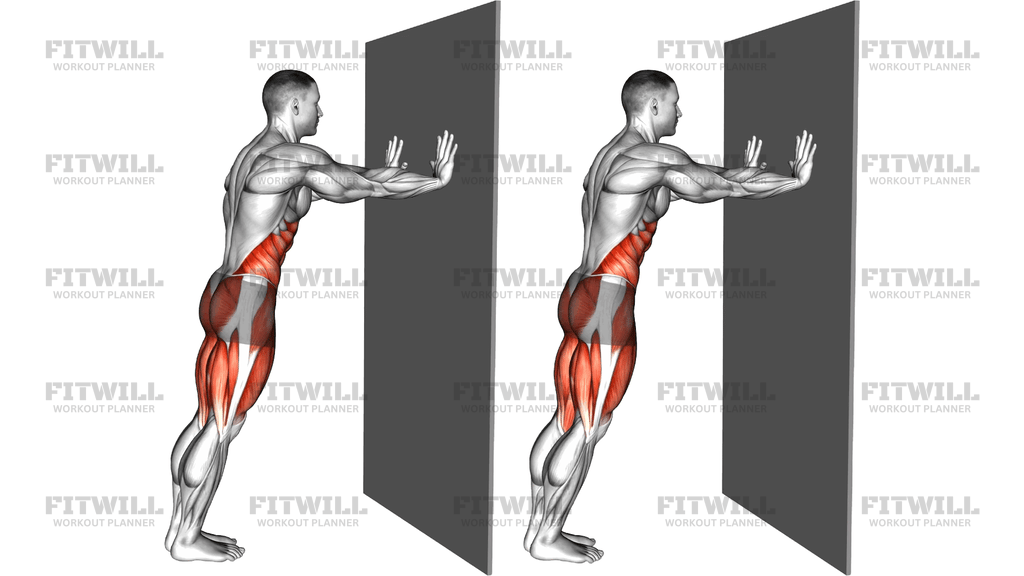
Cross Mountain Climber Kick Against Wall takes the mountain climber pattern and stands it upright. Instead of holding a plank on the floor, you place both hands flat on a wall at about chest or shoulder height and walk your feet back until your body forms a long, angled line. From there, you drive one knee forward and across your body toward the opposite side, then return it and repeat on the other leg. The wall replaces the floor as your support point, which takes load off the wrists and shoulders while keeping the rotational core demand of the cross-body drive.
The main work happens in the obliques and deep abdominal wall. Every time a knee travels diagonally across the midline, the trunk has to rotate slightly and then control the return, which is exactly the twisting job the obliques are built for. The hip flexors and quads power the knee lift, the standing leg and glutes stabilize your base, and the shoulders and arms stay busy isometrically as they press into the wall for the entire set.
The inclined setup makes this a smart progression tool. If floor mountain climbers bother your wrists, lower back, or shoulders, the wall version lets you train the same cross-body knee drive with far less compressive load. The steeper you stand (feet closer to the wall), the easier it is; the farther your feet drift back and the closer your hands get to waist height, the harder the core has to work. That adjustability makes it useful for beginners learning the pattern, for people returning from upper-body niggles, and for advanced lifters who want high-rep or timed core work without floor impact.
Setup matters more than it looks. If your hands are too low or your feet too far back, your hips tend to sag and the movement turns into a lower-back exercise. If your feet are too close, the knee drive becomes lazy because there is no body tension to work against. Aim for a straight line from head to heel, weight pressed firmly through the wall, and a braced trunk before the first knee comes up.
To execute it well, think of the knee traveling toward the opposite hip rather than straight up. The cross-body path is the whole point — a straight-up knee drive turns this into a regular standing climber and loses most of the rotational demand. Move at a deliberate pace, especially the return leg, which should be placed back under control rather than dropped. Because both feet leave and return to the same spot, precision in your foot placement keeps the angle consistent set after set.
You will see this movement used in warm-ups to wake up the trunk before lifting, in circuit and conditioning workouts as a low-impact cardio-core station, and in rehab-friendly programming where floor planks are not appropriate. It also pairs well with other wall-based core drills because you never have to change equipment or position between exercises.
[ Workout Log & Planner ]
Put your next workout in Fitwill
Keep your plan and training log ready when you are.


Instructions
- Stand facing a clear section of wall and place both palms flat against it at roughly chest to shoulder height, fingers spread, arms straight.
- Walk your feet backward until your body forms a straight, angled line from head to heels, with your weight pressed firmly into the wall through your palms.
- Set your feet about hip-width apart and brace your abdominal wall as if preparing for a light push to the torso.
- Keep your shoulders pulled down away from your ears and your neck in line with your spine, eyes toward the wall.
- Drive your right knee forward and across your body toward your left side, letting your trunk rotate slightly with the knee.
- Pause briefly at the top of the drive, feeling the pull across your side waist.
- Return the right foot to its starting spot under control, keeping your hips from sagging as the leg comes back.
- Immediately repeat the drive with your left knee toward your right side to complete one rep of each side.
- Exhale sharply on each knee drive and inhale as the leg returns, keeping the breath rhythmic rather than held.
- Finish the set by bringing both feet back under your shoulders before stepping away from the wall.
Tips & Tricks
- A common fault is driving the knee straight up instead of across the body — this turns the exercise into a plain standing climber. Aim the knee at the opposite hip to keep the obliques doing the work.
- If your lower back arches and your hips sag as your feet move back, you are too far from the wall. Walk the feet in until you can hold a straight line for the whole set, then progress the distance over time.
- Letting the standing heel lift or the foot slide kills your base. Keep the standing foot planted flat and imagine screwing it into the floor.
- Do not let the shoulder blades collapse toward the wall. Press the floor-like pressure actively through both palms for the entire set to keep the shoulders stable.
- The return leg is where most people get sloppy. Place the foot back on its exact starting spot each rep instead of letting it drift wider, which changes your angle and reduces core tension.
- Speed hides errors here. Start slower than feels necessary; once you can keep the trunk braced through twenty controlled reps, add pace or turn it into a timed interval.
- If your wrists or forearms fatigue before your core, your hands are likely too low on the wall. Move them to shoulder height to shorten the lever on the upper body.
- Keep the rotation coming from the trunk and hip, not from cranking your head. Your neck should stay neutral, following the line of the spine toward the wall.
Frequently Asked Questions
Which muscles does the Cross Mountain Climber Kick Against Wall work most?
The obliques and deep core handle the cross-body rotation, while the hip flexors and quads power each knee drive. The shoulders and arms work isometrically the whole time as you press into the wall.
Is this exercise suitable for beginners?
Yes, and it is actually one of the more beginner-friendly ways to learn the cross-body climber pattern. Standing at a steeper angle with your feet close to the wall reduces the load until your core control improves.
Why drive the knee across the body instead of straight up?
The diagonal path is what engages the obliques and trains rotation through the trunk. A straight knee drive mostly works the hip flexors and loses the rotational demand that makes this variation distinct.
How far should my feet be from the wall?
Far enough that your body forms a straight angled line and you feel core tension before moving, but not so far that your hips sag. Start conservative and increase the distance as your strength allows.
Can I use Cross Mountain Climber Kick Against Wall for cardio?
Yes. Once you can control the movement, speeding up the knee switches or performing it in timed intervals raises the heart rate nicely while keeping the impact low compared to floor-based climbers.
What should I do if my wrists hurt with regular floor mountain climbers?
This wall version is a common substitute because the wrists stay neutral and the hands only press rather than bear full body weight. If wall pressure still bothers them, check that your palms are flat and fingers spread rather than collapsed.
How can I make this exercise harder over time?
Walk your feet farther back, place your hands lower on the wall, add a brief pause at the top of each knee drive, or increase rep counts and interval duration. Each option increases the demand on the trunk.
How many reps should I do?
For core control work, aim for ten to fifteen controlled reps per side. For conditioning, use twenty to thirty seconds of continuous alternating drives, resting only when your form starts to slip.
Is it safe for my lower back?
When performed with a braced trunk and hips held level, the wall-supported position places less extension stress on the spine than floor planking. If you feel your back arching or sagging, reduce the distance from the wall and slow the tempo.