Alternate Twisting Knee Thrust
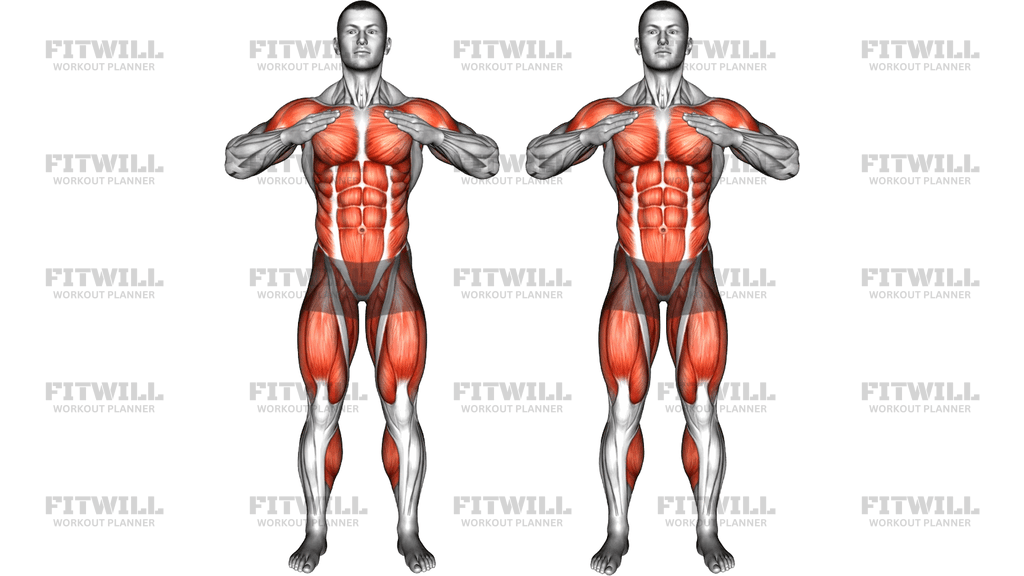
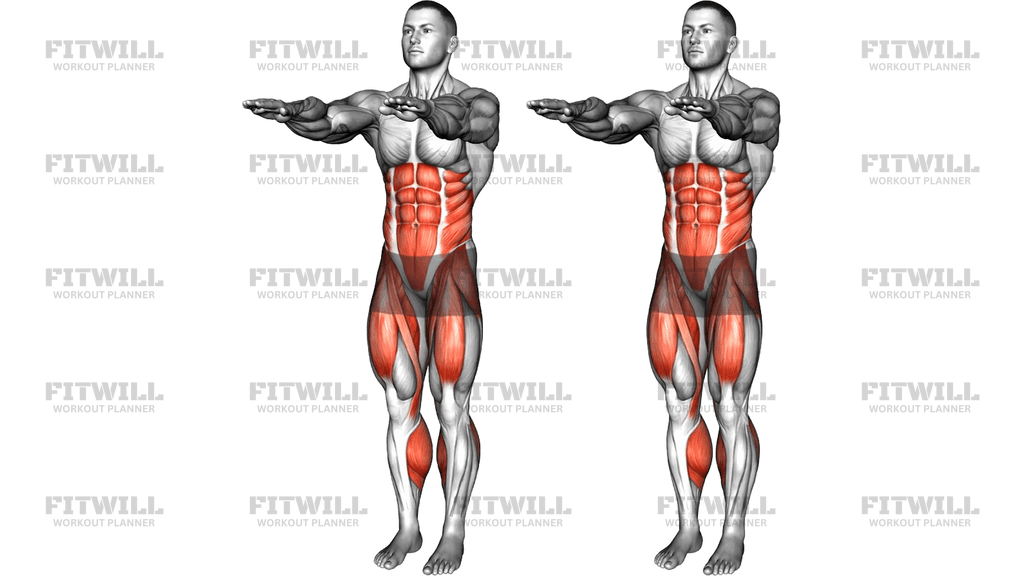
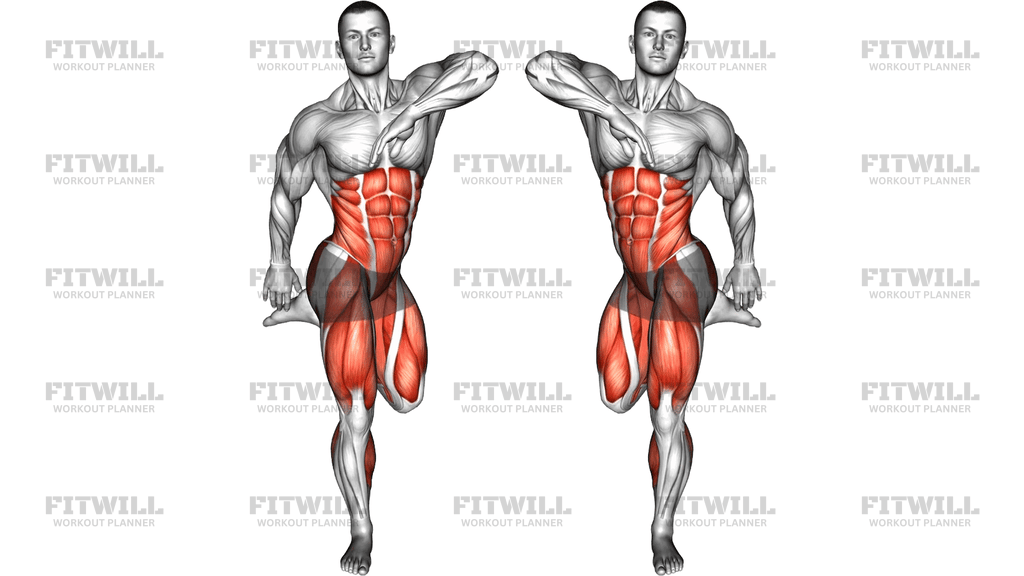
The Alternate Twisting Knee Thrust is a standing body weight exercise that combines a high knee drive with a rotation of the trunk. You start with your feet spread wide, both arms extended straight out in front of your chest, and then you drive one knee up and across your body while twisting your torso toward it. After each thrust the leg returns to the floor and the opposite knee comes up with a twist the other way, so the two sides alternate rep by rep.
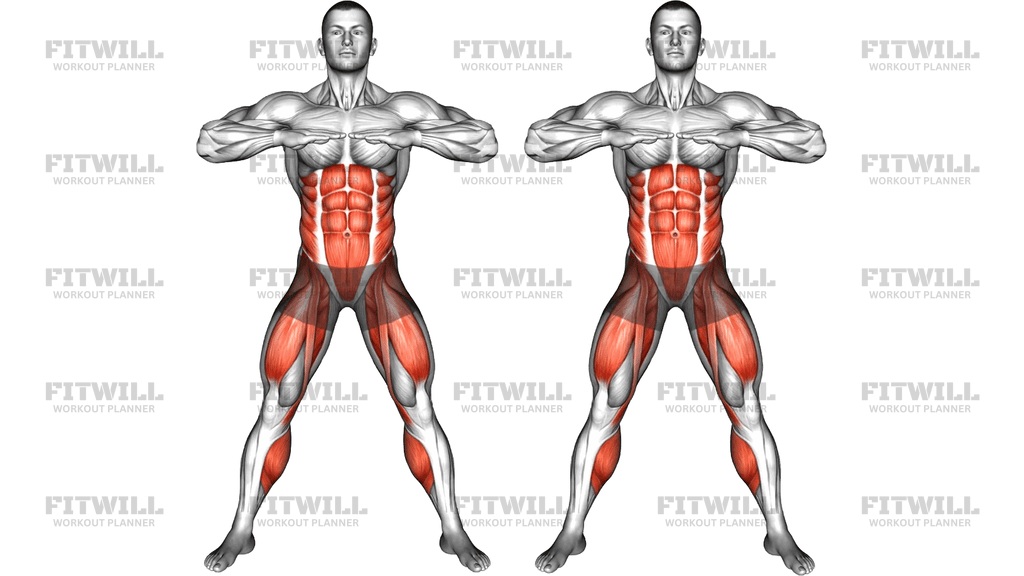
The main work comes from the obliques, which rotate the ribcage over a stable pelvis, and from the hip flexors and quads, which lift the thigh. Because you are standing on one leg at the top of every rep, the standing glute, hip, and ankle stabilizers work quietly the whole time. The arms stay fixed at chest height, giving the twist a target to reach and forcing the rotation to come from the trunk rather than from swinging the shoulders.
This is a useful movement for anyone who wants to train rotational core control without getting on the floor. It shows up in warm-ups, in circuit and conditioning work, and in programs for sports that involve turning, cutting, or transferring force across the midsection, such as tennis, martial arts, or throwing events. Since no equipment is needed and the pace is easy to adjust, it works equally well as a slow, deliberate core drill or as a faster, breath-heavy interval movement.
Setup matters more than it looks. A wide, stable stance gives your base enough width to handle the shifting center of gravity that comes with lifting one knee and twisting. Holding the arms level at chest height matters because dropping or flailing them lets momentum replace muscle work. The twist should come from the waist and ribcage, with the chest rotating to meet the knee, not from the arms dragging the torso around.
Done well, each rep ends with the knee clearly up and across the midline, the torso rotated, and a brief moment of balance before the foot returns. Keep your spine long rather than hunching forward, and let your breathing stay rhythmic — one breath per knee is usually enough. If you cannot keep your balance or your lower back starts to arch or over-rotate, slow the tempo down and reduce the height of the knee until the pattern feels clean, then build back up.
[ Workout Log & Planner ]
Put your next workout in Fitwill
Keep your plan and training log ready when you are.


Instructions
- Stand with your feet roughly twice shoulder-width apart, toes turned slightly out, and your weight spread evenly across both feet.
- Raise both arms straight out in front of your chest at shoulder height, hands relaxed and level with each other.
- Brace your abdominal wall lightly and lengthen your spine so your ribs stack over your hips before you start moving.
- Shift your weight slightly onto your left leg, then drive your right knee up and across the midline of your body toward your left side.
- As the knee rises, twist your torso to the left so your chest and ribcage rotate toward the knee while your arms stay extended at chest height.
- Pause briefly at the top with the knee up and the trunk rotated, feeling the work on the side of your waist.
- Lower the right foot back to the floor under control and rotate your torso back to face forward.
- Repeat the same motion with the left knee driving up and across while you twist to the right, keeping the arms steady.
- Exhale as each knee thrusts up and inhale as the foot returns to the floor, keeping one steady breath per rep.
- Continue alternating sides for your target number of reps or time, resetting your stance width and posture between sets if your feet drift.
Tips & Tricks
- If you find yourself wobbling on every rep, your stance is probably too narrow — widen your feet until the base feels secure, then narrow it gradually as your balance improves.
- A common mistake is pulling the arms around with the knee. Pin your attention on keeping the hands level at chest height so the twist is driven by the trunk.
- Do not round your upper back and collapse your chest toward the knee. Reach with the knee and rotate the ribcage instead of hunching forward to meet it.
- Keep the twisting knee tracked over or slightly across your standing foot. Letting the knee collapse inward puts strain on the joint and weakens the drive.
- Lower the foot deliberately instead of letting it drop. The controlled return is where you train the deceleration role of the hip and trunk.
- If your lower back pinches at the top of the twist, you are likely over-rotating from the lumbar spine. Turn from the ribcage and stop at the point where your pelvis stays squared over your standing foot.
- Start with a slower tempo and lower knee height for the first few sessions; the balance demand surprises most people more than the strength demand.
- To raise the difficulty, hold the top position for a two-count on each rep before lowering rather than adding speed right away.
- Barefoot or flat-soled shoes both work, but avoid thick, soft, cushioned soles that make the side-to-side balance shift harder to feel.
Frequently Asked Questions
Which muscles does the Alternate Twisting Knee Thrust work the most?
The obliques on the side of your waist do the rotating, while the hip flexors and quads lift the thigh. The standing leg's glutes and ankle stabilizers work throughout to keep you balanced.
How high should I drive my knee during the Alternate Twisting Knee Thrust?
Aim for a height where you can keep your torso tall and your pelvis controlled — often around hip height to start. Raise the knee higher only once you can rotate and balance without wobbling or arching your back.
Is the Alternate Twisting Knee Thrust suitable for beginners?
Yes, as long as the tempo is slow and the knee height is modest at first. Beginners should focus on a wide stance, steady arms, and clean rotation before adding speed or volume.
Why do my arms stay extended in front of my chest during this exercise?
The extended arms act as a fixed reference point. If they swing, momentum from the shoulders replaces the rotational work from your obliques, and the exercise loses most of its value.
What is the most common mistake in the Alternate Twisting Knee Thrust?
Rotating from the lower back instead of the ribcage, often with a hunched chest. Keep the pelvis squared over the standing foot and let the chest turn toward the knee.
Can I use the Alternate Twisting Knee Thrust as a warm-up?
Yes. Performed slowly for moderate reps, it raises your core temperature and primes hip flexion and trunk rotation before lifting, running, or sport practice. At a faster pace it also works as a conditioning interval.
What can I substitute if balance is a challenge?
Stand next to a wall or sturdy chair and rest fingertips on it for light support, or reduce the movement to a standing cross-body knee lift without the full twist until your stability improves.
How does the Alternate Twisting Knee Thrust differ from a regular high knee raise?
A high knee raise moves the thigh straight up in line with the torso. Here the knee drives across the midline while the trunk rotates toward it, adding diagonal hip flexion and rotational core work that a straight raise does not train.
Is it safe for my lower back and knees?
When performed with a braced trunk, a controlled tempo, and a knee that tracks over the standing foot, it is a generally safe body weight movement. If rotation or single-leg balance causes discomfort, shorten the range of motion and consult a qualified professional before continuing.