Side To Side Rotational Arm Extension
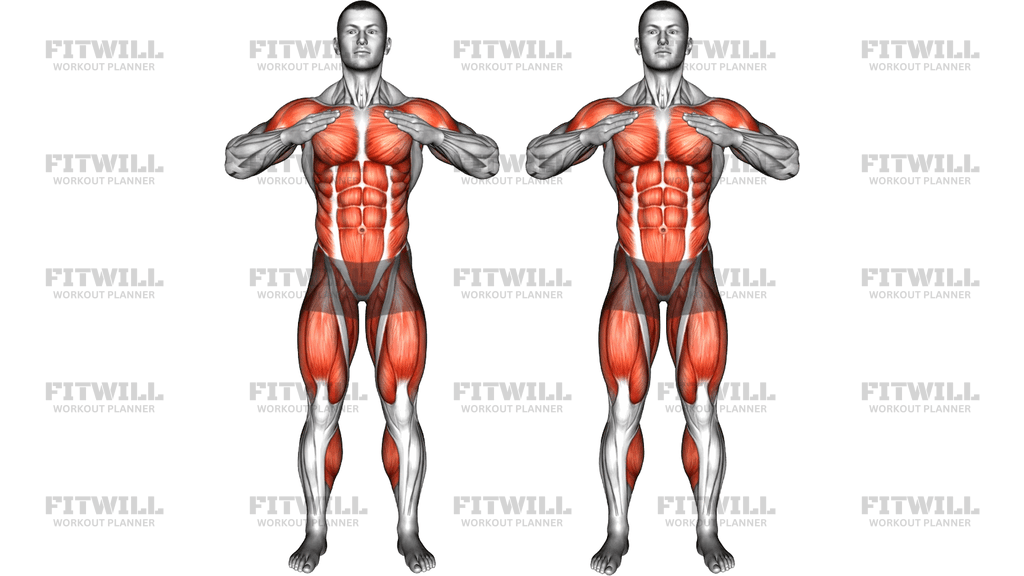
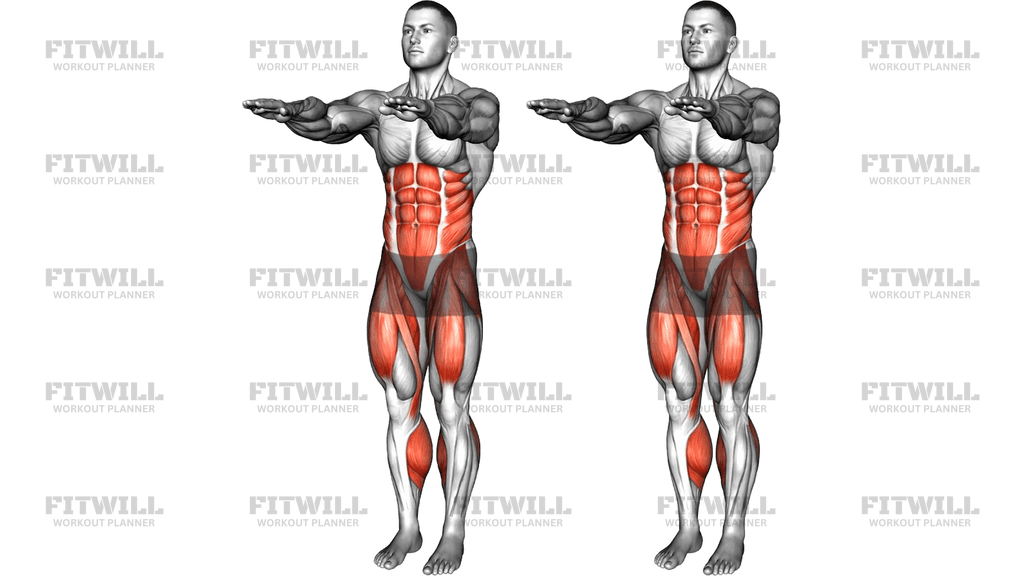
The Side To Side Rotational Arm Extension is a standing bodyweight movement that combines trunk rotation with a sweeping arm action. You set up in a wide stance with both arms raised to your sides and elbows bent, then rotate your torso from one side to the other, extending the arms as you turn and folding them back in as you come through the middle. It looks simple, but the combination of rotation and arm movement makes the sides of your waist work through a long, controlled range.
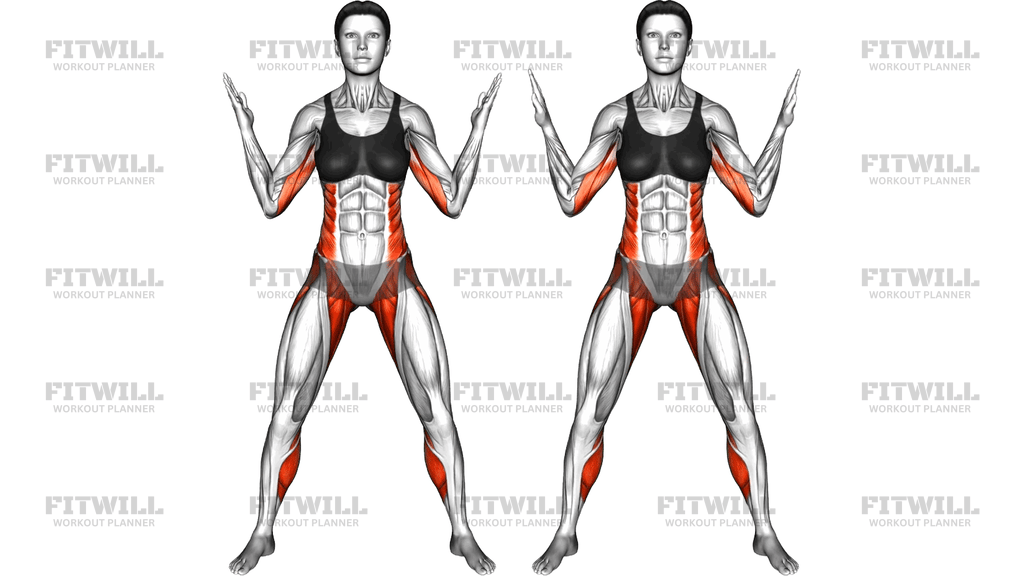
The main work comes from the obliques on both sides of your abdomen, which drive the twist and control the return through center. Holding the arms up and out at roughly ninety degrees also keeps the shoulders and upper arms under steady tension, so they fatigue alongside your core. Because you rotate over a wide, stable base, the inner thighs and calves stay active the whole time to keep you balanced as your weight shifts from one hip to the other.
Setup matters more than most people expect. A stance clearly wider than your shoulders gives your hips room to pivot, and slightly bent knees protect them from twisting awkwardly. If your feet are too narrow, the rotation gets dumped into the knees and lower back instead of traveling through the ribcage and hips, which is where it belongs.
To execute it well, think of the turn starting at your chest and ribs, not your hands. The arms follow the rotation and reach out as you turn, then draw back in as you return toward center. Keep the movement smooth rather than snappy, and let your head travel with your chest so your neck is not cranked around to compensate.
This exercise fits nicely into core circuits, dynamic warm-ups, and low-impact conditioning sessions. It needs no equipment and very little space, which makes it a practical choice for home training, hotel room workouts, or as a mid-session mover between heavier lifts.
As for safety, the main rule is to stay in control on both the turn and the return. If you feel the movement only in your lower back, your stance is probably too narrow or you are rotating too fast. Slow the tempo down, keep the knees soft, and let the waist do the steering.
Fitwill
Log Workouts, Track Progress & Build Strength.
Achieve more with Fitwill: explore over 9600 exercises with images and videos, access built-in and custom workouts, perfect for both gym and home sessions, and see real results.
Start your journey. Download today!




Instructions
- Stand with your feet roughly one and a half times shoulder width apart, toes turned out slightly, and distribute your weight evenly across both feet.
- Bend your knees a little, keep your torso tall, and brace your abdominal muscles before you start moving.
- Raise both arms out to your sides until your upper arms are roughly level with your shoulders, then bend your elbows to about ninety degrees with your palms facing up and open.
- Exhale and rotate your whole torso to the right, pivoting through the hips and allowing the left heel to turn naturally as your weight shifts.
- As you reach the end of the turn, extend both arms out and slightly up in the direction you are facing, keeping the elbows soft rather than locked.
- Inhale and rotate back through center in a controlled way, bending the elbows back toward the ninety-degree position as you come around.
- Repeat the rotation to the left with the same arm extension, and continue alternating sides for the desired number of repetitions.
- Keep your head moving with your chest so your eyes track the direction of the turn instead of staying fixed forward.
- When you finish the set, bring your feet back to hip width and lower your arms slowly rather than dropping them mid-turn.
Tips & Tricks
- If your knees cave inward as you rotate, your stance is too narrow or your knees are straight; widen your feet and keep a constant soft bend so the hips can pivot freely.
- A common mistake is whipping the arms to generate the turn. Drive the rotation from your ribcage and let the arms ride along, or your shoulders will do the work your obliques should be doing.
- Do not let your elbows drop toward your ribs as the set gets hard. If the arms sag, the shoulder tension that makes this exercise effective disappears, so shorten the set instead.
- Keep some pressure on the ball of the foot and heel of the leg you are rotating away from; lifting a heel too early shifts stress into the knee.
- Turn your head with your chest rather than twisting your neck ahead of your torso, which is a frequent cause of neck soreness in rotational standing drills.
- Control the return through center just as much as the turn. Letting gravity swing you back and forth turns a core exercise into an uncontrolled momentum drill.
- If you feel the work only in your lower back, slow the tempo down and shorten your rotation range until you can feel the sides of your waist doing the steering.
- Exhale on every rotation and reset your brace at center; holding your breath through several reps is a sign the pace is too fast.
Frequently Asked Questions
Which muscles does the Side To Side Rotational Arm Extension work?
The obliques on the sides of your abdomen are the primary movers, with the abdominal wall supporting the rotation. Your shoulders and upper arms work isometrically to hold the arms up, while the inner thighs and calves stabilize the wide stance.
Why is the stance so wide in this exercise?
The wide base gives your hips room to rotate and keeps you balanced as your weight shifts from side to side. A narrow stance forces the twist into the knees and lower back instead of the waist.
Should my arms fully straighten during the extension?
Extend the arms out in the direction of the turn but keep a slight bend in the elbows. Fully locking them out adds unnecessary strain to the elbow joint without improving the core demand.
Is the Side To Side Rotational Arm Extension suitable for beginners?
Yes, it is a low-impact bodyweight movement that beginners can learn quickly. Start with a smaller rotation range and a slower tempo, then widen the turn as your control improves.
How is this different from a plain standing torso twist?
In a plain twist the arms stay passive, while here you extend the arms out with each rotation and bend them back at center. That added arm action keeps the shoulders and upper arms under tension and raises the overall effort.
Where should I feel this exercise the most?
You should feel a working sensation along the sides of your waist, alternating from one side to the other as you rotate. Mild engagement in the shoulders and a balancing effort in the hips and calves are also normal.
Do I need any equipment for this movement?
No, it is performed entirely with body weight and only needs enough floor space to stand in a wide stance. That makes it easy to use in home workouts, warm-ups, and circuit training.
What is the most common mistake in this exercise?
Swinging the arms to force the turn and rotating faster than you can control. Both shift the load away from the obliques and toward the lower back and shoulders, so keep the pace deliberate.
Is this exercise safe for people with lower back sensitivity?
The movement is generally gentle when done slowly with a braced core and soft knees, but anyone with a history of back issues should keep the rotation range modest and stop if discomfort appears.
How fast should I perform the rotations?
Aim for a tempo of about one to two seconds out to each side and a controlled return through center. Slower reps make the obliques work harder than fast, swinging reps ever will.