Standing Swim And Jog
Standing Swim And Jog is a bodyweight cardio move that pairs a continuous light jog in place with wide, sweeping arm strokes that mimic a swimming motion. You start with your elbows bent and fists up near your chest, then open your arms out wide to the sides until they extend at shoulder height, drawing them back in as you keep jogging. The result is a full-body rhythm: your legs handle the footwork while your shoulders and arms drive the swim-like sweeps.
This movement works well as a warm-up, a low-skill cardio interval, or an active recovery drill between heavier sets. Because it requires no equipment and very little space, it fits easily into home workouts, hotel room sessions, or circuit training where you need to keep your heart rate up without jumping or loading your joints. It is also a friendly option for beginners since the coordination demand is modest and the pace is fully under your control.
The work is spread across the whole body. Your shoulders do most of the visible effort as they lift and sweep the arms, your biceps and forearms assist on the pull-back, and your core stays engaged to keep your torso upright while your arms move. Meanwhile, your quads, hip flexors, and calves handle the steady in-place jog, and your hip stabilizers keep you balanced as your weight shifts from foot to foot.
Setup matters more than it looks. Standing tall with a soft knee bend and a braced core lets you move your arms freely without your lower back arching or your shoulders creeping up toward your ears. The arm path should stay roughly at shoulder height and out to the sides, not swinging forward across your body, so the shoulders rather than momentum do the steering.
To execute it well, settle into a relaxed jogging rhythm first, then layer in the arm sweeps so the two actions feel like one continuous stroke. Keep your fists loose, your neck relaxed, and your breathing steady. If your shoulders fatigue before your legs, slow the arm tempo rather than dropping your hands.
The most common form issue is shrugging as the arms lift, which turns a shoulder-driven move into a tense, neck-heavy one. The second is jogging heavily and turning it into a bouncing drill; keep the jog light and quiet. Progress by extending your work intervals, raising your knee lift, or speeding up the arm sweeps once the base pattern feels smooth.
Fitwill
Log Workouts, Track Progress & Build Strength.
Achieve more with Fitwill: explore over 9600 exercises with images and videos, access built-in and custom workouts, perfect for both gym and home sessions, and see real results.
Start your journey. Download today!




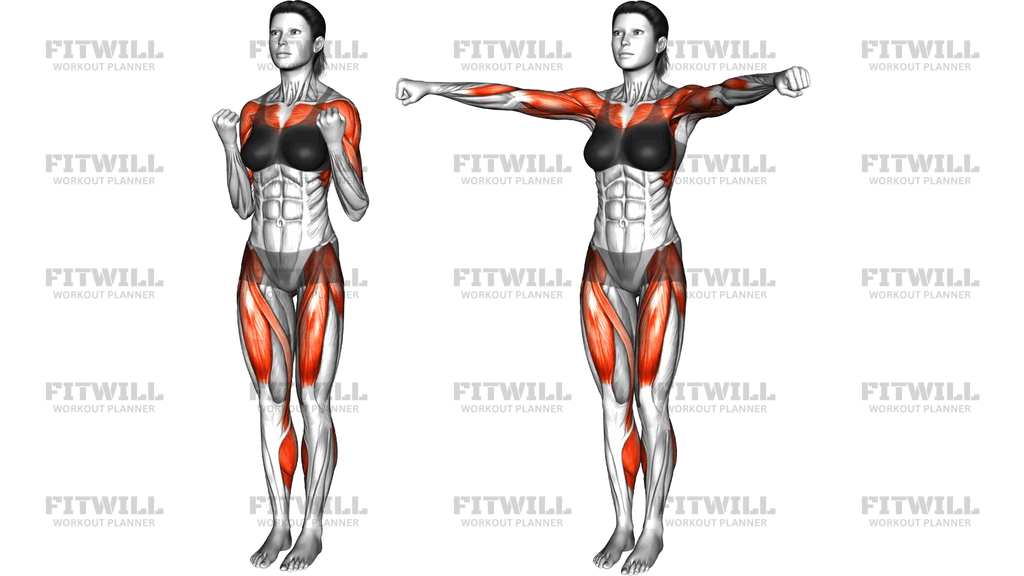
Instructions
- Stand with your feet hip-width apart, weight evenly distributed, and knees slightly bent.
- Bend your elbows and raise your fists to chest height, keeping your hands loose and shoulders down away from your ears.
- Brace your core gently and lift your chest so your torso stays tall throughout the set.
- Begin a light jog in place, lifting your feet just a few inches off the floor and landing softly on the balls of your feet.
- Once the jog feels steady, sweep both arms out wide to the sides and up until they extend at about shoulder height, like the opening of a swim stroke.
- Pull your arms back in by bending your elbows and drawing your fists toward your chest, completing the stroke as your legs keep jogging.
- Exhale as the arms open wide, inhale as they return, and keep the breath rhythmic rather than holding it.
- Continue alternating the sweep and pull with the jog for your target time or repetitions.
- To finish, slow the jog to a march, let the arms lower gradually, and shake out your shoulders before your next exercise.
Tips & Tricks
- If your shoulders ride up as your arms open, consciously press your shoulder blades down before each sweep; shrugged shoulders are the number one reason this move feels tense instead of smooth.
- Keep the arm sweep wide and lateral. If your hands drift forward and cross in front of your chest, you shift work away from the shoulders and lose the swim-stroke pattern.
- Land quietly. Heavy stomping during the jog usually means your knees are locked; a soft knee bend absorbs each landing and protects your joints.
- Match the arm tempo to your leg tempo rather than racing one against the other. When the two fall out of sync, the movement turns choppy and your breathing suffers.
- Keep your fists unclenched. Squeezing your hands tight creates tension that travels up your forearms and into your neck over a long interval.
- If balancing while jogging feels awkward, widen your stance slightly and reduce your knee lift until the foot pattern feels automatic.
- For a lower-impact version, replace the jog with a march and keep the identical arm stroke; the shoulder and core work stays the same.
- When your shoulders tire mid-interval, slow the sweeps instead of dropping your arms to your sides, which keeps the intended range under load.
- Look straight ahead rather than down at your feet; a dropped chin rounds your upper back and shortens the arm path.
Frequently Asked Questions
Which muscles does Standing Swim And Jog work the most?
The shoulders carry the main load during the arm sweeps, supported by the biceps and forearms on the pull-in. Your quads, hip flexors, and calves drive the in-place jog, and your abs work to keep your torso stable.
Is Standing Swim And Jog suitable for complete beginners?
Yes. The pattern is simple and self-paced, so beginners can march in place with slower arm sweeps and build up. It is one of the easiest full-body cardio moves to learn because there is no equipment and no jumping.
How high should my arms go during the sweep?
Aim to open your arms out to the sides until they reach roughly shoulder height, as in the extended phase of the stroke. Going much higher tends to make you shrug, while stopping too low reduces the shoulder work.
Why do my neck and shoulders feel tense during Standing Swim And Jog?
That usually comes from shrugging as the arms lift or clenching your fists too hard. Keep your shoulder blades drawn down and your hands relaxed, and the tension should settle within a few sessions.
Can I do this exercise if jumping is uncomfortable for me?
Yes. Swap the jog for a brisk march while keeping the same wide arm stroke. You keep the shoulder and core work while removing the impact on your knees and ankles.
How long should I perform Standing Swim And Jog per set?
Start with 20 to 40 seconds and build toward 60 seconds or more as your conditioning improves. It also works well timed as a station in a larger circuit.
What is the most common mistake with the arm movement?
Sweeping the arms forward across the chest instead of out wide to the sides. The stroke should open laterally at shoulder height, which keeps the emphasis on the shoulders and preserves the swim-like pattern.
What can I substitute if I want a similar effect?
Standing arm circles while marching, jumping jacks, or shadow boxing all train similar shoulder and leg coordination. Standing Swim And Jog is the better pick when you want a wide lateral arm path with minimal impact.
Should I breathe in a specific rhythm during this exercise?
Aim to exhale as your arms open wide and inhale as they return to your chest. Rhythmic breathing keeps the jog steady and prevents the breath-holding that creeps in when the arms get demanding.