Arm Swing Forward Heel Tap
Arm Swing Forward Heel Tap is a standing, low-impact movement where you alternate tapping one heel forward while swinging both arms down and across the front of your body. There is no equipment involved, no jumping, and no floor work, which makes it an easy drill to slot into a warm-up, an active recovery day, or a low-impact cardio circuit. The rhythm of the arms and legs working together is what separates it from a simple heel tap or a plain arm swing done on their own.
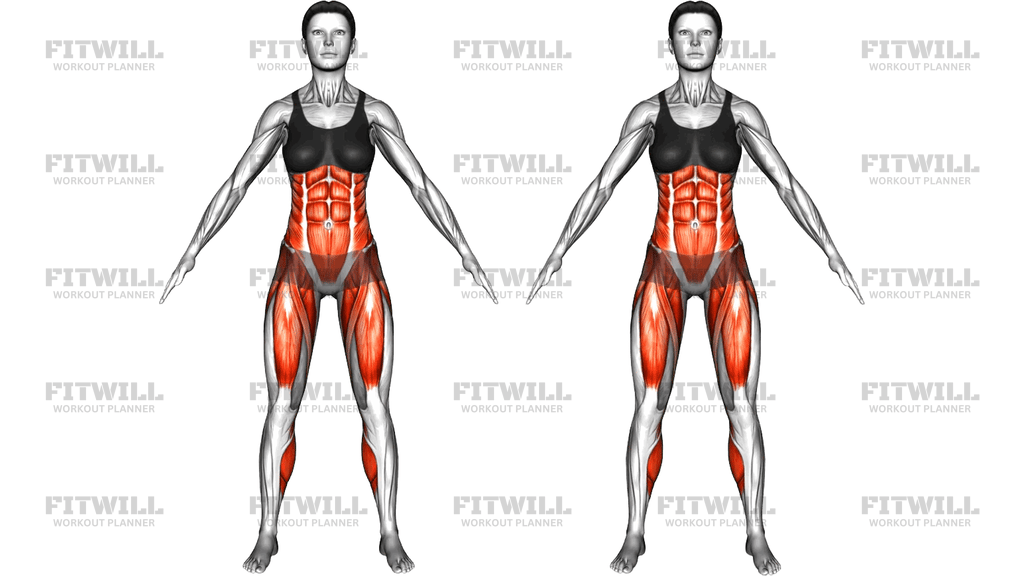
The highlighted work in this movement centers on the abdominal wall and the muscles across the front of the hips and thighs. Every time you lift one foot to tap the heel forward, your hip flexors bring the leg up while your abs brace to keep your torso upright and centered. The arms swinging forward act as a counterbalance, so your core has to keep working to stop your trunk from twisting or leaning as the weight shifts from foot to foot. Your calves and the stabilizers around the standing ankle handle the constant small weight transfers.
This drill suits a wide range of people. Beginners use it to build coordination and comfort with rhythmic movement before progressing to higher-impact cardio. Older adults and anyone returning from time off appreciate that one foot always stays in contact with the floor. More advanced trainees use it as a low-strain way to raise the heart rate between strength sets or as part of a joint-friendly warm-up that wakes up the hips, core, and ankles before squats, lunges, or running.
Setup matters more than it looks. Stand tall with feet about hip-width apart, arms relaxed at your sides, and your weight balanced over the middle of both feet. Keep your ribs stacked over your pelvis rather than arching your lower back, because a braced trunk is what turns this from a casual leg lift into real core work. Your gaze stays forward and your shoulders stay down away from your ears throughout.
To perform it well, lift one leg and reach the heel a few inches forward so the heel touches the floor lightly in front of you while both arms swing forward and down toward that side. Return the foot to center, let the arms swing back out to your sides, and repeat with the other heel. The tap should be light and controlled, not a stomp. Aim for a steady, even tempo where each side gets the same amount of time and the same reach.
The most common form issue is rushing. When the tempo runs ahead of your control, the torso starts to lean back, the low back arches, and the heel tap turns into a toe flick. Slow down, shorten the reach, and let the arms lead the rhythm. Breathe steadily throughout, exhaling as the arms swing forward, and stop the set when your posture slips rather than when you are completely exhausted.
[ Workout Log & Planner ]
Put your next workout in Fitwill
Keep your plan and training log ready when you are.


Instructions
- Stand with your feet hip-width apart, arms hanging relaxed at your sides, and your weight balanced evenly over both feet.
- Draw your shoulder blades gently down and back, stack your ribs over your pelvis, and brace your abs lightly as if preparing for a light nudge to the stomach.
- Shift your weight onto your right leg and lift your left foot, keeping the knee soft rather than locked.
- Reach your left heel a few inches forward and tap it lightly on the floor in front of you, toes pointing up.
- As the heel taps down, swing both arms forward and down toward the front of your body so the hands pass near hip height.
- Let the arms swing back out to your sides as you return the left foot to the floor under your hips.
- Repeat the same tap-and-swing pattern with the right heel, alternating sides for the desired number of reps or time.
- Exhale as the arms swing forward and inhale as they return to your sides, keeping the breathing rhythm tied to the movement.
- Keep your torso upright the whole time; if you feel yourself leaning back or arching your lower back, shorten the heel reach.
- Finish the set by standing on both feet, letting your arms settle, and taking a few slow breaths before starting the next round.
Tips & Tricks
- Keep the tap light. If you hear a heavy slap each rep, you are dropping the leg instead of lowering it under control.
- If your lower back arches when the leg lifts, squeeze your glutes slightly on the standing-leg side to hold your pelvis level.
- Let the arms set the tempo. Counting arm swings rather than heel taps keeps both sides of the body moving at the same speed.
- A common mistake is flicking the toes instead of tapping the heel. Point the toes up deliberately so the heel, not the forefoot, meets the floor.
- Keep the reach modest at first. A heel tap a few inches in front of you trains the same muscles as a long reach with far less balance demand.
- If you wobble on the standing leg, widen your base slightly or hold onto a sturdy chair with one hand until your ankle control improves.
- Avoid shrugging as the arms swing. Think of sweeping the arms from the shoulders with the elbows slightly soft, not lifting from the traps.
- Progress by increasing tempo or duration rather than reach; a longer step forward turns this into a different, more balance-heavy drill.
- If one side feels tighter or less coordinated, do one extra tap on that side each round rather than skipping the harder side.
Frequently Asked Questions
What muscles does the Arm Swing Forward Heel Tap work?
The main work comes from the abs, which brace and stabilize your trunk, along with the hip flexors that lift the leg and the quads that control the forward tap. The calves and standing-leg stabilizers handle the constant weight shifts.
Is the Arm Swing Forward Heel Tap good for beginners?
Yes, it is one of the friendliest starting points for rhythmic movement because one foot always stays on the floor and there is no equipment. Beginners should start with a short heel reach and a slow tempo before speeding up.
Why do the arms swing forward instead of staying at my sides?
The forward arm swing adds a counterbalance that makes your core work harder to keep the torso centered, and it ties the upper and lower body into one coordinated rhythm. It also raises the heart rate a bit more than a heel tap alone.
How far forward should I reach my heel?
A few inches in front of your standing foot is enough when you are learning. Reach further only when you can tap without leaning your torso back or arching your lower back.
Should my heel actually touch the floor, or hover?
Touch the floor lightly with each tap, as the name describes. The contact point gives you a consistent target and makes the rep easy to count, but the touch should be controlled, not a stomp.
Can I use this as a warm-up before strength training?
Yes, it works well as a low-impact warm-up because it raises the heart rate while taking the hips, core, and ankles through a controlled range. Two to three rounds of 30 to 45 seconds is plenty before squats, lunges, or running.
What is a good substitute if balance is an issue?
Stand next to a wall or hold the back of a sturdy chair with one hand and continue the same heel tap and arm swing pattern. You can also march in place with the same arm swing until single-leg balance feels secure.
How many reps or how long should I do the Arm Swing Forward Heel Tap?
For a warm-up, 30 to 60 seconds of steady alternating taps works well. In a low-impact cardio circuit, aim for 45 to 90 seconds per round and adjust the tempo rather than the reach as you tire.
Why do I keep tapping with my toes instead of my heel?
This usually happens when the knee lifts too high or the tempo is too fast, so the forefoot reaches the floor first. Lift the leg slightly lower, point the toes up on purpose, and slow the rhythm until the heel leads every tap.