Figure 8 March
The Figure 8 March is a standing, equipment-free movement that combines an alternating high-knee march with both arms tracing a continuous figure 8 in front of your chest. Your arms stay extended forward at chest height, palms facing down and hands nearly touching at the midline, while your legs drive the rhythm underneath. Because the upper and lower body are working on different patterns at the same time, the exercise doubles as a coordination drill, not just a warm-up.
This movement is useful for almost anyone. It raises your heart rate gently, loosens the shoulders and hips, and wakes up the deep trunk muscles that stabilize you every time one leg lifts. Coaches commonly use it as a dynamic warm-up before running, strength training, or martial arts, and it works equally well as a low-impact cardio burst at home when you have no equipment and little space.
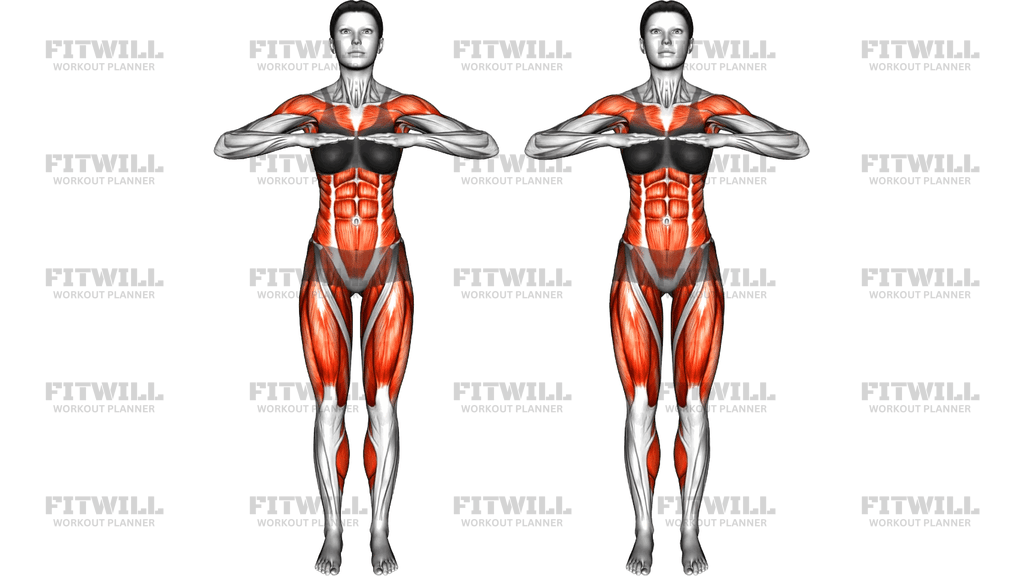
The main work comes from your core. As each knee lifts, your abdominals and obliques have to brace to keep your torso upright while your hip flexors drive the knee up. The extended arms challenge your shoulders and upper back to hold position while they move through the figure 8 path, which builds shoulder endurance and cross-body coordination. Because you are always balanced on one leg briefly with each step, the stabilizers around your ankles and hips get quiet but constant work.
Setup matters more than it looks. Stand tall with feet hip-width apart, ribs stacked over your pelvis, and arms extended forward so your hands can cross paths at the midline without your shoulders shrugging up to your ears. If your arms sit too low or too wide, the figure 8 collapses into random circling and you lose the cross-body pattern that makes the drill valuable.
Execution is about rhythm and control, not speed. Trace the figure 8 smoothly, keep your knees driving to roughly hip height, and let your torso stay quiet even though your limbs are moving. A common mistake is rocking the upper body side to side to help the arms; resist that, because the whole point is that your trunk stays stable while your limbs move independently.
Practically, the Figure 8 March fits anywhere from a two-minute warm-up block to a longer interval circuit. Start with 20 to 30 seconds of continuous marching, rest, and repeat. If balance is a challenge, slow the tempo down before you reduce the knee height, and always keep the movement within a range where you can breathe steadily and stay in control.
Fitwill
Log Workouts, Track Progress & Build Strength.
Achieve more with Fitwill: explore over 9600 exercises with images and videos, access built-in and custom workouts, perfect for both gym and home sessions, and see real results.
Start your journey. Download today!




Instructions
- Stand tall with your feet hip-width apart, arms extended straight forward at chest height, palms facing down, and fingertips of each hand nearly touching at the midline.
- Soften your knees slightly and brace your abs as if preparing for a light poke to the stomach, keeping your ribs stacked over your pelvis.
- Begin the figure 8 with both arms together: sweep them to one side, across your body at chest height, out to the other side, and back through the middle so your hands continuously trace a sideways 8 in front of your chest.
- Once the arm pattern feels smooth, start marching in place, lifting each knee to about hip height in time with your arm sweeps.
- Keep your torso upright and facing forward; do not let your chest or hips rotate as the arms cross the midline.
- Breathe steadily throughout, inhaling through the nose and exhaling through the mouth rather than holding your breath as the pace builds.
- Continue for your target time, typically 20 to 60 seconds, keeping the figure 8 path consistent rather than letting the arms drift into loose circles.
- To finish, plant both feet flat, let your arms lower to your sides slowly, and reset your posture before the next round.
Tips & Tricks
- If your arms drift into wide, sloppy loops, exaggerate the crossing point: lightly brush your fingertips past each other at the midline each sweep so the 8 stays crisp.
- A shrugging, tense neck usually means the arms are too high or the shoulders are doing the work; drop the hands slightly and deliberately relax your traps between reps.
- Watch for upper-body sway. If your torso rocks side to side with each knee lift, slow the march and imagine your pelvis is a bowl of water you are keeping level.
- Keep the knee lift at hip height or just below; punching the knee higher than you can control tends to pull your low back into an arch.
- Land softly on the ball of each foot with each march step instead of slapping down flat-footed, which keeps the rhythm light and spares your knees.
- Match your march tempo to your arm speed rather than the other way around; the figure 8 sets the timing, and the legs follow.
- If your shoulders fatigue before your legs, that is normal early on; lower the arms a few inches rather than bending your elbows to rest them.
- In a small space, march in place rather than traveling forward so the figure 8 path stays directly in front of your chest.
Frequently Asked Questions
What muscles does the Figure 8 March work?
Your abs and obliques do most of the stabilizing work, while your hip flexors lift each knee and your shoulders and upper back hold and move the extended arms. Ankles and hips also work to keep you balanced with each step.
Is the Figure 8 March good for beginners?
Yes, it is low impact and requires no equipment. Beginners can march with lower knees and a slower figure 8 until the coordination feels natural.
How high should I lift my knees during the Figure 8 March?
Aim for roughly hip height, which is high enough to engage your hip flexors and core but low enough that you never arch your lower back or lose your balance.
Should my arms trace the figure 8 horizontally or vertically?
The standard version sweeps the arms in a horizontal 8 at chest height, crossing at the midline in front of your sternum, with palms facing down and elbows nearly straight.
Why do I keep losing the figure 8 shape when I start marching?
This usually happens because the legs and arms compete for your attention. Lock in the arm pattern first at a slow tempo, then add the march, and let the arms set the rhythm instead of chasing your knees.
Can I use the Figure 8 March as a warm-up?
Absolutely. It raises your heart rate, mobilizes the shoulders and hips, and primes your core, which makes it a solid warm-up before running, lifting, or sport sessions.
What can I substitute if standing balance is difficult?
Hold onto a wall or sturdy chair with one hand, reduce the knee height, or march without lifting the feet fully by simply alternating heel raises while keeping the arm pattern.
How long should I perform the Figure 8 March per set?
Twenty to sixty seconds of continuous marching works well for most people; use longer intervals if you are conditioning and shorter ones if you are using it purely as a warm-up drill.
Is it a problem if my shoulders get tired before my legs?
Shoulder fatigue is common because your arms are held away from your body the whole time. Lower your hands a few inches or shorten the set rather than bending your elbows, which changes the figure 8 path.