Sitting Side Bend On A Chair
The Sitting Side Bend On A Chair is a simple bodyweight movement that targets the muscles along the sides of your waist, mainly the obliques, while you stay seated. You sit upright on a chair with your hands lightly placed behind your head, keep your hips and legs completely still, and bend your torso sideways to one side before returning to center and repeating on the other side. Because the chair removes the balance and leg-strength demands of standing side bends, all of your attention can go into the side-bending motion itself.
This exercise is especially useful for people who spend long hours seated, beginners building their first awareness of the lateral core, older adults who want a safe way to train the waist, and anyone recovering general mobility after a layoff. It also works well as a warm-up or between-set movement in a larger core routine, since it requires no equipment beyond an ordinary sturdy chair.
The muscles doing the work are the external and internal obliques on the side you are bending away from and the side you are bending toward, with support from the deep abdominal wall and the quadratus lumborum in the lower back. When you keep your hips glued to the seat, your torso has to do the moving, which is exactly what makes the exercise effective. If your hips lift, tilt, or rotate, the workload leaks into the legs and lower back instead.
Setup matters more than it looks. Sit toward the front half of the seat with both sit bones evenly weighted, feet flat on the floor about hip-width apart, and your spine tall. Place your fingertips lightly behind your head or ears rather than pulling on your neck, and brace your core gently as if someone were about to poke your stomach. From there, the movement is a clean sideways arc: your chest and head travel out to one side, your shoulders stay square to the front, and you come back to a tall neutral position before switching sides.
One of the biggest advantages of the Sitting Side Bend On A Chair is how easy it is to fit into real life. Office workers can do a set at their desk, travelers can do it in a hotel room, and it can serve as a low-impact introduction before progressing to standing side bends, dumbbell side bends, or cable woodchops. Treat it as a controlled, deliberate movement rather than a big swinging motion, and it will do its job well.
A note on safety: move within a range that feels like a stretch-and-squeeze along your waist, never into sharp pain. Avoid jerking, twisting forward, or collapsing your chest down toward your lap. If you have a history of lower back problems, start with smaller ranges of motion and focus on slow, even tempo.
[ Workout Log & Planner ]
Put your next workout in Fitwill
Keep your plan and training log ready when you are.


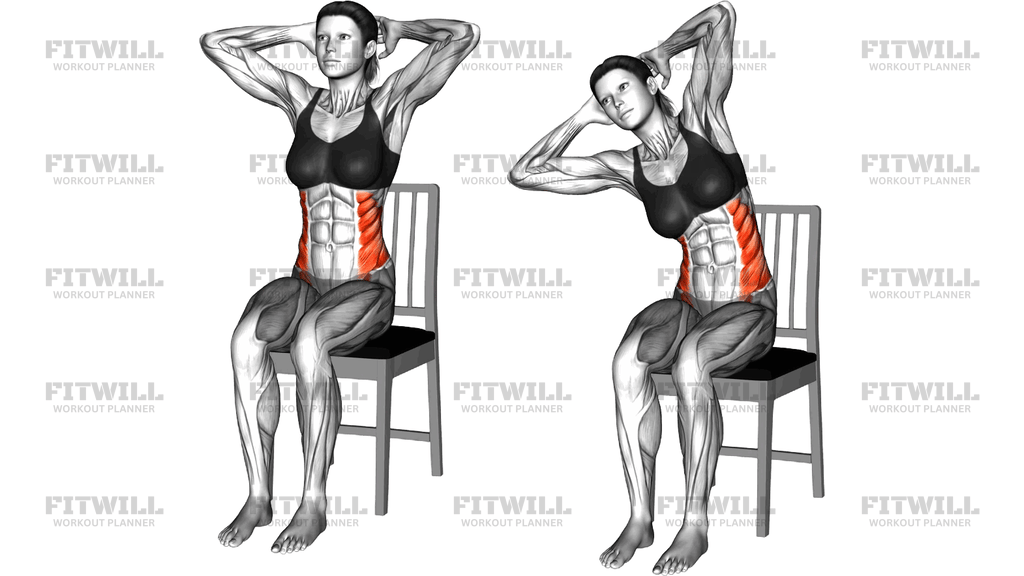
Instructions
- Sit on a sturdy chair with your feet flat on the floor, hip-width apart, and your sit bones evenly placed on the front half of the seat.
- Sit up tall with your spine straight and your shoulders relaxed down away from your ears.
- Place your fingertips lightly behind your head or ears with elbows flared out to the sides, and avoid pulling on your neck.
- Brace your abdominal muscles gently and keep both hips pressing evenly into the seat throughout the movement.
- Bend your torso sideways to the right in a smooth arc, letting your right elbow drop toward your right hip while your left elbow points up and over.
- Stop at the point where you feel a clear squeeze along the left side of your waist and a stretch along the right, keeping your shoulders square to the front.
- Squeeze the obliques to pull your torso back up to a tall, centered position without twisting or leaning forward.
- Repeat the bend to the left side with the same control, and continue alternating sides for your target number of repetitions.
- Exhale as you bend to the side and inhale as you return to center.
- When you finish the set, lower your hands to your lap, reset your posture, and check that your hips never lifted off the seat during the reps.
Tips & Tricks
- The most common mistake is twisting forward so your chest drops toward your lap instead of bending straight sideways. Fix it by imagining your shoulders sliding along a wall directly behind you.
- Do not let the opposite hip lift off the chair as you bend. If it does, you are going too far; shorten the range until both sit bones stay planted.
- Keep your hands resting behind your head rather than interlaced and gripping hard. Pulling on your neck shifts tension away from the waist and can strain the cervical area.
- Move slowly, about two seconds out and two seconds back. A fast swinging tempo lets momentum do the work and the obliques get almost nothing.
- Think of lengthening before bending: reach the top elbow up toward the ceiling first, then arc over. This keeps the bend in your waist instead of crumbling your ribcage down.
- If you feel the lower back working hard instead of the sides of your waist, reduce your brace slightly and bend less deeply. The quadratus lumborum tends to take over on deep bends.
- Keep your eyes forward and chin level. Looking down or around adds rotation and changes which muscles are loaded.
- Once the bodyweight version feels easy, you can hold a light object such as a small water bottle or book against your chest to add gentle resistance, but only after your form is consistent.
Frequently Asked Questions
Which muscles does the Sitting Side Bend On A Chair work?
The main movers are the external and internal obliques on the sides of your waist. The deep abdominal muscles and the quadratus lumborum in the lower back assist as your torso bends and returns.
Is the Sitting Side Bend On A Chair good for beginners?
Yes, it is one of the most beginner-friendly lateral core exercises because the chair handles balance and you control the range completely. Start with 8 to 10 bends per side at a slow tempo.
Why do my hips lift off the chair when I bend to the side?
That usually means you are bending too far or pushing off the floor with your feet. Keep both sit bones deliberately pressed into the seat and shorten the range until the hips stay quiet.
Should my hands be behind my head or crossed over my chest?
Both positions work, but behind the head with light fingertips gives you a clearer sense of the arc and keeps the elbows open. Just never pull on your neck with your hands.
Can I do the Sitting Side Bend On A Chair at my desk during the workday?
Absolutely, as long as your chair is stable and does not have wheels or armrests blocking the movement. A set of 10 to 15 reps per side is a good desk break for the waist.
How is this different from a standing side bend?
Sitting removes the balance demand and locks out any contribution from the legs and hips, so the obliques do all the work. The standing version recruits more stabilization and allows a slightly longer range.
How many reps and sets should I do?
Two to three sets of 10 to 15 controlled bends per side works well for most people. Since the resistance is only your torso, tempo and range matter far more than volume.
Will the Sitting Side Bend On A Chair reduce fat around my waist?
No exercise targets fat loss in a specific area. This movement strengthens and tones the oblique muscles, while overall fat reduction depends on diet and total activity levels.
Is it safe if I have lower back discomfort?
Use a smaller range of motion, keep the movement slow, and stop well before any sharp or radiating sensation. If symptoms persist, check with a qualified health professional before continuing.
What can I use if I do not have a suitable chair?
Any stable seated surface such as a bench or the edge of a sturdy ottoman works, as long as your feet can rest flat and nothing restricts your elbows swinging out to the sides.