Lying Around The World (Version 2)
Lying Around The World (Version 2) is a prone bodyweight movement where you sweep straight arms in a wide arc from overhead down to your hips and back again, keeping them lifted off the floor the whole way. Lying face down with your arms stretched past your head, you raise the arms, chest, and shoulders slightly off the ground, then trace a large semi-circle out to the sides and down toward your thighs before reversing the path back overhead. The continuous arc is what gives the exercise its name, and it challenges the shoulders through nearly their full range of horizontal travel instead of one fixed plane.
The main work comes from the rear shoulders, which control the arms as they travel through the wide arc, along with the mid and lower traps and rhomboids that pull the shoulder blades down and together as the arms sweep past your sides. Because you are face down, the erector spinae of the lower back hold the chest lifted against gravity for the entire set, and the lats and rotator cuff stabilizers help steer the arms on the curve. It is a small-load, high-control exercise rather than a heavy strength builder.
This version is especially useful for people whose shoulders feel stiff or achy from pressing and desk work, since it trains the often-neglected rear delts and scapular muscles in a long, sweeping pattern. Swimmers, throwers, and overhead athletes also use it as a low-impact way to build endurance through the exact arc their sport demands. Because the load is only your own arms, it suits beginners and warm-ups just as well as it serves as a finisher after heavier back or shoulder work.
Setup matters more than it looks. Lie on a mat with legs straight, forehead hovering just off the floor or resting lightly, and arms fully straight with palms facing down or thumbs turned slightly up. If your chest stays glued to the floor, the exercise turns into an arm-only sweep and you lose most of the back and shoulder benefit; if you crank the chest way up, your lower back takes over and the shoulder work gets sloppy. A modest lift, maybe a few centimeters, is all you need.
Execute the arc slowly: lift the arms, sweep them out wide in line with your shoulders, keep gliding until your hands approach your hips, pause briefly, then trace the same path back overhead without letting the hands touch down. Keep the arms locked straight the whole way, because any elbow bend shortens the arc and reduces the demand on the delts and upper back. Move with a steady two-to-three-second tempo each direction and breathe continuously rather than holding your breath.
The most common mistakes are rushing the sweep, letting the hands drag on the floor at the bottom, shrugging the shoulders toward the ears, and arching the neck to look forward. Keep the neck neutral, the shoulders relaxed away from the ears, and the arms hovering for the full set. If you feel pinching at the front of the shoulder or strain in the low back, reduce the height of the lift or shorten the arc slightly and rebuild from there.
[ Workout Log & Planner ]
Put your next workout in Fitwill
Keep your plan and training log ready when you are.


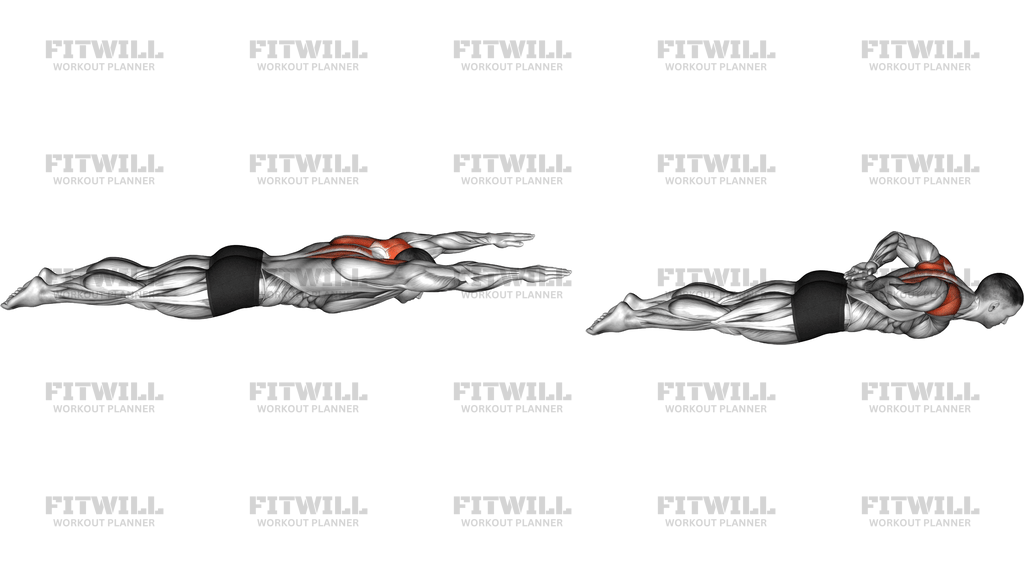
Instructions
- Lie face down on an exercise mat with your legs straight behind you, feet together, and your neck neutral with your forehead hovering just above the floor or resting lightly on the mat.
- Extend both arms straight overhead so your upper arms are alongside your ears, palms facing down, with a slight upward turn of the thumbs.
- Brace your abdominal muscles lightly and squeeze your glutes to protect your lower back before anything moves.
- Lift both straight arms and your upper chest a few centimeters off the floor, keeping the shoulders relaxed and away from your ears.
- Sweep your arms out wide to the sides in a large arc, keeping the elbows locked straight, until your hands are out in line with your shoulders.
- Continue the arc down toward your hips so your hands finish near your thighs, palms down, with the shoulder blades drawn together and down.
- Pause for a beat at your hips, then reverse the exact same path, gliding the arms back out wide and overhead without letting the hands touch the floor.
- Exhale steadily as the arms sweep down to the hips and inhale as they return overhead, keeping the breath continuous.
- Complete the desired repetitions with the arms hovering for the entire set, then lower the arms and chest fully to the mat to rest before the next set.
Tips & Tricks
- Keep your thumbs rotated slightly toward the ceiling as the arms sweep overhead; this positions the rear delts and lower traps better than palms-down-only and is easier on the shoulder joint.
- If your hands keep tapping the floor at the top of the arc, your arm lift is fading, not your arc — focus on the arms hovering an inch off the mat from start to finish.
- The chest only needs a small lift; heaving it high turns this into a lower-back exercise, so if you feel your erectors burning before your shoulders, reduce the torso height.
- Do not let the shoulder blades shrug toward the ears as the arms travel overhead — think of lengthening the arms away from the body instead of lifting the shoulders.
- Slow the sweep down to two or three seconds each direction; momentum from a fast swing hides the exact rear-shoulder weakness this exercise is meant to expose.
- If a full arc to the hips causes pinching at the front of the shoulder, shorten the range to shoulder-height on each side and widen it gradually over weeks.
- Squeeze the glutes throughout the set — it stabilizes the pelvis and stops the low back from arching excessively as the chest lifts.
- Reps in the 10 to 15 range with strict form build the scapular endurance this pattern is designed for; high-speed sets to failure usually just teach sloppy mechanics.
- Rest about 30 to 45 seconds between sets, since the small stabilizing muscles fatigue quickly and form degrades fast once they do.
Frequently Asked Questions
What muscles does Lying Around The World (Version 2) work?
The rear shoulders do most of the arm control through the arc, supported by the mid and lower traps, rhomboids, and lats. The lower back works isometrically to hold the chest lifted, and the core stabilizes the trunk.
Why are the arms swept all the way from overhead down to the hips instead of stopping at shoulder height?
The full arc trains the rear delts and scapular muscles through a long, continuous range rather than one small segment, which makes it valuable for swimmers and throwers. If the full range causes discomfort, a shortened arc is a reasonable starting point.
Is Lying Around The World (Version 2) suitable for beginners?
Yes, because the only load is the weight of your own arms, the exercise scales easily. Beginners should use a small chest lift, a slow tempo, and fewer reps until the hovering arms and straight elbows feel controlled.
How is this different from a prone Y raise or reverse snow angel?
A Y raise holds the arms in one overhead position, and a reverse snow angel usually allows elbow bend and floor contact. Lying Around The World (Version 2) keeps the elbows locked straight and the arms hovering through the entire continuous arc from overhead to the hips.
Why do my lower back muscles fatigue before my shoulders?
That usually means the chest is lifting too high or the glutes are not engaged, so the erector spinae are doing extra work. Keep the lift to a few centimeters, squeeze the glutes, and if it persists, shorten the set duration.
Can I substitute this if lying face down is uncomfortable?
Standing band pull-aparts or bent-over rear-delt raises train the rear shoulders in a similar way, though they lose the overhead-to-hip arc. Face-down exercises on a bench can also replace the floor position if lying prone bothers your ribs or low back.
Should my palms face down or up during the sweep?
A slight thumb-up rotation as the arms travel overhead is the friendliest position for most shoulders and biases the rear delts and lower traps. Fully palms-down sweeping tends to encourage internal rotation, which some shoulders do not tolerate well.
How many sets and reps should I do?
Two to three sets of 10 to 15 slow, controlled sweeps work well, either as a warm-up before pressing or pulling or as a finisher for the upper back. Rest 30 to 45 seconds between sets so the stabilizers recover enough to keep the arms hovering.
Is it safe if I have a history of shoulder impingement or low back issues?
Move within a pain-free arc, keep the chest lift small, and avoid sweeping through any position that produces pinching. If symptoms continue, check with a qualified professional before continuing.