Bodyweight Step Up Knee Raise On Stepbox
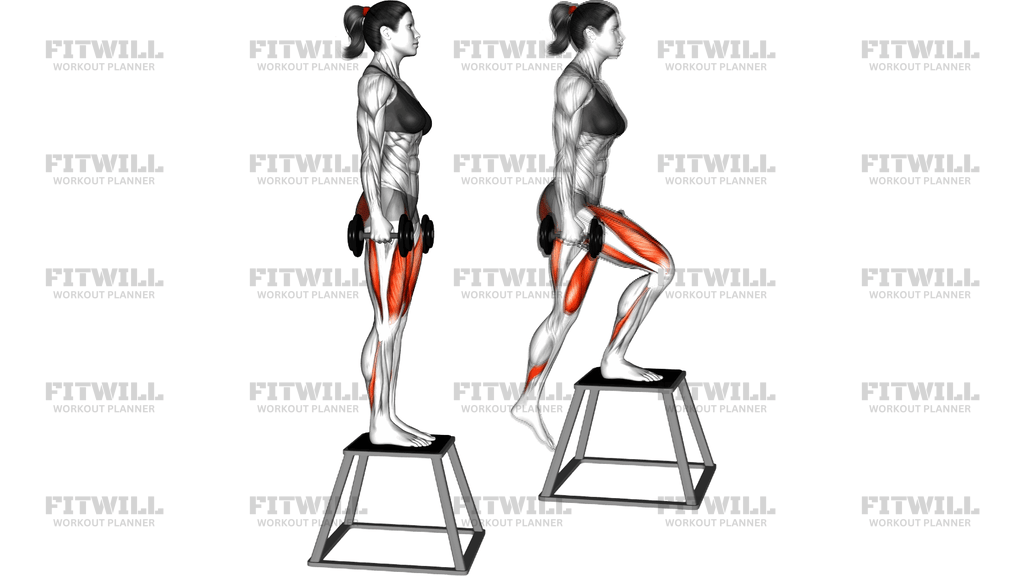
The Bodyweight Step Up Knee Raise On Stepbox is a single-leg strength exercise that combines two movements most people already know: the step-up and the standing knee raise. You place one foot on a step platform or stepbox, drive through that leg to stand fully upright on the box, and then lift your trailing knee up toward hip height before lowering it back down under control. Because you finish balanced on one leg at the top of every rep, the exercise demands far more stability and coordination than a standard step-up.
This movement is a great fit for people who want to build functional lower-body strength without loading a barbell or holding dumbbells. Runners, hikers, and field-sport athletes benefit from the single-leg drive and hip stability it develops, and it also translates directly to everyday actions like climbing stairs while carrying something. It is equally useful as a warm-up activation drill before heavier squat or lunge work, since it wakes up the glutes and hip flexors at a low intensity.
The main work comes from the quadriceps and glutes of the working leg, which push your entire body weight up onto the box. The knee raise at the top brings the hip flexors of the opposite leg into play, while your calves, gluteus medius, and deep core stabilizers fight to keep you from wobbling sideways as you balance on one foot. That combination of pushing, lifting, and balancing in one sequence is what makes this version more demanding than it looks.
Setup matters more here than in a basic step-up. The platform should be low enough that you can step up without pushing off the floor with your bottom leg or rolling onto the toes of the working foot. A box around knee height or slightly lower works for most people. Stand facing the box at a comfortable distance, keep your torso tall, and let your arms hang naturally or use them lightly for rhythm rather than support.
To execute it well, think of the working leg as the only engine. Place your whole foot squarely on the platform, shift your weight over that foot, and press through the heel and midfoot to stand tall on the box. At the top, pause for a beat with your hips fully open, then drive the free knee up until your thigh is roughly parallel to the floor. Lower the knee with control, then step the same foot back down to the floor rather than dropping or hopping off.
The most common errors are pushing off the back leg, rushing the knee raise, and letting the knee of the working leg collapse inward on the way up. Slow the tempo down, keep the entire foot on the platform, and complete all reps on one side before switching legs. If you find yourself losing balance on every rep, the box is probably too high or you are moving too fast to control the top position.
[ Workout Log & Planner ]
Put your next workout in Fitwill
Keep your plan and training log ready when you are.


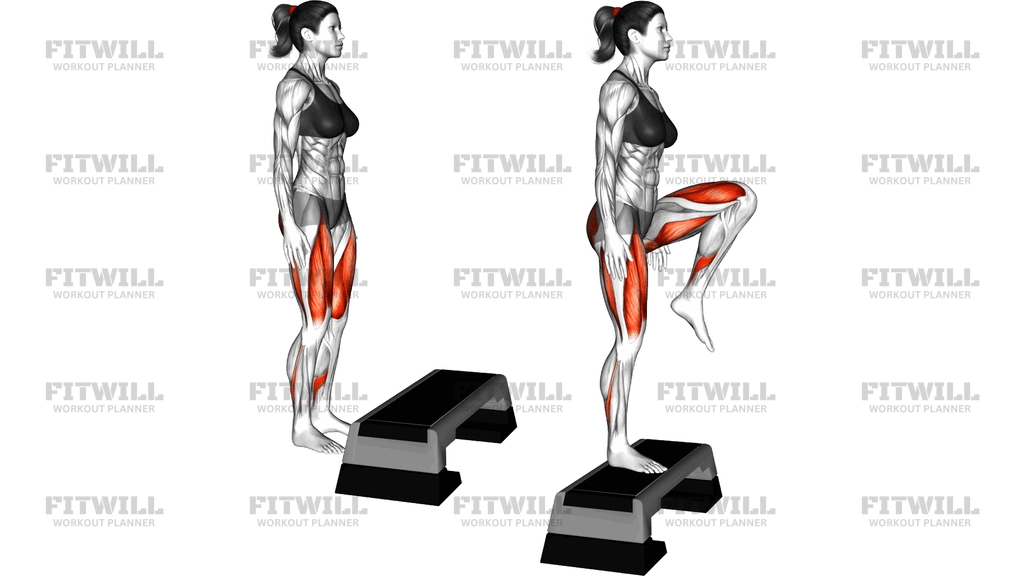
Instructions
- Place a step platform or stepbox on a level, non-slip surface and stand facing it about a foot away, with your feet hip-width apart.
- Set your right foot fully on top of the platform so your whole foot, heel included, is in contact with the surface.
- Stand tall and brace your abdominal muscles lightly, keeping your chest up and your gaze straight ahead.
- Shift your weight over the right foot and press through the heel and midfoot to straighten the right leg and rise up onto the box.
- Bring your left foot up and immediately drive the left knee forward and upward until your thigh is about parallel to the floor.
- Hold the top position briefly, standing fully upright on the right leg with hips open and torso vertical.
- Lower the left knee back down with control, then place the left foot on the floor and step back into the starting stance.
- Exhale as you drive up and raise the knee, and inhale as you lower the leg and step back down.
- Complete all repetitions on one leg, then switch to the left foot on the box and repeat on the other side.
Tips & Tricks
- If your bottom leg pushes off the floor to help you up, the box is too high; drop to a lower platform so the working leg does the entire lift.
- Keep the whole working foot planted on the box. Rising onto the toes usually means you are leaning forward or the platform is too tall.
- Pause at the top with the knee raised for one full second. This turns the move from a quick shuffle into a genuine balance and stability drill.
- Watch the knee of your working leg: it should track over your toes, not cave inward as you press up. Actively spread the floor with your foot if it tends to collapse.
- Do not swing the free leg to generate the knee raise. Lift it with the hip flexors under control, or you will use momentum and lose the core demand of the movement.
- Keep your torso vertical rather than bending forward over the box. A tall spine keeps the emphasis on the glutes and quads instead of straining the lower back.
- Place the box against a wall or in a corner until your balance improves, so you can touch it lightly if you wobble at the top.
- Start with the weaker or less coordinated leg first, and match the number of reps on the stronger side to keep both legs even.
- Move slowly enough that your foot lands quietly on both the box and the floor. Loud, heavy landings are a sign you are dropping rather than controlling the descent.
Frequently Asked Questions
What muscles does the Bodyweight Step Up Knee Raise On Stepbox work?
The quadriceps and glutes of the working leg do most of the pushing, while the knee raise at the top targets the hip flexors of the opposite leg. Your calves, gluteus medius, and core stabilizers also work hard to keep you balanced on one foot.
How high should the stepbox be for this exercise?
A platform around knee height or slightly lower suits most people. You should be able to step up with your entire foot on the box and without pushing off the floor with the trailing leg.
Is the Bodyweight Step Up Knee Raise On Stepbox suitable for beginners?
Yes, as long as you start with a low platform and move slowly. Beginners often need a few sessions to feel steady at the top position, so practicing near a wall for light support is a reasonable way to learn it.
Why do I lose my balance when I raise the knee at the top?
Balancing on one leg while the other knee lifts is the hardest part of the movement. Slow the tempo, keep your torso tall, squeeze the glute of the standing leg, and make sure your whole foot stays planted on the box rather than perched on the toes.
How is this different from a regular step-up?
The knee raise adds a hip flexor lift and a one-leg balance hold at the top of every rep. That makes it more demanding on your hip stabilizers and core than a standard step-up, where both feet return to a stable stance.
Can I substitute this if I don't have a step platform?
Any sturdy, stable surface at the right height works, such as a low bench, a stable stair, or a solid aerobic step. Avoid anything that can slide or tip, and never use a chair with wheels.
Should I do all reps on one leg or alternate legs?
Finish all repetitions on one side before switching. This keeps the working leg fully engaged, makes it easier to count balanced volume, and avoids the rhythm changes that come with alternating mid-set.
How many reps and sets should I do?
For strength and stability, 8 to 12 controlled reps per leg for 2 to 3 sets is a solid starting point. If your balance fails before your legs do, reduce the reps and focus on slow, steady top positions.
Is it safe for my knees?
When performed with a moderate box height, a controlled tempo, and the knee tracking over the toes, this is generally a knee-friendly movement. Stop and lower the platform if you feel pinching or discomfort at the front of the knee during the step-up.