Kneeling Side Plank Raise
The Kneeling Side Plank Raise is a lateral core exercise performed from a side plank supported on your forearm or hand with your knees stacked on the floor. Instead of simply holding the position, you repeatedly lower your hips a few inches toward the floor and then drive them upward toward the ceiling, creating a controlled dipping and lifting motion through the side of your waist. This turning a static hold into a dynamic repetition is what makes the movement so effective for the obliques.
The main muscles working are the obliques on the side closest to the floor, with strong support from the deep core musculature, the glute medius on the top hip, and the shoulder stabilizers holding you up. The kneeling cut-down in difficulty compared with a full side plank raise means you can focus on quality of movement rather than just surviving the hold, which makes it a smart choice for beginners building toward the full version and for anyone whose lower back or shoulder doesn't tolerate long static side planks well.
Setup matters more than people expect. Because your contact points are only one forearm or hand and your stacked knees, a small change in knee position or elbow placement dramatically changes the load on your spine and shoulder. Place your elbow directly under your shoulder, stack your knees, and keep your body in one straight line from head to knees. From there, the raise itself should come from your waist, not from pushing with your top arm or swinging your hips forward.
To perform it well, brace your core as if bracing for a light poke to the side, lower your hips down with control until they hover just above the floor, then squeeze the side of your waist to lift them as high as your range allows. The top hand can rest on your hip to help you feel the movement. Pause briefly at the top of each rep, then lower again under control. Breathing should stay steady: exhale as you lift, inhale as you lower.
This exercise fits well into core circuits, warm-ups for lifts like squats and deadlifts where lateral trunk stability matters, and rehabilitation-style programs that progress from kneeling to full side plank variations. Because it is done one side at a time, it also exposes and helps correct left-to-right differences in side plank strength, which is common in people who play rotational sports or carry loads asymmetrically in daily life.
Keep the movement small and honest. A raise of a few centimeters with a straight, rigid torso trains the obliques far better than a big dip that sags the lower back or rolls the hips forward. If you feel the work shifting into your shoulder, lower back, or the front of your hip, reset your alignment or reduce the range before continuing.
Fitwill
Log Workouts, Track Progress & Build Strength.
Achieve more with Fitwill: explore over 9600 exercises with images and videos, access built-in and custom workouts, perfect for both gym and home sessions, and see real results.
Start your journey. Download today!




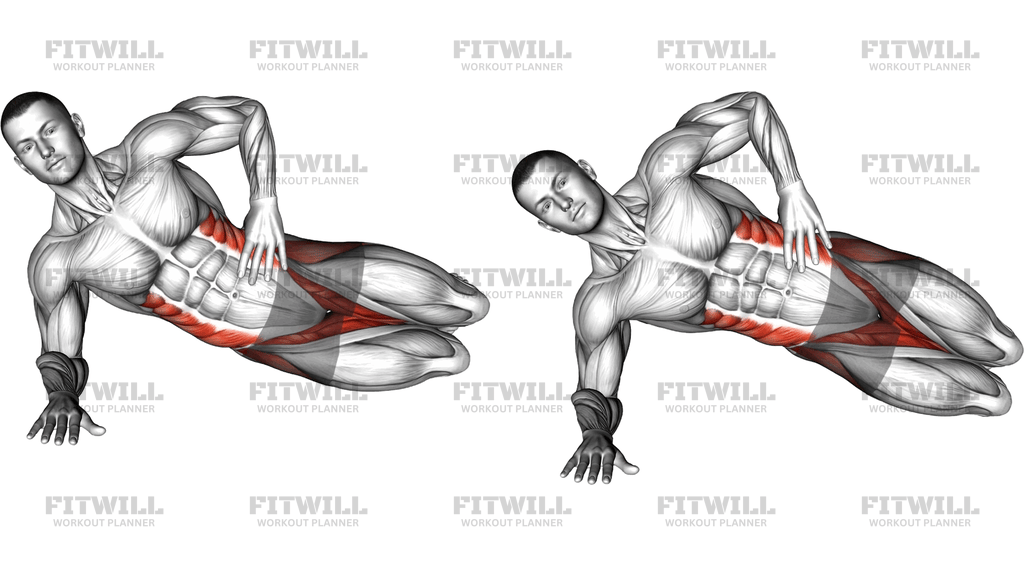
Instructions
- Lie on your side on an exercise mat with your knees bent and stacked on top of each other, so your knees and lower legs rest on the floor.
- Prop your upper body up on your lower forearm (or hand) with the elbow directly under the shoulder, and place your top hand on your hip.
- Lift your hips off the floor until your body forms a straight line from your head through your knees, with your weight on your forearm and the side of your bottom knee.
- Brace your core and squeeze your glutes to lock in that straight line before starting the reps.
- Inhale, then slowly lower your hips down toward the floor, stopping just before they touch or lightly tap the mat.
- Exhale and drive your hips upward by squeezing the side of your waist, lifting them as high as you can without rolling your chest toward the floor.
- Pause for a beat at the top with your torso rigid, feeling the contraction along the side of your ribcage and waist.
- Lower back down under control to complete one repetition, keeping your neck relaxed and your gaze forward.
- Complete all reps on one side, then rest briefly, roll to the other side, and match the repetitions on the second side.
Tips & Tricks
- If your shoulder complains, drop from a straight-arm support down to your forearm — the elbow-under-shoulder position takes a lot of strain off the joint in this exercise.
- The most common mistake is rolling the hips forward as you fatigue, which turns the side plank raise into a front plank. Keep your top hip stacked directly over the bottom knee and your chest facing sideways, not down.
- Lower only a few inches — the dip should be small and deliberate. Letting the hips crash down removes tension from the obliques and jars the lower back.
- Push the floor away with your supporting forearm throughout the set. Allowing the shoulder to sink toward your ear is a frequent cause of neck and trap tightness in this movement.
- Place your top fingertips on your hip bone and use them as a level: if you feel the hip rotating forward during a rep, stop, reset, and continue with a shorter range.
- Squeeze the glutes of your top leg at the start of every rep — it anchors the pelvis and makes the lifting phase noticeably stronger.
- Do your weaker side first and match the repetitions with your stronger side rather than the other way around, so the imbalance doesn't grow.
- If you can't hold a straight line for at least five seconds, regress to a static Kneeling Side Plank hold for a week or two before adding the raise.
Frequently Asked Questions
Which muscles does the Kneeling Side Plank Raise target?
The obliques on your lower side do most of the work, supported by the deep core muscles, the glute medius of the top hip, and the shoulder stabilizers holding you up. The quadratus lumborum along the side of your lower back also contributes to the lifting phase.
Why is the Kneeling Side Plank Raise done from the knees instead of the feet?
Kneeling shortens the lever, so the same dipping and raising motion becomes much easier to control. That lets you focus on keeping a straight torso and feeling the side of your waist work before progressing to the full side plank raise on your feet.
Should I support myself on my forearm or my hand?
Either works, but the forearm version with the elbow directly under the shoulder is easier on the wrist and shoulder and is the better starting point. Use the straight-arm version only if your wrist and shoulder feel comfortable and your alignment stays clean.
How high should I raise my hips during the Kneeling Side Plank Raise?
Lift as high as you can while keeping your body in one straight line from head to knees and your chest facing sideways. Height matters less than a rigid torso — a smaller lift with perfect alignment beats a big lift where your hips roll forward.
My shoulder hurts during this exercise — what should I change?
Check that your elbow is stacked directly under your shoulder and actively push the floor away so the shoulder doesn't sink toward your ear. If discomfort continues, shorten your sets or regress to a static kneeling hold and build up gradually.
How many repetitions and sets should I do?
Two to three sets of 8–12 controlled raises per side is a solid working range. Prioritize slow, smooth reps over speed, and stop the set when your hips start to sag or roll forward.
What can I use instead of the Kneeling Side Plank Raise if it's too hard?
A static Kneeling Side Plank hold builds the base strength without the dynamic dip. If even that is difficult, try a side plank with the bottom knee bent further and the support arm on a bench to reduce the load.
Is the Kneeling Side Plank Raise safe for people with lower back issues?
It is generally gentler on the spine than many flexion-based ab exercises because the trunk stays neutral, but anyone with a history of back problems should keep the range small, avoid letting the hips drop hard, and clear the exercise with a qualified professional first.
How is the Kneeling Side Plank Raise different from a regular side plank?
A regular side plank is a static hold where you fight gravity in one position, while the raise adds repeated hip lowering and lifting through a range of motion. The dynamic version trains the obliques through movement and makes it easier to measure progress rep by rep.