Double Side Step Kickback Rows
Double Side Step Kickback Rows is a standing, body-weight movement that links a side-stepping leg pattern with a rowing arm action. From a tall stance you take two quick lateral steps to one side, sweep your arms forward together as if reaching for a handle, then drive both elbows back in a rowing motion while flicking the trailing heel up into a small kickback. You then repeat the same sequence toward the opposite side, keeping the rhythm continuous. Because it combines footwork with upper-body pulling, it behaves like a moving full-body drill rather than a single-joint exercise.
The leg pattern is where most of the lower-body work happens. The wide side steps load the inner thighs and hips as you decelerate each step, and the kickback at the end of the sequence squeezes the glute of the moving leg. Staying light on your feet also wakes up the calves and ankle stabilizers, which have to absorb and redirect your weight every time you change direction. This makes the drill useful for warming up the hips before lower-body training or for keeping the legs active on days when you are not loading them heavily.
The arm pattern pulls the upper back and shoulders into the picture. As the elbows travel back behind the ribs, the muscles between the shoulder blades and the rear shoulders do the pulling, while the core braces to stop your torso from twisting with each step. Done at a steady pace, the combination raises your breathing rate noticeably, which is why it fits well into circuit training, general conditioning, or the activation block at the start of a session.
Setup matters more than it looks for a body-weight drill. Your stance should stay about shoulder-width between steps, your knees should stay softly bent rather than locked, and your arms should move from your back and shoulders rather than from loose hands flicking around. If the feet cross, the knees cave inward on the side steps, or the elbows drift out wide instead of tracking back, the rowing action loses its purpose and the hips stop doing their share of the work.
A good rep looks smooth rather than rushed: two controlled side steps, one deliberate row-and-kickback, then the same quality on the other side. Beginners can slow the tempo down and keep the arm sweeps small while they learn the pattern, and more experienced trainees can speed it up slightly, add a lower hip position on each step, or extend the duration to turn it into a conditioning set. Because there is no external load and the range is self-selected, the main safety concerns are simply foot placement on the floor and avoiding hard, jerky direction changes before your joints are warm.
[ Workout Log & Planner ]
Put your next workout in Fitwill
Keep your plan and training log ready when you are.


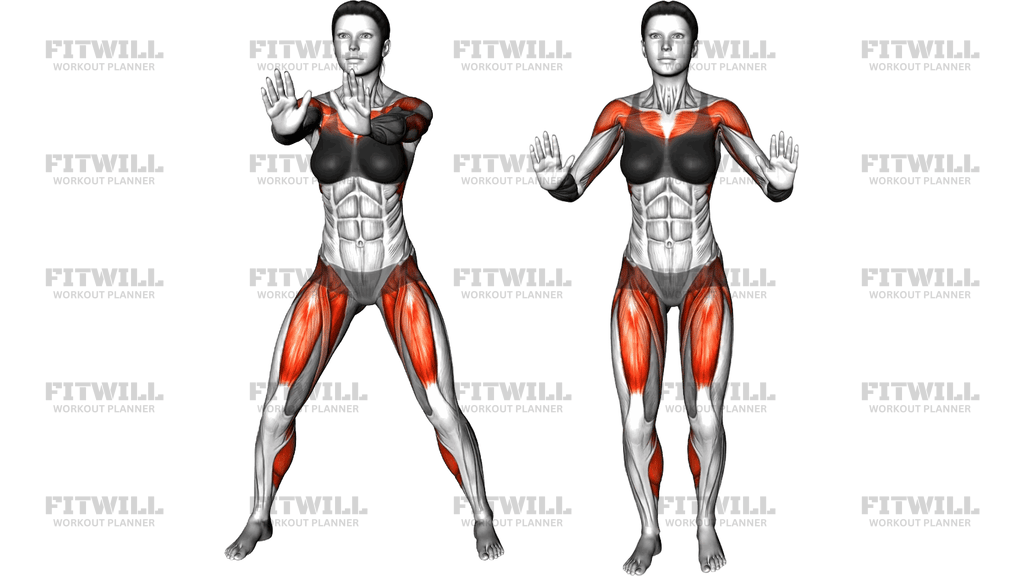
Instructions
- Stand tall with your feet together, arms relaxed at your sides, and your weight balanced over the middle of each foot.
- Take two quick side steps to the right, landing each step with a soft knee bend and your feet roughly shoulder-width apart or slightly wider.
- As you complete the second step, sweep both arms forward until your hands meet in front of your chest, palms facing each other.
- From that forward reach, pull both elbows straight back past your ribs in a rowing motion, squeezing your shoulder blades together.
- At the same moment as the pull, flick your trailing heel up behind you into a short kickback and squeeze the glute of that leg.
- Open your arms back out with control as your feet come together again, keeping tension in your shoulders instead of letting them drop loosely.
- Exhale on the row and kickback, and inhale as you reset your feet and arms for the next side.
- Repeat the full two-step, row, and kickback sequence toward the left side, and keep alternating for your desired reps or time.
- Reset your posture between rounds: feet together, shoulders down, ribs stacked over hips, and your gaze forward.
Tips & Tricks
- Push the floor away with the whole foot on each side step instead of hopping off your toes, or your knees will absorb the direction change with a caved-in position.
- Point your elbows backward rather than out to the sides during the row portion; wide elbows turn the pull into a shoulder shrug and take the work off the upper back.
- Keep the kickback small and controlled. A high, swinging leg usually means your lower back is arching to help, which defeats the glute squeeze you are after.
- If your arms get ahead of your feet, count out loud: step, step, row and kick. The rhythm keeps both halves of the movement honest.
- Stay on soft knees throughout. Straightening your legs between steps turns the drill into a stiff shuffle and removes the hip and inner-thigh work.
- Keep your palms meeting at chest height, not face height. Reaching too high pulls your shoulders up toward your ears.
- If the floor is slippery, shorten your side steps. The pattern works at any width, but a foot that slides out from under you on a hard surface is a real risk.
- Breathe steadily instead of holding your breath on the row; the drill is rhythmic enough that breath-holding will tire you out early.
- Face a mirror occasionally to check that your torso stays square. If it twists toward the stepping side, your core is letting the arms steer the movement.
Frequently Asked Questions
What muscles does Double Side Step Kickback Rows work?
The main drivers are the glutes and inner thighs during the side steps and kickback, with the upper back and rear shoulders handling the rowing pull. Your core and calves work throughout to stabilize each change of direction.
Is Double Side Kickback Rows suitable for beginners?
Yes, because there is no equipment and the range is self-chosen. Beginners should slow the tempo, keep the kickback low, and master the step-step-row rhythm before adding speed.
Do I need any equipment for Double Side Step Kickback Rows?
No, it is a body-weight movement. Comfortable footwear and enough floor space to step sideways are all you need.
How is the kickback different from a glute kickback on a machine?
Here the kickback is a brief, unloaded heel flick timed with the row, so it trains coordination and glute activation rather than progressive strength. If your goal is maximal glute loading, weighted kickbacks are the better tool.
Why do my shoulders shrug when I do the rowing part?
That usually means the elbows are flaring out or the hands are reaching too high. Bring the palms to chest height and drive the elbows straight back so the pull comes from your shoulder blades, not your upper traps.
How many reps should I do?
Count one full cycle to each side as two reps. Ten to twenty total cycles make a solid activation set, or run it for thirty to sixty seconds as part of a warm-up or circuit.
Can I use Double Side Step Kickback Rows as cardio?
Yes, when performed continuously at a brisk pace it raises your heart rate noticeably. Keep the movements slightly smaller as you speed up so your footwork stays clean.
What should I do if my knees hurt during the side steps?
Reduce the width of each step and make sure your knees track over your toes with a soft bend rather than caving inward. If discomfort continues, skip the drill and choose a straight-plane leg movement instead.
Where does this exercise fit best in a workout?
It works well as a dynamic warm-up before lower-body or full-body training, or as a flowing station in a circuit. Doing it first, while your joints are fresh, makes the coordination demands easier to manage.