Walking Side And Sky Reach
Walking Side And Sky Reach is a standing, bodyweight movement that combines forward walking with two arm patterns: pressing both arms straight up toward the sky and opening the elbows out wide beside the head. You move through these arm positions in rhythm with your steps, so your legs keep traveling while your shoulders, upper back, and trunk work through a full overhead range. Because there is no equipment involved, the only resistance is your own body position, which makes the drill easy to scale and simple to slot into almost any session.
This movement is most useful as a dynamic warm-up before upper body lifting, running, or full-body training. The overhead reach lengthens the lats and chest while waking up the shoulders, and the wide-elbow position opens the chest and trains shoulder blade control. Meanwhile, the walking component raises your heart rate gently and keeps the hips, quads, and calves active. It is a good fit for beginners, for people who sit for long hours and need regular overhead motion, and for older trainees who want to maintain shoulder mobility without loading a barbell or dumbbell.
Setup matters more than it looks. Stand tall with your feet together and your ribs stacked over your pelvis before you take the first step. If you start with an arched lower back or your chin jutting forward, every overhead reach will reinforce that position rather than improve your posture. Keep your neck long, your gaze forward, and your abdominal wall gently braced so the reach comes from the shoulders, not from leaning backward.
To execute well, step forward and, as your foot lands, drive both arms from beside your head straight up overhead, finishing with your biceps near your ears and palms facing each other or forward. On the next step, bring your hands back down to head height and flare your elbows out wide, feeling the chest open. Alternate between these two arm shapes with each step, keeping the tempo steady and the movement smooth rather than jerky. Your arms should travel in a controlled vertical path close to the midline of your body during the sky reach, not swing wildly behind you.
A common use case is performing 20 to 40 total steps across a hallway or open floor, then repeating for two or three rounds. It also works as an active recovery drill between strength sets, or as a low-impact stand-alone circuit movement when paired with marching, arm circles, or hip openers. Because the drill is rhythmic, it doubles as light cardio when performed continuously for a minute or more.
The main safety points are simple. Do not force the overhead range if your shoulders pinch or your lower back arches to get your arms higher; shorten the range and gradually improve it instead. Keep your steps moderate in length so your balance stays comfortable, and stop the set if you feel dizziness or sharp joint pain. Controlled motion with honest range always beats rushing through extra steps.
[ Workout Log & Planner ]
Put your next workout in Fitwill
Keep your plan and training log ready when you are.


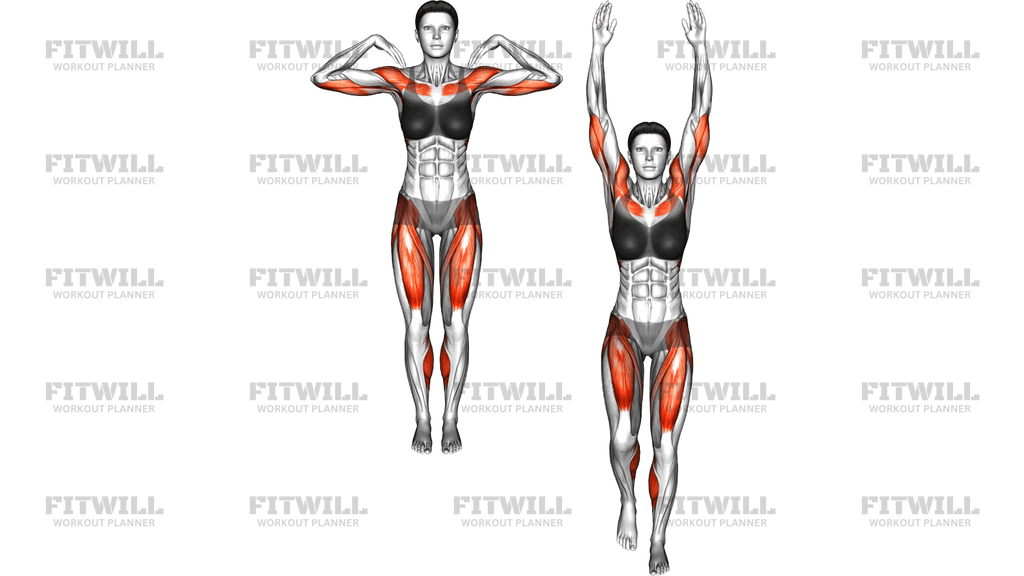
Instructions
- Stand tall with your feet together, arms bent so your hands are beside your head and your elbows are flared out to the sides, palms facing forward.
- Pick a straight, clear walking path of at least 10 to 15 feet, and set your gaze on a point straight ahead at eye level.
- Brace your abdominal wall lightly and stack your ribs over your pelvis so your lower back stays neutral before you begin stepping.
- Step forward with your left foot and, as it lands, press both arms straight up overhead toward the sky until your elbows are fully extended and your biceps are near your ears.
- Bring your arms back down to head height as you step forward with your right foot, flaring your elbows wide to the sides so your chest opens.
- Continue alternating: a sky reach overhead on one step, a wide-elbow side opening on the next, keeping the arm motion synced to your foot strikes.
- Exhale as the arms press up, inhale as they lower and open, and keep your breathing steady throughout the walking set.
- Keep your steps moderate and your torso upright; avoid leaning back as the arms go overhead.
- Walk to the end of your path, turn carefully with small steps, and reset your posture before starting the next length.
- Complete 20 to 40 total steps or two to three lengths, then lower your arms and stand still for a few breaths before moving on.
Tips & Tricks
- If your arms will not go fully overhead without your ribs flaring up, stop at the height where your torso stays stacked and improve the range over several weeks.
- A frequent mistake is turning the sky reach into a lower-back arch; cue yourself to squeeze your glutes slightly as the arms press up to keep the pelvis neutral.
- Do not let the wide-elbow position collapse forward; keep the elbows lifted to roughly ear height so the chest actually opens instead of the shoulders rounding.
- Keep the arm path close to the midline on the overhead press; arms drifting far behind your head usually means the shoulders are compensating for limited range.
- Match the arm speed to your step speed; if the arms finish long after each foot strike, slow the walk down until the timing is clean.
- On the turn at the end of your path, take small deliberate steps with arms down rather than pivoting with arms overhead, which challenges balance unnecessarily.
- If your neck tenses, check that your chin stays level; reaching the head forward toward the hands is a common habit that loads the neck instead of the shoulders.
- Breathe out on the reach rather than holding your breath, especially if you are using this drill as continuous cardio for a minute or longer.
- Start each set slower than feels necessary; the value of this movement comes from clean positions at range, not from covering ground quickly.
Frequently Asked Questions
What muscles does Walking Side And Sky Reach work?
The primary work is in the shoulders, particularly the deltoids, along with the upper traps that control the shoulder blades. The quads, calves, and hips keep you walking, and the obliques and core stabilize your trunk every time the arms go overhead.
Is Walking Side And Sky Reach good for beginners?
Yes, it is one of the friendliest full-body warm-up drills because it uses no equipment and the range can be adjusted instantly. A beginner can shorten the overhead reach and still get the mobility and circulation benefits.
Why do my lower back and ribs lift when I do the sky reach portion?
That usually means your shoulder or lat flexibility limits the overhead motion, so your spine arches to fake extra range. Squeeze your glutes lightly and stop the press at the height where your ribs stay stacked over your pelvis.
How is Walking Side And Sky Reach different from a standing overhead arm raise?
The walking version adds continuous footwork, which raises your heart rate and challenges balance and coordination while your arms move. Alternating the sky reach with the wide-elbow position also trains two different shoulder and chest patterns in one drill.
How many steps should I do per set?
Twenty to forty total steps, or two to three lengths of a hallway, is a solid dose for a warm-up. For a light cardio round, keep walking continuously for 45 to 60 seconds with a steady tempo.
Can I use this as a warm-up before lifting weights?
Absolutely; it is especially useful before overhead pressing, pull-ups, or any upper body session because it takes the shoulders through a full range while keeping the body warm. Follow it with a loaded warm-up set to bridge into your working weight.
What should I do if my shoulders pinch during the overhead reach?
Reduce the range so the press stays pain-free, keep your palms facing each other rather than forward, and slow the tempo. If pinching persists, substitute a shorter-range arm reach or a controlled arm circle pattern and build range gradually.
Where should my hands be during the wide-elbow step?
Your hands stay beside your head with fingertips near your ears and elbows flared out wide, roughly at ear height. This is the position you return to between every sky reach, and it should feel like an open stretch across the chest.
Can I do Walking Side And Sky Reach if I have balance issues?
Yes, but walk near a wall or rail and use shorter, slower steps with your eyes on a fixed point ahead. You can also perform the same arm patterns marching in place until your confidence improves.