Hands Behind Double Superman Pulse
Hands Behind Double Superman Pulse is a prone bodyweight exercise that trains the entire back side of your body at once. You lie face down with your hands clasped behind your lower back, then lift your chest and both legs off the floor together and hold that arched position while making small, controlled pulses with the arms and legs. The hands-behind-back position removes the counterbalance of extended arms, so your upper back and spinal extensors have to work harder than they would in a standard Superman.
This movement is useful for anyone who spends long hours sitting, because it directly targets the muscles along the spine that tend to get weak and dormant, along with the glutes and hamstrings that extend the hips. It also fits well into posterior chain warm-ups before squats or deadlifts, and into core circuits where you want back extension work to balance out all the forward-flexion exercises like crunches and planks. Swimmers and field-sport athletes often appreciate it because the arch position mirrors the body line used in swimming and sprinting.
The main muscles working are the erector spinae along the lower and mid back, supported strongly by the glutes and hamstrings as they lift the legs. The mid-back muscles between the shoulder blades help retract and hold the arm position behind you, and the deep core stabilizes you as you balance on your torso. Because you are pulsing rather than holding completely still, the muscles work continuously through small ranges instead of fatiguing in one fixed shape.
Setup matters more than it looks. Your hands behind your back act like a small bar you press into, which helps open the chest and encourages the shoulder blades to pull together. Where you place your hands changes the difficulty: clasped low on the lower back gives more leverage, while pulling them higher toward the shoulder blades shortens the lever and demands more from the upper back.
To execute well, lift into the arch with intention rather than speed. Think about lengthening through the crown of your head and reaching your heels toward the wall behind you, then pulse by rising slightly higher and lowering a few centimeters in a steady rhythm. Keep your neck in line with your spine, looking at the floor, and let the lift come from your back and hips rather than from cranking your head up.
A few practical points keep this safe and effective. Keep the pulses small; this is not a movement where bigger equals better. Stop at the height where you can keep both chest and legs off the floor without your lower back pinching or your breath turning ragged. If holding the full double-leg position is too demanding at first, build capacity with single-leg versions before progressing to this two-limb variation.
[ Workout Log & Planner ]
Put your next workout in Fitwill
Keep your plan and training log ready when you are.


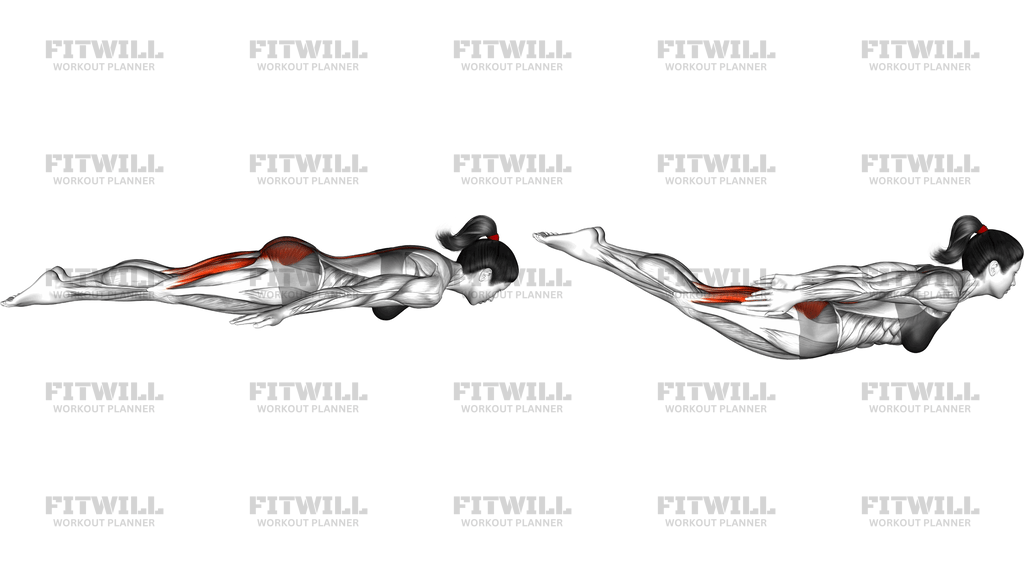
Instructions
- Lie face down on an exercise mat with your legs straight and together and the tops of your feet resting on the floor.
- Bring both arms behind your body and clasp your hands together at your lower back, letting your shoulders roll back gently.
- Rest your forehead slightly off the floor and keep your neck long, gazing down at the mat rather than forward.
- Brace your abdominal muscles lightly to support your spine before you begin moving.
- Exhale and lift your chest, shoulders, and both legs off the floor at the same time until you feel your lower back, glutes, and hamstrings working together.
- From the lifted position, perform small pulses: rise a few centimeters higher, then lower slightly without letting your chest or feet touch down.
- Keep the pulse rhythm steady and even between the upper and lower body, pressing your clasped hands back and down as you lift.
- Breathe continuously throughout, inhaling through your nose and exhaling on each pulse instead of holding your breath.
- After your final pulse, lower your chest and legs to the mat with control, unclasp your hands, and rest briefly before the next set.
- Reset your leg position and hand placement each rep so you start every set from the same aligned position.
Tips & Tricks
- If your lower back pinches at the top, reduce the lift height; the arch should feel like muscle work, not joint compression.
- Squeeze your glutes to raise the legs instead of swinging them up, since momentum takes the load off the hamstrings and spinal muscles.
- Do not crank your chin up to lift higher; the lift should come from your chest and shoulders so your neck stays neutral.
- Keep your knees straight throughout the pulses. Bent knees shorten the lever and let the hamstrings off the hook.
- Press your clasped hands actively away from your body. Passively resting them there loses the shoulder blade engagement this version is meant to build.
- Keep both legs working evenly. One hip dropping lower than the other is a common sign one side is compensating.
- If you cannot keep chest and legs airborne for the full set, reduce the pulses per set or switch to a single-leg Superman until your endurance improves.
- Pulse at a controlled tempo of roughly one lift and one lower per second; rushing the rhythm turns the exercise into bouncing.
- Place your hands as low as comfortable on your lower back at first. Moving them higher toward the shoulder blades is a progression, not a starting point.
Frequently Asked Questions
Which muscles does the Hands Behind Double Superman Pulse work the most?
The erector spinae along the lower back do the main work of lifting your chest, with strong support from the glutes and hamstrings as they raise the legs. The muscles between the shoulder blades also stay active holding your hands behind your back.
Why are the hands placed behind the back instead of extended forward like a regular Superman?
With the hands clasped behind your lower back, you lose the counterbalance of the arms, so your upper and lower back muscles have to generate more of the lift themselves. The position also helps pull the shoulder blades together and open the chest.
Is the Hands Behind Double Superman Pulse suitable for beginners?
Yes, as long as the pulses are kept small and the lift stays comfortable. Beginners can start with a static hold or single-leg version and progress to the double-leg pulse once lifting both limbs together feels controlled.
How high should I lift my chest and legs during the pulses?
Lift only as high as you can while keeping the chest and both feet off the floor and your neck neutral. A few centimeters of controlled travel is enough; the pulse is a small rise and lower, not a big rocking motion.
Why do my legs drop between pulses?
This usually means the glutes and hamstrings are fatiguing or the pulses have become too large. Slow the tempo, reduce the range, and consciously squeeze the glutes on every lift to keep both legs airborne.
What can I use instead of this exercise if lying face down is uncomfortable?
A reverse hyper on a bench, glute bridges, or bird dogs train a similar posterior chain pattern without loading the spine in extension. These substitutions are useful if the prone arch position causes discomfort.
How many reps and sets of the Hands Behind Double Superman Pulse should I do?
Two to three sets of 15 to 30 seconds of continuous pulsing works well for endurance, or counted reps of 15 to 20 pulses. Stop the set when your form, not your stamina, starts to slip.
Should I feel this in my lower back, and when is it too much?
Muscular work along the spine is expected, since that is the target area. Sharp pain, pinching, or pain that radiates into the hips or legs is a signal to stop, reduce the range, and switch to a gentler variation.
Can I do the Hands Behind Double Superman Pulse before lifting weights?
Yes, a short set works well as an activation drill before squats, deadlifts, or overhead pressing, because it wakes up the spinal extensors and glutes. Keep the volume low so you warm the area without fatiguing it.