Chest To Wall Middle Split
The Chest To Wall Middle Split is a wall-supported flexibility drill that takes you into a wide straddle position while your chest stays anchored against the wall. Instead of free-standing middle split work, where the torso tends to pitch forward or the hips drift out of line, the wall gives you a fixed reference point. You face the wall, spread your legs as wide as your range allows, and gradually sink or slide deeper while the chest maintains contact with the surface.
This position primarily targets the adductors along the inner thigh, along with the hamstrings and the outer hip muscles that resist the legs being pulled apart. Because the wall blocks the chest from collapsing forward, the pelvis stays relatively neutral and the stretch is driven through the hips rather than being cheated by rounding the lower back. That makes it a much more honest measure of your true middle split range than a floor straddle where gravity and a curved spine can mask tightness.
The setup matters more than it looks. Having the chest against the wall means you cannot lean away when the intensity builds, and it forces the knees and toes to track forward instead of rolling inward. Your hands rest on the floor beside you for balance and light load control, so you can meter exactly how much weight sinks into the stretch. This is why many coaches prefer it over passive floor straddles for anyone working toward a full middle split.
This drill is popular with martial artists, dancers, gymnasts, and lifters who want better hip abduction for deep squats and lateral movements. It works well as the main flexibility piece at the end of a leg session, or as one hold in a dedicated split-training routine a few times per week. Beginners benefit from it just as much as advanced trainees, since the wall lets you control depth very precisely.
Execution is slow and patient. You do not force the legs wider; you breathe, relax the inner thighs, and let gravity settle you a few millimeters at a time. Expect the adductors to complain first, then the hamstrings as the legs straighten. A hold of one to three minutes per round, repeated two to three rounds, is a common working range.
Safety comes down to respecting the tissue. The inner thigh attachments are prone to cranky reactions if you bounce or push through sharp pain, so work at a strong but tolerable stretch sensation, never a stabbing one near the groin or sit bones. Warm hips stretch far better than cold ones, and coming out of the position as deliberately as you went in protects you from the most common strains.
[ Workout Log & Planner ]
Put your next workout in Fitwill
Keep your plan and training log ready when you are.


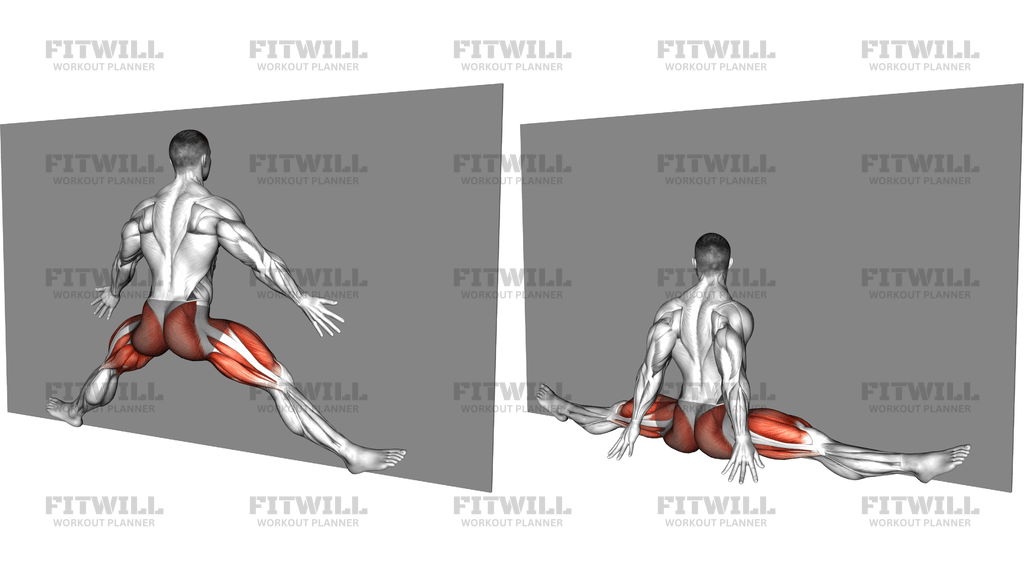
Instructions
- Stand facing a clear stretch of wall with about two to three feet of space, then place your chest lightly against the wall and turn your toes outward slightly or keep them facing forward.
- Step both feet out to the sides into a wide straddle, keeping the chest in contact with the wall and your legs as straight as your flexibility allows.
- Place your palms flat on the floor on either side of your body, fingers spread, so you can share your weight between your hands and legs.
- Brace your core gently and keep the pelvis tucked slightly so your lower back stays long instead of arching or rounding.
- Slowly walk your feet a little wider, or bend the knees slightly and sink the hips downward, letting the legs slide toward a fuller middle split while the chest stays glued to the wall.
- At your deepest comfortable position, point the kneecaps and toes toward the ceiling or forward, and hold for 30 seconds to 3 minutes while breathing slowly and deeply.
- With each exhale, consciously relax the inner thighs and allow the hips to sink a fraction lower; avoid bouncing or pulsing in the position.
- To exit, press firmly through the palms, bend both knees, and walk the feet back together before standing up away from the wall.
- Reset for a moment, shake out the legs, and repeat for 2-3 rounds, aiming to go slightly deeper on later rounds only if the first felt clean.
Tips & Tricks
- If your chest keeps peeling off the wall, your feet are too wide for your current range; narrow the stance until the chest contact is comfortable and progress from there.
- Groin pain right at the inner thigh attachment is a signal to reduce depth, not push through; a broad stretch through the inner and back of the thigh is the intended sensation.
- Warm up with leg swings, body-weight squats, or a few minutes of light cardio first, since cold adductors resist this position noticeably more.
- Do not let the pelvis tilt forward and the belly push into the wall; this fakes extra range by arching the lower back instead of opening the hips.
- Wear socks or use smooth flooring so the feet can slide gradually, but keep enough friction under the hands to control the descent.
- If the hamstrings cramp at the back of the thigh, bend the knees a few degrees and rebuild toward straight legs over several sessions.
- Squeeze the outer hips and thighs lightly toward each other for a few seconds, then release; this contract-relax trick usually buys a little extra depth safely.
- Time your holds rather than guessing, since the position feels very different at second 90 than it does at second 20.
- Coming out of the stretch by snapping the legs together quickly is the most common way people strain themselves; always bend the knees and walk in deliberately.
Frequently Asked Questions
What muscles does the Chest To Wall Middle Split stretch?
It primarily stretches the adductors of the inner thigh, with strong involvement from the hamstrings and the outer hip muscles such as the gluteus medius. The glutes assist by staying active to control the pelvis.
Why does my chest need to stay on the wall during the Chest To Wall Middle Split?
The wall prevents your torso from leaning and rounding forward, which would otherwise hide tight hips by dumping the movement into the lower back. Keeping chest contact keeps the stretch where it belongs, in the hips.
Is the Chest To Wall Middle Split suitable for beginners?
Yes, as long as you start with a modest foot width and keep depth tolerable. The wall actually makes it beginner-friendly because you can control exactly how far you sink.
Should my toes point forward or outward in this stretch?
Toes facing forward or angled slightly up toward the ceiling keeps the kneecaps tracking neutrally. Turning the toes out too far shifts stress away from the adductors and changes the stretch.
How long should I hold the Chest To Wall Middle Split?
Aim for 30 seconds to 3 minutes per round for 2-3 rounds. Long, relaxed holds with steady breathing work better for range than short, forced ones.
My groin pinches near the inner thigh bone when I go deep. What should I do?
Reduce the width and depth immediately and stay at a range with only a broad stretch sensation. Sharp or pinpoint pain near the adductor attachment is a warning to back off and build up more gradually.
Can I use the Chest To Wall Middle Split to train for a full middle split?
It is one of the best drill choices for that goal because the wall enforces alignment that floor straddles often lose. Pair it with other hip work and train it consistently several times per week.
What can I substitute if I have no open wall space?
A seated floor straddle with a tall, neutral spine and hands planted for support is the closest alternative, though you lose the external feedback that makes the wall version so effective.
Should this stretch be done before or after training?
It fits best after training or in a dedicated flexibility session, when the muscles are warm and receptive. Doing long holds on cold adductors right before heavy leg training is not ideal.
How do I safely get out of the position?
Press your palms into the floor, bend both knees to shorten the lever, and walk your feet back toward each other before standing. Never try to spring straight up from a deep straddle.