Kettlebell Romanian Deadlift To Squat
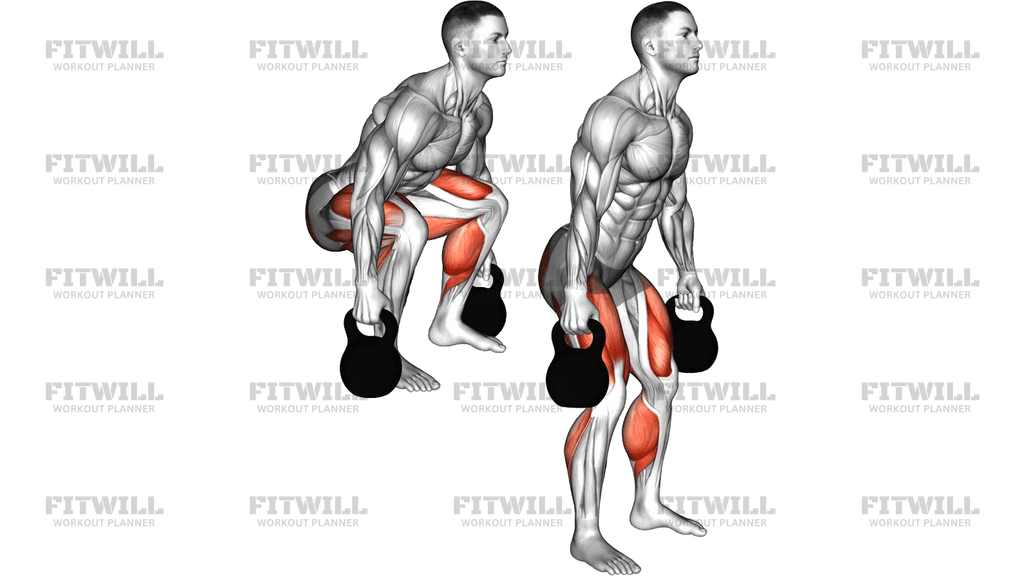
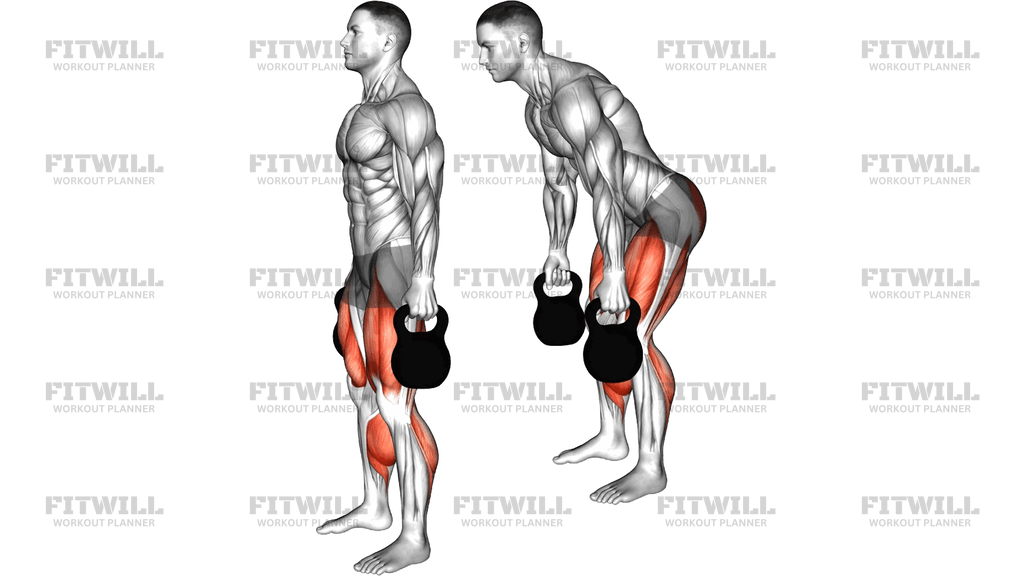
The Kettlebell Romanian Deadlift To Squat is a two-part lower body pattern performed with one or two kettlebells held at your sides. You hinge backward into a Romanian deadlift to load the hamstrings and glutes, stand back up tall, and then drop straight into a squat before returning to standing. Linking the two patterns in one rep forces you to transition cleanly between a hip-dominant hinge and a knee-dominant squat, which is exactly where most lifters get sloppy.
This combination earns its place in a program because it covers both major lower body movement patterns with a single load. The RDL portion stretches the hamstrings and teaches you to push the hips back while keeping the spine neutral, while the squat portion adds quad and glute work through a bent-knee position. Your grip and upper back also stay busy the whole time, since the kettlebells hang from straight arms through both movements.
It suits intermediate lifters who already own both a hip hinge and a bodyweight squat separately and want to build coordination under load. It is also an efficient choice for busy sessions, home training with limited equipment, or as a warm-up groove before heavier deadlift or squat work. Beginners can use it too, ideally with one light kettlebell and a slow tempo until the transition feels natural.
Setup matters more than it looks. Because the weight hangs at your sides rather than on your back or in front of your chest, there is nothing pulling you into position — your own brace and hip timing have to do the work. Stand with feet roughly hip-width or slightly wider, kettlebells gripped firmly, shoulders packed down, and ribs stacked over the pelvis before you start the hinge.
To execute it well, think of it as two clean reps joined at standing. Hinge until you feel a real hamstring stretch with a flat back, drive the hips forward to stand, take one full breath at the top, then sit down into a squat with your knees tracking over your toes and your chest tall. Stand fully between reps rather than blurring the two shapes together. The most common errors are turning the RDL into a rounded-back good morning and turning the squat into a half-bend that never loads the legs properly.
As for safety, keep the load moderate at first. The transition point between the hinge and squat is where fatigue tends to round the lower back, so stop the set when you can no longer keep your spine neutral and your kettlebell path vertical. Barefoot or flat-soled shoes help you feel the floor through both patterns.
[ Workout Log & Planner ]
Put your next workout in Fitwill
Keep your plan and training log ready when you are.


Instructions
- Place two kettlebells (or one, held centrally) on the floor just outside your feet, then stand over them with feet about hip-width apart and toes pointing forward or slightly out.
- Hinge down with a flat back, grip the handles firmly, and stand up so the kettlebells hang at full arm's length at your sides, shoulders pulled down away from your ears.
- Brace your core as if bracing for a light punch, pull your ribs down over your hips, and set your gaze on a point on the floor about a meter ahead of you.
- Start the RDL by pushing your hips straight back, letting the kettlebells slide down your thighs toward mid-shin level while your chest lowers toward parallel with the floor.
- Stop the hinge when you feel a strong hamstring stretch and your back is at risk of rounding, then drive your hips forward and squeeze your glutes to return to a full stand.
- Pause briefly at the top with legs straight and kettlebells still at your sides, then begin the squat by bending your knees and hips together, sitting down between your heels.
- Descend until your thighs reach at least parallel or as deep as your mobility allows with heels planted, keeping the kettlebells hanging vertically beside your shins.
- Drive through your whole foot to stand back up to full hip and knee extension, exhaling as you rise.
- That completes one rep; take a breath at the top, reset your brace, and begin the next rep with the hinge.
- When finished with the set, hinge down with a flat back and set the kettlebells on the floor under control rather than dropping them from standing.
Tips & Tricks
- The most common fault is rushing the transition at the top — if you flow from hinge straight into squat without standing fully, the hamstrings never reload and the squat gets shallower. Make each rep two distinct shapes.
- If your lower back rounds during the RDL portion, you have hinged past your available hip range. Cut the depth back to where your back stays flat; the stretch should be in the hamstrings, not the spine.
- Keep the kettlebells close to your legs through both phases. If they drift forward during the hinge, your hips are not moving back far enough, and if they swing in the squat, you are descending too fast.
- During the squat, check that your heels stay planted. Lifting the heels usually means the load is too heavy or your ankles are tight — try turning your toes out slightly or elevating your heels on a small plate.
- Grip often fails before the legs on this one. Chalk your hands or use a lighter pair of bells rather than letting the handles slip mid-rep, since a shifting load pulls your shoulders out of position.
- Think about the hinge as pushing your backside toward a wall behind you, and the squat as sitting down between your heels. Two different cues for two different directions of movement.
- Keep your neck neutral in the hinge by looking at the floor a meter ahead, not up at the mirror — craning up shortens the back of the neck and encourages chest lifting.
- If your knees cave inward in the squat, actively spread the floor with your feet as you descend and drive up.
- Tempo fixes most technique problems here: try two seconds down in the hinge, one breath at the top, two seconds down in the squat, then an explosive stand.
Frequently Asked Questions
Which muscles does the Kettlebell Romanian Deadlift To Squat work?
The hinge portion targets the glutes and hamstrings, while the squat portion shifts emphasis to the quads and glutes. The lower back, grip, and upper back work isometrically to hold the kettlebells in position throughout.
Should I use one kettlebell or two for the Kettlebell Romanian Deadlift To Squat?
Two kettlebells balance the load evenly at your sides and match the setup shown, but one kettlebell works well for beginners and lets you focus on technique. With a single bell held centrally or in one hand, expect a slightly different balance demand.
How deep should the hinge go in the Kettlebell Romanian Deadlift To Squat?
Descend until you feel a firm hamstring stretch, usually when the kettlebells reach mid-shin and your torso is near parallel to the floor. Stop earlier if your lower back starts to round — depth should come from the hips, not the spine.
Is the Kettlebell Romanian Deadlift To Squat suitable for beginners?
Yes, provided you have already learned the hinge and squat separately. Start with one light kettlebell, move slowly, and treat the exercise as a technique drill before adding meaningful load.
Why do I have to stand fully between the RDL and the squat?
Standing fully separates the two patterns so each gets a clean range of motion — blending them turns the exercise into a vague half-rep that loads neither the hamstrings nor the quads properly. The pause also gives you a breath and a brace reset.
My grip gives out before my legs during this exercise — what should I do?
Reduce the load, use chalk, or switch to a kettlebell size you can hold securely for the whole set. A slipping handle drags your shoulders down and forward, which compromises both the hinge and the squat.
Can I substitute a barbell or dumbbells for the Kettlebell Romanian Deadlift To Squat?
Dumbbells work almost identically held at your sides, so they are a fair swap. A barbell changes the setup to a front or back position and makes the transition between patterns clumsier, so it is a less natural substitute for this specific flow.
How many reps and sets should I do of the Kettlebell Romanian Deadlift To Squat?
Because it is technically demanding, 3 to 4 sets of 6 to 10 total reps at a controlled tempo works well. Stop the set when your back position or squat depth degrades rather than grinding extra reps.
Is it safe for my lower back to combine the RDL and squat in one rep?
It is safe when your spine stays neutral through both phases and the load matches your control. The risk comes from fatigue-induced rounding at the transition point, so use a moderate weight and end the set before form breaks.
Should my feet stay in the same position for both the hinge and the squat?
Yes — keep the same hip-width or slightly wider stance throughout so you do not waste time and stability repositioning between patterns. A small toe-out angle of 5 to 15 degrees usually suits both the hinge and the squat.