Standing Torso Twist Arms Swing
Standing Torso Twist Arms Swing is a dynamic, bodyweight warm-up movement where you rotate your upper body from side to side while letting your arms swing loosely with the momentum. Your feet stay planted while your waist and ribcage rotate, and the arms act as counterweights that naturally amplify the twist. Because it requires no equipment and almost no space, it is one of the most practical ways to wake up the trunk before training.
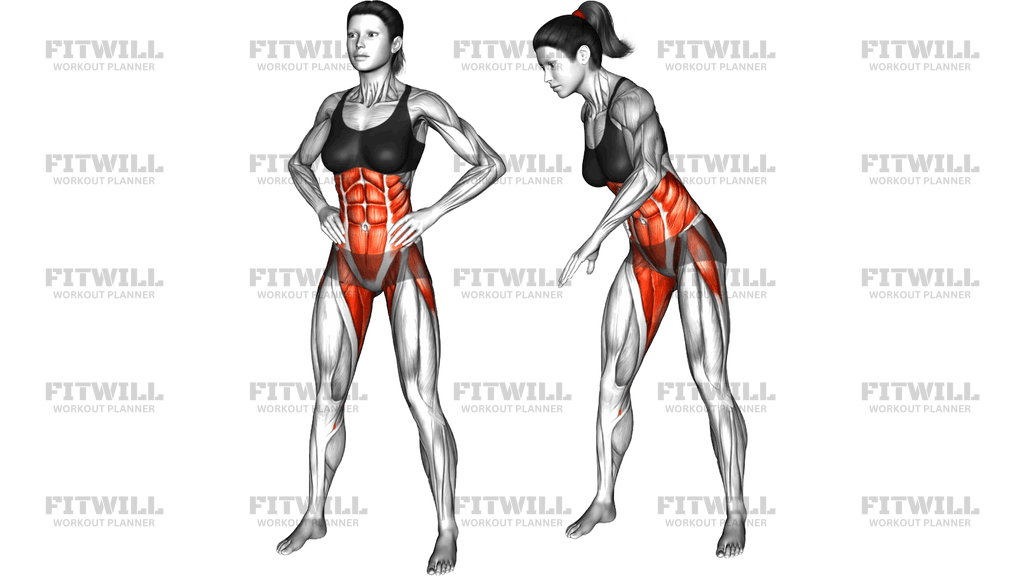
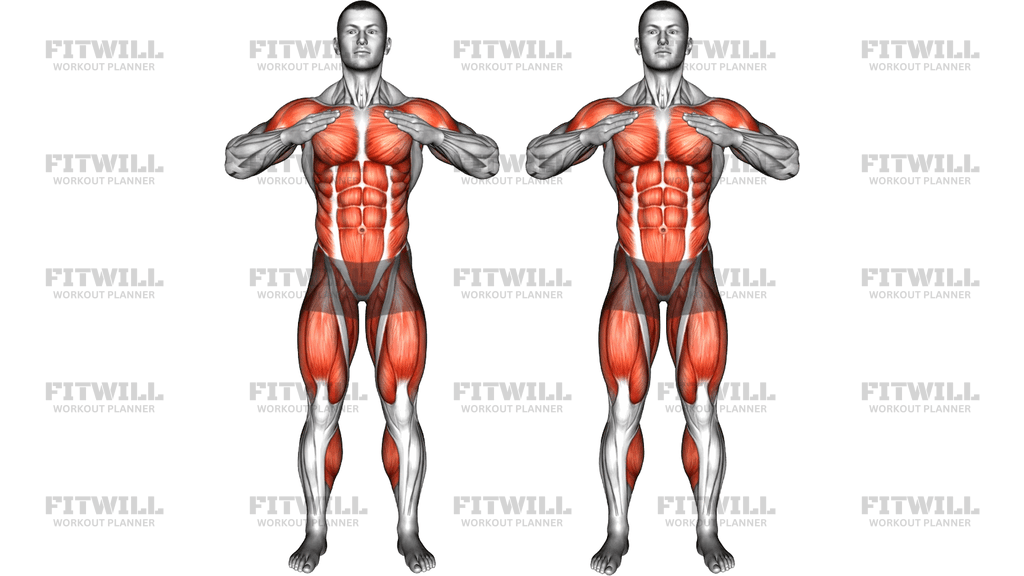
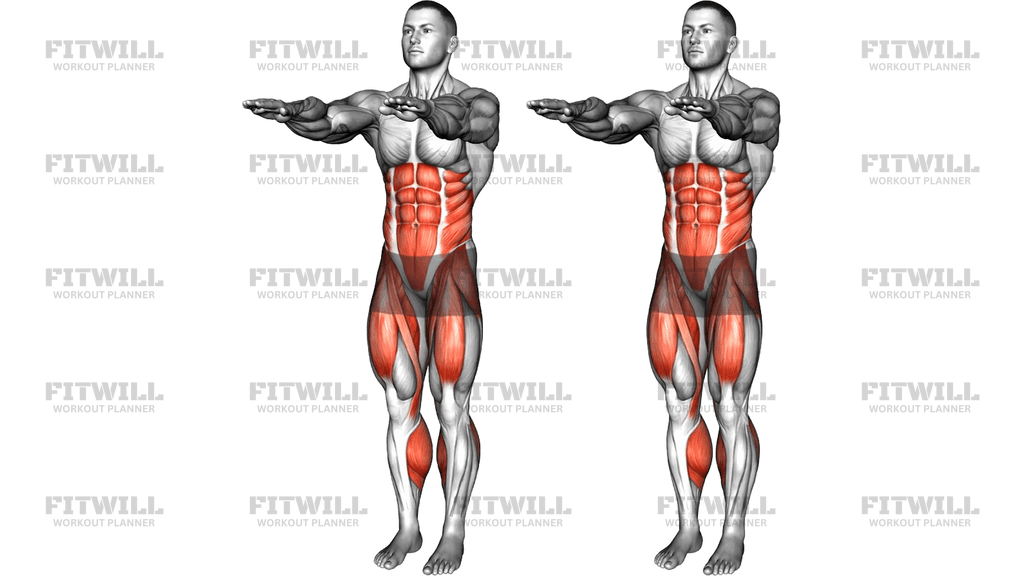
This movement primarily targets the obliques along the sides of your waist, along with the deep core muscles that control rotation. The lower back muscles work isometrically to keep you upright as you turn, while the shoulders and arms stay relaxed and travel with the swing. The highlighted areas in the muscle diagram — the waist, mid-back, and shoulder region — reflect exactly where most of the action happens.
It is especially useful as part of a general warm-up before sports that involve rotation, such as tennis, golf, baseball, or martial arts, and before core or lower body strength sessions. It also works well as a standalone mobility break during a long day of sitting, since gentle rotation helps relieve stiffness through the mid-back and waist. Because the intensity is self-regulated by how far you turn and how fast you swing, it suits complete beginners and experienced lifters alike.
Setup matters more than it looks. Stand with your feet roughly shoulder-width apart or slightly wider, weight evenly distributed, knees soft but not bent into a squat. Your spine should stay tall and neutral — the rotation should come from the waist and ribcage, not from collapsing or arching the lower back. Keep your shoulders down and your jaw and hands relaxed so the arms can swing freely rather than being muscled through the arc.
To execute it well, begin twisting gently side to side, letting each arm cross in front of your body as the opposite side rotates back. Start with a small range and gradually let the swing grow as your tissues warm up. The arms should feel like loose pendulums; if you are actively gripping or forcing them, you are working too hard. Breathe steadily throughout rather than holding your breath at the end of each turn.
A few practical safety points: keep the movement rhythmic and controlled rather than whipping aggressively, especially when cold. Avoid twisting so far that your knees wrench or your heels lift and slam down. If you feel any sharp pain in the spine or hips, shorten the range immediately. Two to three sets of 15–30 seconds, or roughly 20–30 total swings, is a sensible starting volume.
Fitwill
Log Workouts, Track Progress & Build Strength.
Achieve more with Fitwill: explore over 9600 exercises with images and videos, access built-in and custom workouts, perfect for both gym and home sessions, and see real results.
Start your journey. Download today!




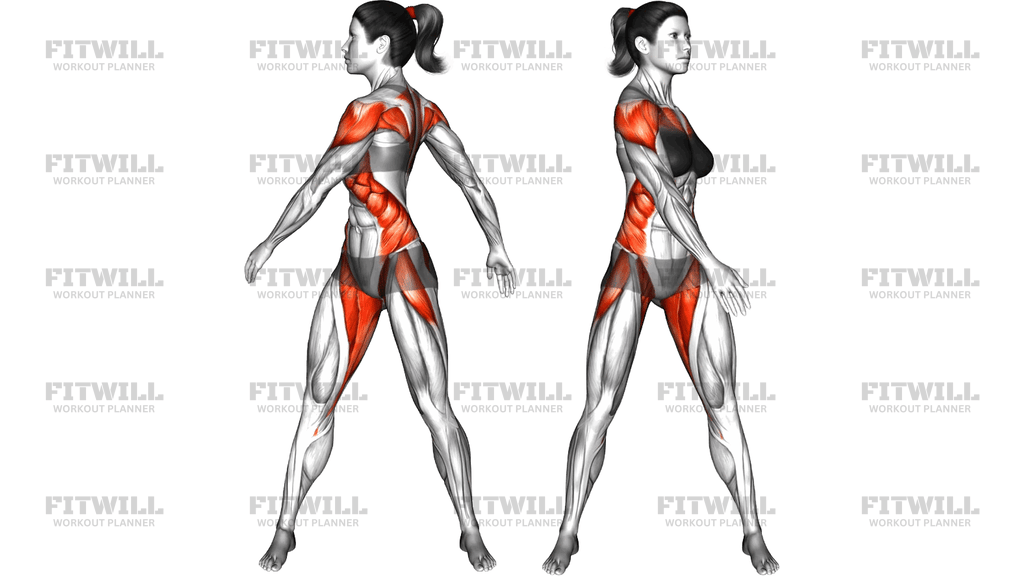
Instructions
- Stand with your feet about shoulder-width apart or slightly wider, toes pointing forward and your weight spread evenly across both feet.
- Soften your knees slightly and keep them pointing in the same direction as your toes so they do not twist inward as your torso rotates.
- Tallen your spine, relax your shoulders down, and let your arms hang loosely at your sides with your hands open and unclenched.
- Brace your core lightly, as if preparing for a gentle push, so your lower back stays supported during the rotation.
- Twist your upper body to one side by rotating from the waist and ribcage, letting the arm on that side swing back behind you while the opposite arm swings across the front of your body.
- Continue the momentum and rotate to the other side, allowing the arms to swap positions naturally — one forward across your chest, one back behind your hip.
- Keep the rhythm smooth and pendulum-like, starting with a small range and gradually increasing the twist as your waist and mid-back loosen up.
- Breathe continuously and evenly throughout the set; do not hold your breath at the end of each turn.
- After your final repetition, slow the swing down in stages until your torso returns to facing forward, then stand still for a moment before moving to the next exercise.
Tips & Tricks
- The most common mistake is twisting from the knees instead of the waist — if your kneecaps are rotating side to side, anchor your feet and let only the ribcage turn.
- Do not force range with your arms; gripping hard and yanking the swing robs the core of the work and can irritate the shoulders. Keep your fingers open and hands light.
- If your heels lift and slam down with each turn, shorten the swing and re-distribute your weight across the whole foot before widening the range again.
- Avoid letting your lower back arch and hinge backward as you rotate — think of turning around a vertical axis running through the crown of your head.
- Warm up into the movement: the first 5–6 swings should be small and slow, with the range growing only as you feel the waist release.
- If you feel the swing only in your shoulders, soften them further — the driving motion should come from the trunk, with the arms simply following.
- Speed is a tool, not a requirement; a controlled moderate pace trains rotation better than fast whipping, especially if this is your first warm-up drill of the day.
- Keep your head traveling with your torso rather than locking your gaze forward, which limits rotation and strains the neck at the end ranges.
- For a pre-workout version, keep the pace lively but the range moderate; for a cooldown, slow everything down and use a smaller, more deliberate turn.
Frequently Asked Questions
What muscles does the Standing Torso Twist Arms Swing work?
It mainly works the obliques on the sides of your waist, with support from the deep core and lower back muscles that stabilize your spine during rotation. The shoulders and arms stay active but relaxed as they swing with the momentum.
Is the Standing Torso Twist Arms Swing a strength exercise or a stretch?
It is best treated as a dynamic stretch and warm-up drill. It raises your core temperature, mobilizes the waist and mid-back, and primes the rotation pattern without loading the muscles heavily.
How many reps of the Standing Torso Twist Arms Swing should I do?
Aim for 20–30 continuous swings, counting one rep per full side-to-side cycle, or swing for 30–60 seconds. One to three rounds before a workout is plenty for most people.
Should my feet stay planted during the Standing Torso Twist Arms Swing?
Yes, keep both feet planted with the knees softly bent and pointing forward. Letting the feet pivot can be comfortable, but for a core-focused version, anchoring the feet forces the rotation to come from the waist.
Why do my shoulders fatigue before my core in this movement?
You are probably tensing your arms and driving the swing with your shoulders instead of letting the trunk rotation create the momentum. Shake your hands out, drop your shoulders, and restart with a smaller, looser swing.
Can beginners do the Standing Torso Twist Arms Swing?
Yes, it is one of the most beginner-friendly warm-up drills because the range and speed are entirely self-controlled. Start with small, slow twists and expand the range only as it feels comfortable.
What can I use instead of the Standing Torso Twist Arms Swing?
A standing torso rotation with hands on hips, a seated twist on the floor, or slow controlled rotations with a light stick across the shoulders are all reasonable alternatives. The arm swing version is simply the most fluid option for warming up.
Is it safe to swing hard and fast from the start?
No, aggressive twisting on cold muscles is the most likely way to strain the lower back or hip area. Build the range progressively over the first several swings and only increase the pace once you feel loose.
Can the Standing Torso Twist Arms Swing help with desk stiffness?
Yes, gentle side-to-side twisting with loose arm swings is a convenient mid-day mobility break for a stiff mid-back and waist. Keep the range modest and the pace slow if you are using it for relief rather than warm-up.