Barbell Incline Pronated Grip Front Raise
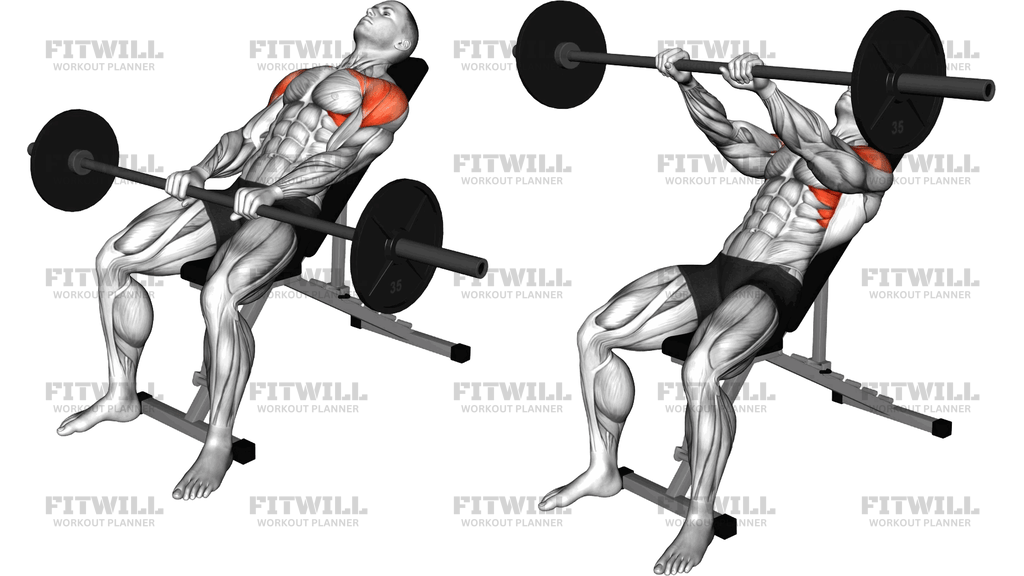
The Barbell Incline Pronated Grip Front Raise is an isolation movement for the front of the shoulders, performed lying back on an incline bench with a barbell held at thigh level using an overhand, shoulder-width grip. From there, you raise the bar in a smooth arc until your arms are roughly in line with your torso and pointed toward the ceiling, then lower it back to your thighs under control. Because the bench is angled rather than flat, the front delts work through a slightly longer range than they do in a standing front raise, which is exactly why this variation earns its place in a shoulder program.
This lift suits intermediate lifters who want to load the anterior deltoid more directly than pressing allows, and it is especially useful for people whose shoulders lag behind their chest and arms. The barbell format enforces symmetry, since both arms must contribute equally or the bar visibly tilts. That makes it a good diagnostic tool as well as a builder: if one side drifts upward first, you have found an imbalance worth addressing while the weights are still light.
Setup matters more here than in most raises. The bench angle, typically set between 30 and 45 degrees, determines how much of the work shifts between the front delts and the upper chest, and it also dictates how much gravity pulls the bar toward your hips. Your back and head should stay in contact with the pad, your feet planted on the floor, and your grip firm but not crushing. A grip that is too narrow crowds the shoulders; too wide and the bar path becomes unstable and the wrists absorb stress they should not.
Execution is deceptively simple: brace your core, keep your arms nearly straight with a soft elbow, and lift the bar by flexing at the shoulder until it travels over your upper chest or slightly beyond. Height is where most lifters go wrong. Swinging the bar far overhead or letting momentum take over turns a deltoid exercise into a full-body heave. Stop where your shoulders finish the job, pause briefly, and bring the bar back along the same path to your thighs.
Common use cases include shoulder-focused hypertrophy days, remedial front-delt work after years of pressing, and as a finishing movement after overhead or incline pressing when the delts are pre-fatigued and respond to lighter, stricter work. Because the incline position removes the ability to use leg drive or torso lean, the exercise is naturally self-limiting.
From a safety standpoint, respect the loading. A barbell raises weight directly over your face and chest while you are pinned against a bench, so start lighter than you think you need, never use a false grip with the thumb removed, and bail by lowering the bar to your thighs and sitting up rather than dropping it. Controlled tempo, honest weight selection, and keeping the wrists neutral will keep this movement productive for years.
[ Workout Log & Planner ]
Put your next workout in Fitwill
Keep your plan and training log ready when you are.


Instructions
- Set an adjustable bench to an incline of roughly 30 to 45 degrees and position it so you have clear space around the bar path.
- Sit on the bench and roll a lightly loaded barbell across your hips, then grip it with an overhand, pronated grip about shoulder-width apart, thumbs wrapped around the bar.
- Lean back onto the bench so your head, upper back, and hips stay in contact with the pad, feet flat on the floor, and let the bar rest across the front of your thighs with arms fully extended.
- Brace your abdominal muscles and gently pull your shoulder blades down and back so you are not shrugging toward your ears.
- Keeping a slight bend in the elbows and your wrists straight, raise the bar in a controlled arc in front of your body until it is level with or slightly above your shoulders, in line with your torso.
- Pause for a beat at the top with the front delts doing the holding, avoiding any swing of the legs or arching off the bench.
- Lower the bar slowly along the same arc until it lightly touches your thighs, maintaining tension rather than letting gravity take over.
- Exhale as you raise the bar and inhale as you lower it, keeping the breathing rhythm steady throughout the set.
- Complete all repetitions, then lower the bar to your thighs, sit up carefully with the bar resting on your legs, and set it down safely on the floor or rack.
Tips & Tricks
- Choose a weight far below what you would press. The front delts are a small muscle and the incline position removes every source of leverage, so loading a barbell here like a press invites sloppy reps.
- If the bar tilts to one side, it usually means the stronger arm is taking over. Slow the tempo down and consciously match the speed of both hands, or temporarily switch to dumbbells to balance the sides.
- Do not chase bar height. Raising the bar well past vertical encourages your upper traps and lower back to pitch in; a raise to shoulder level or a touch above keeps the front delts as the prime mover.
- Check your bench angle before each set. A pad set too steep turns the movement into an incline press pattern, while too shallow lets the bar rest closer to your body and shortens the working range.
- Keep the thumbs wrapped around the bar at all times. With a barbell hovering over your face and chest, an open false grip is an avoidable risk.
- Bend the elbows only slightly, no more than a soft curve. Locked-out elbows are harsh on the joint, and heavily bent elbows turn the raise into a front-delt and biceps hybrid that shortens the lever and cuts the challenge.
- If your wrists ache, your grip is likely too narrow or the bar is resting too far back in the hand. Widen the hands slightly and let the bar sit over the base of the palms, stacked over the forearms.
- Avoid bouncing the bar off your thighs at the bottom of each rep. Let it touch down lightly and re-tighten before the next lift so every repetition starts from a controlled position.
- Place this movement after your heavy presses in the session. Doing a strict barbell raise first will blunt your pressing performance for little benefit.
Frequently Asked Questions
Which muscles does the Barbell Incline Pronated Grip Front Raise work?
The front shoulders, specifically the anterior deltoid, are the primary movers. The upper chest and side shoulders assist, and the upper traps help stabilize as the arm rises.
How does the incline version differ from a standing Barbell Front Raise?
Lying back on an incline bench removes leg drive and torso lean, so you cannot cheat with momentum. The angle also lengthens the working range for the front delts compared with raising from a standing position.
What bench angle should I use for the Barbell Incline Pronated Grip Front Raise?
Set the bench between 30 and 45 degrees. Lower angles make the movement easier and slightly more chest-dominant, while steeper angles increase the demand on the front delts and make the bar feel heavier.
Why does the exercise use a pronated grip instead of a neutral grip?
An overhand grip with the palms facing down positions the shoulder to raise the arm directly in front of the body, which targets the anterior deltoid most directly. It also keeps the wrists in a stable, neutral line over the forearms.
How high should I raise the barbell?
Raise the bar until your arms are roughly in line with your torso, at or just above shoulder height. Lifting far overhead shifts work to the traps and encourages arching off the bench.
Is the Barbell Incline Pronated Grip Front Raise suitable for beginners?
Beginners can do it, but most should start with a very light bar or an empty barbell and focus on learning the path. Many novices get more value from dumbbell front raises first, since the fixed bar exaggerates any left-right imbalance.
My lower back lifts off the bench during the raise. How do I fix it?
The weight is likely too heavy or you are raising the bar too high. Reduce the load, stop at shoulder level, and brace your core before each rep so your ribs stay down and your back stays against the pad.
What can I use instead of a barbell for this movement?
Dumbbells, a plate, or a cable handle all work as substitutes. Dumbbells are the closest match and let each shoulder work independently, which is helpful if the barbell highlights a strength difference between sides.
How many sets and reps should I do?
Because it is a strict isolation movement, two to four sets of 10 to 15 controlled reps is a sensible range. Keep the tempo deliberate rather than chasing heavy weight.
Is it safe to do this exercise without a spotter?
Yes, provided you load conservatively and keep your thumb wrapped around the bar. If a rep fails, lower the bar to your thighs, sit up with it resting on your legs, and set it on the floor rather than trying to press it away or dropping it.