Sitting Abs Twist
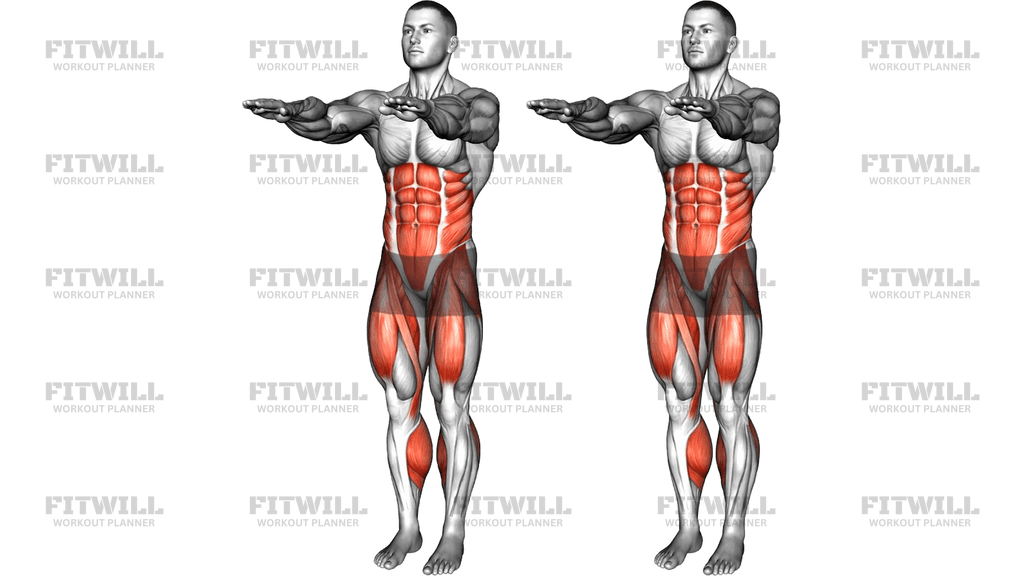
The Sitting Abs Twist is a bodyweight rotational exercise performed from a cross-legged seated position on the floor. With your arms extended straight out in front of your chest, you rotate your upper body from one side to the other, letting your head and shoulders travel together while your hips and legs stay anchored. The illustration highlights the obliques along the sides of the waist, which is exactly where the work should be felt.
This movement is useful for anyone who wants to train rotation without equipment or floor-crawling movements. Because you sit with your legs crossed, your lower body is essentially removed from the equation, which forces the midsection to do the turning. That makes it a good fit for beginners learning what rotational control feels like, for office workers whose midsections rarely rotate during the day, and for lifters who want a low-fatigue way to warm up the trunk before heavier training.
The primary muscles at work are the internal and external obliques, which drive the turning of the ribcage. The rectus abdominis helps hold the trunk together, the deep core stabilizes the spine throughout each turn, and the muscles of the lower back work to keep you upright as your torso sweeps side to side. Holding the arms out at chest height also asks the shoulders and upper back to stay engaged, so the whole trunk gets some work, not just the waist.
Setup matters more than it looks. Sit tall on your sit bones with your legs crossed comfortably, and lift through the crown of your head so your spine is long before you start turning. If you slouch, the twist comes from rounding and collapsing rather than from true rotation, and the obliques stop doing their job. Extend both arms at chest height, roughly parallel to the floor, and keep them there for the entire set.
Execution is about controlled rhythm, not speed. Rotate your torso to one side as far as your range comfortably allows, pause briefly, then sweep through the center to the other side. Each pass through the middle counts toward your reps. Breathe steadily throughout, and avoid letting the hips or knees rock with the movement.
Because it requires no equipment and very little space, the Sitting Abs Twist works well as a warm-up drill, a core finisher, or a daily mobility habit. Keep the tempo moderate, stay honest about your range, and progress by slowing the turns or adding more controlled reps rather than whipping through the motion.
[ Workout Log & Planner ]
Put your next workout in Fitwill
Keep your plan and training log ready when you are.


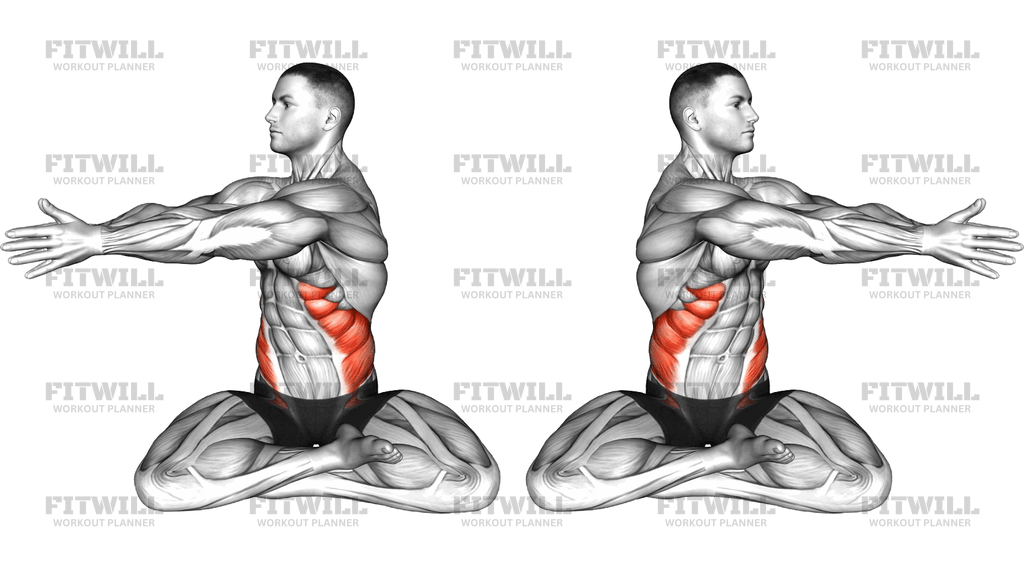
Instructions
- Sit on the floor or an exercise mat with your legs crossed in front of you, resting on your sit bones.
- Extend both arms straight out in front of your chest at shoulder height, hands open and roughly parallel to the floor.
- Sit up tall, lengthening through the crown of your head, and gently brace your abdominal wall.
- Keeping your hips and legs still, rotate your upper body to the right as far as your range comfortably allows.
- Pause for a moment at the end of the turn, keeping both arms level and your chest lifted.
- Sweep your torso back through the center and rotate to the left with the same controlled speed.
- Continue alternating sides in a smooth, deliberate rhythm, counting one rep each time you pass through center.
- Exhale as you turn into each twist and inhale as you return through the middle.
- Keep your head traveling with your shoulders rather than twisting ahead of or behind your chest.
- After your final rep, bring your torso back to center, lower your arms, and release the cross-legged position.
Tips & Tricks
- The most common mistake is rocking the knees and hips with each turn. Imagine your pelvis is glued to the mat and let only your ribcage rotate.
- If your arms droop as the set goes on, your turns are losing value. Either reset the arms to chest height or end the set, since a dropped arm line usually means a collapsed torso.
- Slouching turns this into a spine-rounding exercise instead of an oblique exercise. Re-lengthen your spine between reps if you feel yourself sinking.
- Do not chase extreme range. A controlled three-quarter turn with a tall spine beats a violent full twist that yanks on the lower back.
- Keep your shoulders relaxed and down as the arms extend forward. Shrugging toward your ears steals work from the core and tenses the neck.
- Slow the tempo down instead of adding speed when you want more challenge. A two-second turn each way noticeably increases the oblique demand.
- If sitting cross-legged bothers your knees or hips, sit on a folded mat or low cushion to raise your hips, or extend your legs in front of you while keeping the same tall torso and arm position.
- Warm up your spine with a few gentle seated circles before starting if your back feels stiff, especially in the morning.
Frequently Asked Questions
Which muscles does the Sitting Abs Twist work?
The internal and external obliques do most of the work as they rotate the ribcage. The rectus abdominis and deep core stabilize the trunk, while the lower back muscles keep you sitting tall and the shoulders hold the arms at chest height.
Is the Sitting Abs Twist good for beginners?
Yes. It requires no equipment, happens in a stable seated position, and the range is easy to self-regulate. Beginners should focus on a tall spine and a controlled tempo before worrying about how far they turn.
Why do the arms stay extended in front of the chest during the Sitting Abs Twist?
The extended arms lengthen the lever your torso rotates with, which gives the obliques more resistance and makes the rotation visible. They also give you a clear feedback line: if the arms drop or drift, your torso position has slipped too.
Should my hips move during the Sitting Abs Twist?
No. The hips and crossed legs should stay anchored to the floor while only your upper body rotates. If your pelvis is rocking side to side, slow down and reduce the range until the movement comes purely from the ribcage.
How many reps of the Sitting Abs Twist should I do?
Ten to twenty alternating turns, counting a rep each time you pass through center, works well for most people. Because the load is light, quality of rotation matters far more than chasing a high number.
Can I add weight to the Sitting Abs Twist?
Once your form is consistent, you can hold a light medicine ball or plate at your chest to increase the rotational demand. Keep the weight modest, because the seated position offers less support for heavy loads than standing rotations.
Is the Sitting Abs Twist safe for my lower back?
For most people, yes, as long as the turns are controlled and done within a comfortable range. Sit tall, avoid fast whipping motions, and stop if you feel sharp pain rather than muscular effort. If you have a back condition, check with a qualified professional first.
Can I do the Sitting Abs Twist every day?
Yes, its low-load nature makes it suitable for frequent practice, and many people use it as a daily mobility drill. Just keep the reps moderate so the obliques and lower back are not fatigued before heavier training sessions.
What can I substitute if sitting cross-legged is uncomfortable?
Sit on a low cushion or folded mat to elevate your hips, or perform the same arm-and-rotation pattern seated on a bench with your feet flat on the floor. The key elements, a tall spine and hips staying still while the torso rotates, stay the same.