Standing Russian Twist
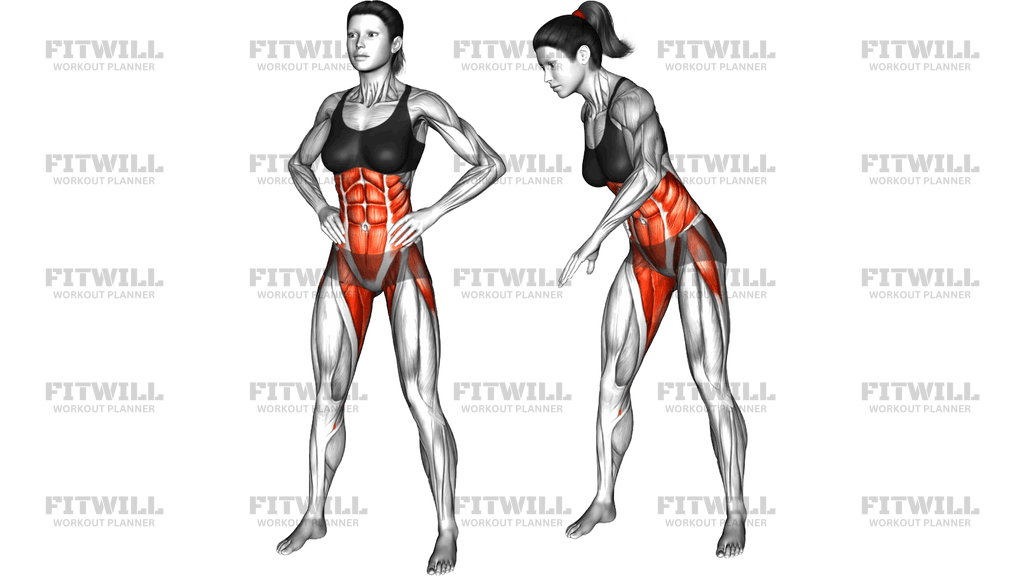
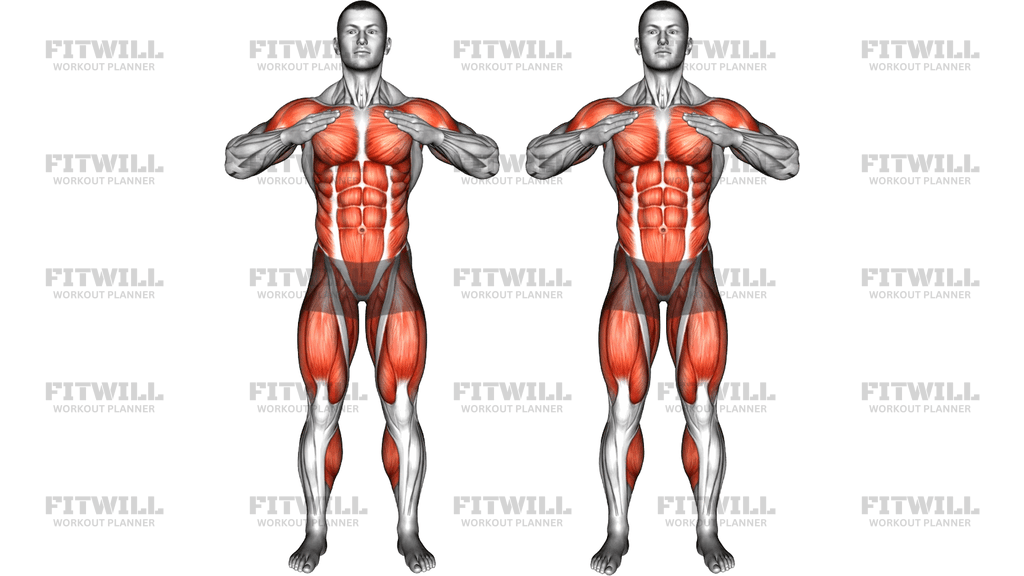
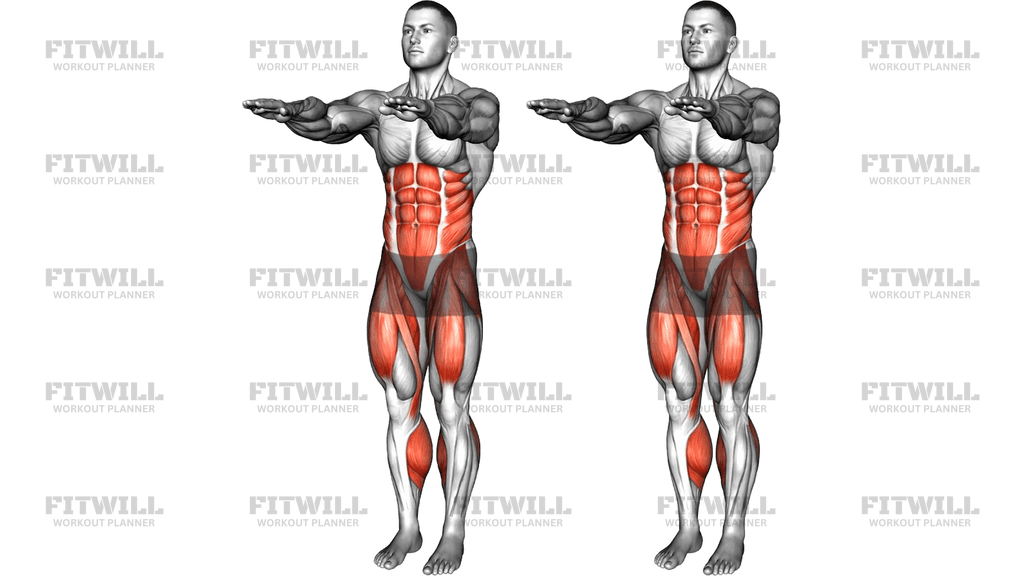
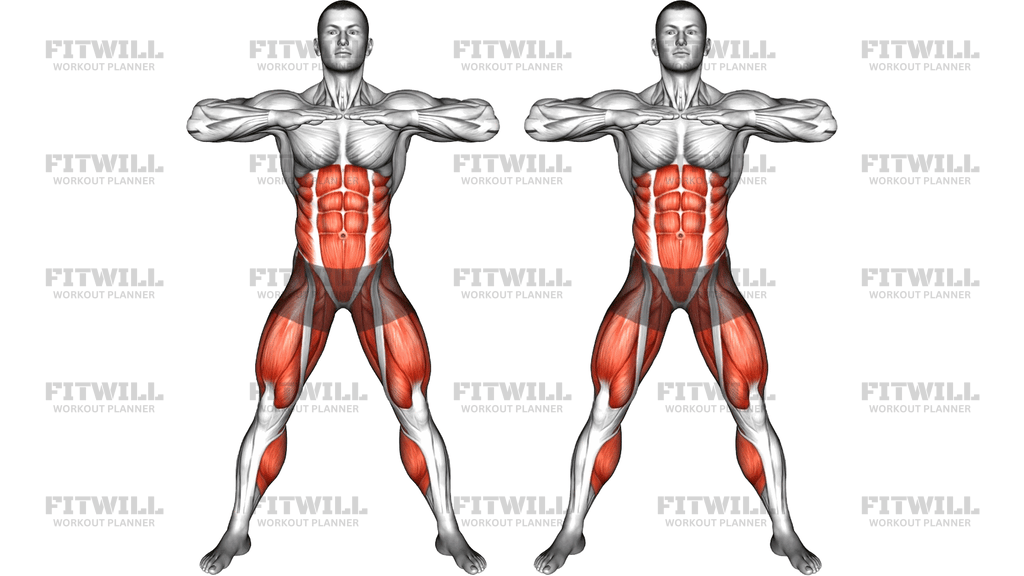
The Standing Russian Twist is a rotational core exercise performed on your feet with no equipment required. You stand with a wide, stable stance, extend both arms straight out in front of your chest, and twist your entire torso from side to side while your hips and legs stay planted. Because you are upright rather than seated or lying down, your core has to work both to produce the rotation and to keep your torso tall throughout the set.
This movement targets the obliques along the sides of your waist, with steady support from the deep core muscles that brace your spine. The standing position also quietly trains your balance and hip stability, since your legs have to resist the twisting motion instead of joining it. That makes it a practical choice for anyone whose daily life or sport involves turning, swinging, or changing direction.
The setup matters more than it looks. A stance about shoulder-width or slightly wider gives you a solid base, and keeping the arms extended at chest height acts as a long lever that forces the rotation to come from your ribcage and waist rather than from your shoulders. If the arms drop or the elbows bend, the movement gets shorter and the obliques stop doing the work.
To perform it well, brace your midsection as if preparing for a light push, then rotate your upper body deliberately to one side until you feel the twist through your waist, pause briefly, and rotate through the center to the opposite side. The motion should feel controlled in both directions, not flung. Your hips stay facing forward the whole time; letting them swing with the turn removes most of the challenge.
The Standing Russian Twist fits well into warm-ups, circuit training, and core finishers. It is also a friendly starting point for people who find floor-based twisting work uncomfortable on the lower back or hips, since the upright torso is easier to control. Start with slow rotations and no added resistance, and only progress the speed or add a light object once you can keep your hips square and your spine tall for a full set.
[ Workout Log & Planner ]
Put your next workout in Fitwill
Keep your plan and training log ready when you are.


Instructions
- Stand with your feet roughly shoulder-width apart or slightly wider, toes pointed forward, and let your knees stay soft rather than locked.
- Raise both arms straight out in front of your chest at shoulder height, hands together or lightly touching, elbows fully extended.
- Pull your shoulders back and down, lift your chest, and brace your midsection as though bracing for a light push to the stomach.
- Keeping your hips and feet facing forward, rotate your upper body to the right as far as you can control, turning from the ribcage and waist.
- Pause for a beat at the end of the rotation so the twist comes from your trunk, not from momentum.
- Rotate smoothly through the center and continue to the left side at the same controlled speed.
- Keep breathing steadily throughout: exhale as you rotate into each turn and inhale as you come back through the middle.
- Continue alternating sides for your target number of repetitions or time, keeping the arms level with your chest the entire set.
- To finish, slow the rotation down, bring your torso back to face forward, and lower your arms before stepping out of the stance.
Tips & Tricks
- If your hips swing with your shoulders, imagine your belt buckle pointed at a target in front of you for the whole set. The twist should happen above the waist, not below it.
- Dropping arms is the most common breakdown. If your hands sink below chest level, that is a sign your shoulders are taking over; reset the arms or end the set.
- Resist twisting at maximum speed early on. Fast, loose rotations let momentum do the work, while a one-second pause at each end keeps tension on the obliques.
- Keep your knees slightly bent. Locked knees combined with a hard twist puts unnecessary stress on your lower back.
- Do not force the end range. Rotate only as far as you can while keeping your torso upright; leaning backward to gain a few extra degrees defeats the purpose.
- Your head should travel with your shoulders rather than staying fixed forward, but keep your eyes level instead of letting your chin drop.
- Once bodyweight rotations feel easy, hold a light medicine ball or weight plate at your chest to lengthen the lever, but only if your hips stay square.
- Breathe through the movement instead of holding your breath. A held breath plus rotation tends to build pressure and make you stiff rather than stable.
- If your lower back feels pinched, reduce the rotation range and focus on keeping your ribcage stacked over your pelvis throughout the turn.
Frequently Asked Questions
Which muscles does the Standing Russian Twist work?
The obliques on the sides of your waist are the main movers, with the rectus abdominis and deep core muscles bracing your spine. Your hips and legs also work isometrically to keep your lower body from rotating.
Is the Standing Russian Twist good for beginners?
Yes, it is one of the more approachable rotational exercises because the upright position is easy to control and no equipment is needed. Beginners should start with a slow, moderate range and master keeping the hips square before adding speed or load.
Why do my hips keep turning during the Standing Russian Twist?
Your hips usually rotate when the range is too aggressive or the stance is too narrow. Widen your feet, slow the tempo, and think of twisting from the ribcage while your belt buckle stays pointed forward.
Should I keep my arms straight in the Standing Russian Twist?
Yes, the extended arms at chest height act as a lever that makes the rotation come from your trunk. Bending the elbows or dropping the arms shortens the lever and shifts the work toward your shoulders.
How is the Standing Russian Twist different from the seated version?
The seated version rounds the torso and usually involves a weight touching the floor, while the standing version keeps your spine tall and removes floor contact. The standing variation is often friendlier to the lower back and adds a balance demand.
Can I add weight to the Standing Russian Twist?
Once you can keep your hips facing forward and your arms level for a full set, hold a light medicine ball or plate close to your chest. Add load gradually, because extra weight makes rotation errors much more obvious.
How many repetitions of the Standing Russian Twist should I do?
A typical set is 10 to 20 total rotations, counting each side-to-side trip as one, or 20 to 40 seconds of continuous controlled twisting. Slow down rather than adding reps if your form starts to slip.
Is the Standing Russian Twist safe for my lower back?
For most people it is a low-strain option because the torso stays upright and the load is light. Keep your knees soft, brace your midsection, and stay within a comfortable rotation range; if twisting causes discomfort, shorten the range or consult a professional.
Can I use the Standing Russian Twist in a warm-up?
Yes, it works well as an activation drill before sports or lifting sessions that involve rotation, such as swinging, throwing, or martial arts. Use a smaller range and a relaxed pace when it is part of a warm-up.