Dumbbell One Arm Low Fly
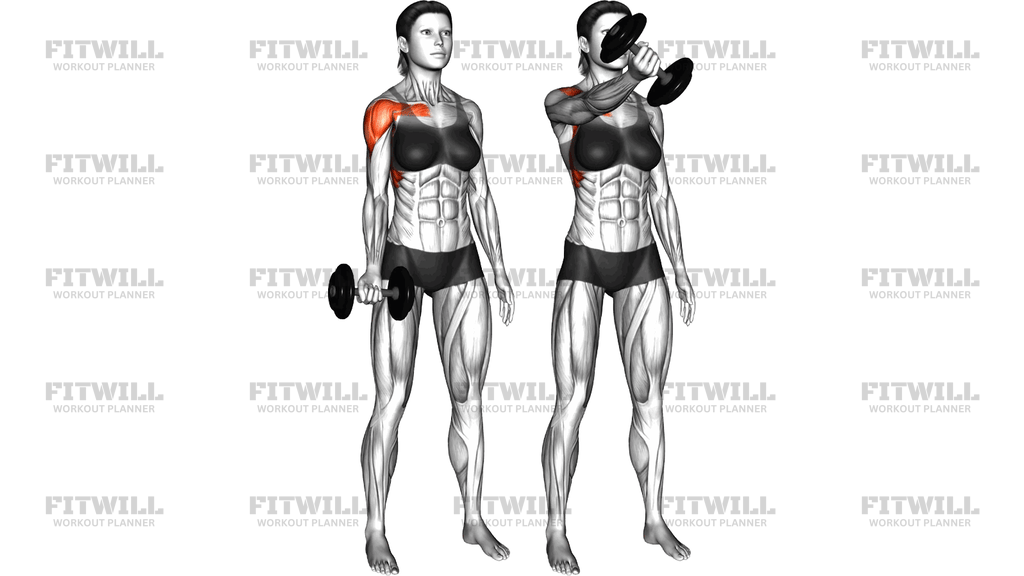
The Dumbbell One Arm Low Fly is a standing, single-arm movement where you sweep a dumbbell from a low position beside your thigh up and slightly across the front of your body until your arm reaches roughly eye level. Because you work one side at a time with the arm slightly adducted toward the midline at the top, the emphasis lands on the upper portion of the chest and the front of the shoulder, while your core works to keep your torso from twisting as the weight travels.
This exercise suits lifters who want to isolate the clavicular fibers of the chest without lying on a bench, and it is a good option when a bench is unavailable or when you want to add unilateral work to a shoulder and chest day. It is also useful for exposing left-to-right differences. If one arm fatigues faster or your torso rotates more on one side, that asymmetry becomes obvious quickly, and you can address it with equal-volume single-arm work.
The setup matters more than it looks. Standing tall with a light dumbbell, a soft bend in the knees, and a stable stance gives your arm a fixed anchor to sweep from. If your feet are narrow or your torso leans back, momentum from the hips replaces tension in the chest and front shoulder, and the movement turns into a sloppy swing. Keeping the working arm mostly straight with only a slight elbow bend preserves the fly character of the arc, so the dumbbell travels along a wide path rather than being curled upward.
Execution should feel like an arcing scoop. Start with the dumbbell beside your thigh, palm facing your leg, then raise it forward and slightly inward along a smooth diagonal until your hand is about level with your face or upper chest. Pause briefly at the top without shrugging, then lower along the same path under control until the dumbbell returns to your thigh. Breathe out as you raise, in as you lower, and finish all reps on one side before switching hands.
In practice, this movement fits best as an accessory after heavier pressing, typically for two to four sets of ten to fifteen reps per arm. Choose a weight you can stop at the top without launching, since the shoulder is working in a long lever position and the top of the arc is where form tends to break down. If you feel it more in your neck or the front of your shoulder joint than in your chest, the weight is likely too heavy or the arc too far outside your natural shoulder line.
[ Workout Log & Planner ]
Put your next workout in Fitwill
Keep your plan and training log ready when you are.


Instructions
- Stand with your feet about hip-width apart, knees slightly bent, holding one dumbbell in your right hand at your side with your palm facing your thigh.
- Brace your core and pull your shoulder blades down and back so your torso stays tall and does not rotate during the sweep.
- With a soft, nearly fixed bend in your elbow, sweep the dumbbell forward and slightly toward the midline of your body, as if tracing a wide arc from your thigh to the opposite shoulder.
- Continue raising until your hand is roughly at eye or upper-chest level, keeping your shoulder down instead of shrugging toward your ear.
- Pause for a beat at the top, feeling the upper chest and front shoulder under tension, without locking or snapping the elbow straight.
- Lower the dumbbell slowly along the same diagonal path back to the starting position beside your thigh, resisting the pull of gravity rather than dropping the arm.
- Exhale as you raise the dumbbell, inhale as you lower it, keeping the breath steady throughout the set.
- Complete all planned reps on the right arm, then switch the dumbbell to your left hand and repeat for the same number of reps.
- Reset your stance and brace between sides, and only add weight once the arc stays smooth on both arms.
Tips & Tricks
- The most common mistake is turning this into a swing: if the dumbbell flies up with a hip thrust or torso lean, drop the weight until the lift comes purely from the shoulder and chest.
- Keep the elbow bend constant. If the arm straightens at the bottom and bends more at the top, you are drifting into a front raise and lose the fly-style stretch across the chest.
- Stop the arc at about eye level and slightly toward your midline. Raising the dumbbell directly out to the side shifts work away from the upper chest and loads the side shoulder instead.
- Watch for trunk rotation toward the working arm, a sign the core is disengaging; grip the floor with your feet and think of pointing your chest forward the whole time.
- Do not let the shoulder blade creep up at the top of the rep. Keep it depressed so the front shoulder does the moving, not the traps.
- Because each arm works alone, start with your weaker side and match the reps with your stronger side rather than doing more reps on your good arm.
- A very light dumbbell is honest here: the long lever from a nearly straight arm makes a modest weight feel heavy at the top, so progress in small jumps.
- If your shoulder joint complains at the top of the arc, reduce the range slightly rather than forcing the hand to face height.
- Control the lowering phase to a two- or three-count; the eccentric is where you feel the chest fibers lengthen, and rushing it removes most of the benefit.
Frequently Asked Questions
What muscles does the Dumbbell One Arm Low Fly work?
The primary targets are the upper chest fibers and the front of the shoulder, with the core stabilizing your torso as the weight arcs across the body. The traps and grip work lightly to hold the shoulder position and the dumbbell.
Is the Dumbbell One Arm Low Fly suitable for beginners?
Yes, as long as you start with a light dumbbell and focus on a smooth, controlled arc. Beginners often benefit from this exercise because the single-arm setup immediately reveals any twisting or swinging that needs correcting.
How high should I raise the dumbbell in the Dumbbell One Arm Low Fly?
Raise the dumbbell until your hand is roughly at eye or upper-chest level, angled slightly toward the middle of your body. Going higher than that usually means shrugging or arching backward rather than adding chest work.
Why does only one arm work at a time in this exercise?
The single-arm format forces your core to resist rotation and lets each side of your chest work independently, which helps balance out strength differences between your left and right sides.
What is the difference between the Dumbbell One Arm Low Fly and a regular front raise?
A front raise lifts the weight straight up in front of the shoulder, while the low fly sweeps the dumbbell along a wide diagonal arc toward the midline, which keeps tension on the upper chest as well as the front shoulder.
How heavy should the dumbbell be?
Choose a weight you can sweep to eye level without leaning back, shrugging, or swinging your hips, typically much lighter than what you would use for a pressing exercise. If the last few reps need momentum, the dumbbell is too heavy.
Can I do the Dumbbell One Arm Low Fly if I do not have a bench?
Yes, that is one of its main advantages. It is performed entirely standing with a single dumbbell, so it works well in minimal setups or as a bench-free accessory on chest day.
What should I do if I feel this more in my neck or traps than my chest?
Check that your shoulder blade stays pulled down throughout the arc and that you are not shrugging at the top. Reducing the weight and shortening the range slightly usually brings the tension back to the chest and front shoulder.
Where should the Dumbbell One Arm Low Fly fit in my workout?
Use it as an accessory after your main chest or shoulder presses, for two to four sets of ten to fifteen reps per arm. It pairs well with other unilateral dumbbell work late in a session when fatigue from heavy lifting is not an issue.