Lever Belt Deadlift
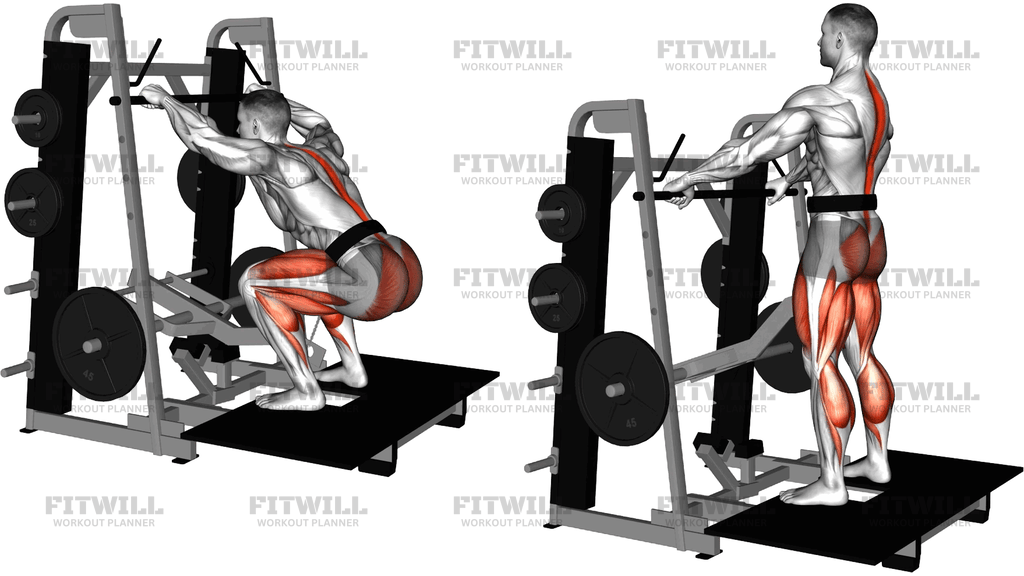
The Lever Belt Deadlift is a plate-loaded machine version of the classic deadlift, performed on a leverage machine that combines a waist belt with a set of front handles. Instead of gripping a free barbell, you strap a belt around your hips that connects to the machine's lever arm, then hold the fixed handles in front of you while your body moves from a deep squat up to a full standing position. The weight plates ride on the lever, so resistance stays consistent and the machine guides the path of the load.
This setup is useful for lifters who want the hip-dominant, full-body pulling pattern of a deadlift without the balance demands and spinal loading position of a barbell. Because the handles are fixed and the lever arm stabilizes the weight, you can focus entirely on driving through your legs and hips. It is a solid choice for beginners learning the deadlift pattern, for lifters rehabbing back into heavy hip extension, or for anyone training in a commercial gym where a leverage rig is available.
The movement trains the entire posterior chain. The glutes and hamstrings produce most of the hip extension force, the quads work hard from the deep bottom position, and the lower back muscles, highlighted heavily in this exercise, contract isometrically to keep the torso upright and rigid throughout the pull. The traps, upper back, forearms, and calves contribute as supporting muscles, especially near lockout.
Setup matters more here than it might seem. The belt must sit snugly across your hips, your feet must be planted flat on the platform at roughly hip width, and your grip on the handles should be relaxed rather than white-knuckled, since the belt and lever, not your hands, carry the load. Starting from the deep squat position with arms extended forward and finishing tall with arms down at your sides keeps the resistance path in line with your hips.
Execution is straightforward: brace hard, push the floor away, and stand up by extending the knees and hips together, keeping the chest lifted. Pause briefly at the top without leaning back, then reverse the motion under control until you return to the bottom position. Because the machine removes some of the stabilization demand, it is tempting to rush, but controlled reps with a deliberate pause at the top produce far better results than bouncing through the bottom.
The main practical advantage is safety and repeatability. The guided lever path limits how far your torso can drift into a compromised position, which makes this a reliable option for higher-rep posterior chain work or for pushing close to fatigue without a spotter. Treat it as a complement to free-weight deadlifting, not a total replacement, since the stabilizing work a barbell demands is reduced here.
[ Workout Log & Planner ]
Put your next workout in Fitwill
Keep your plan and training log ready when you are.


Instructions
- Load the appropriate weight plates onto the lever arm's plate pegs, starting lighter than your barbell deadlift weight until you learn the machine's feel.
- Stand on the platform with your feet about hip-width apart, toes angled slightly out, and position yourself so the belt attachment hangs directly in front of your hips.
- Fasten the belt snugly around your hips, just below the waist, so it is secure but not digging in, and confirm it is connected to the lever arm.
- Grip the front handles with your arms fully extended, then squat down into the starting position with your chest up, back flat, and hips below knee level.
- Take a deep breath into your belly and brace your core and lower back before initiating any pull.
- Drive your feet through the platform and stand up by extending your knees and hips at the same time, keeping the handles moving along the machine's guided path.
- Finish standing tall with your arms down at your sides, hips fully extended, and shoulders back without leaning backward.
- Pause for a moment at the top, then inhale and lower yourself back into the deep squat by pushing your hips back and bending your knees under control.
- Exhale at the top of each rep and reset your brace before the next repetition.
- Complete your set, then let the lever arm settle onto its rest before releasing the handles and unstrapping the belt.
Tips & Tricks
- Do not turn this into a squat by bouncing out of the bottom. The value is in the hip extension, so pause briefly in the deep position and drive up deliberately.
- Keep your grip on the handles loose. Your arms should act as linkages; squeezing the handles hard just fatigues your forearms and pulls your shoulders forward.
- Check the belt height before each set. A belt riding too high on the waist transfers force awkwardly, while one sitting on the hips pulls evenly through the lever arm.
- If your heels lift off the platform as you stand, widen your stance slightly or turn your toes out a few more degrees so you can stay flat-footed.
- Avoid hyperextending at the top. Standing tall with glutes squeezed is enough; arching back under load strains the lower back without adding muscle stimulus.
- Because the machine stabilizes the weight, it is easy to add plates quickly. Progress in small increments and keep the chest-up position honest at the bottom.
- Keep your shoulders directly over the handles at the start. Letting them drift behind the load turns the lift into a strain on the shoulders rather than a hip drive.
- Breathe in a consistent pattern: big brace at the bottom, exhale at the top. Losing the brace mid-rep is the most common cause of a rounded pull on this machine.
- If your lower back rounds at the bottom position, reduce the depth slightly by raising the starting height if the machine allows, or reduce the load until your spine stays neutral.
Frequently Asked Questions
What muscles does the Lever Belt Deadlift work?
It primarily targets the glutes, hamstrings, and lower back, with strong involvement from the quads out of the deep bottom position. The traps, upper back, forearms, and calves work as supporting muscles.
How is the Lever Belt Deadlift different from a barbell deadlift?
The weight is attached to your hips via a belt and moves along a fixed lever path, so your grip and spinal stabilizers are challenged less. You still get the hip hinge and squat-to-stand pattern, but with more guidance and less balance demand.
Is the Lever Belt Deadlift good for beginners?
Yes, it is one of the friendlier ways to learn a heavy hip extension pattern because the machine controls the load path. Start light, master the brace and the drive through the floor, then progress gradually.
Why does the Lever Belt Deadlift use a belt instead of hand grip?
The belt transfers the load directly to your hips, which removes grip strength as a limiting factor. That lets your legs and glutes handle heavier work without your forearms giving out first.
How deep should I start each rep of the Lever Belt Deadlift?
Start from a deep squat with your hips below knee level and your back flat, matching the position shown in the setup. If your lower back rounds at that depth, reduce the range slightly until you can keep a neutral spine.
Should my arms stay straight during the Lever Belt Deadlift?
Yes, keep your arms extended and relaxed on the handles throughout the rep. Bending your elbows or pulling with your arms shifts tension away from the hips and onto the upper body.
What is the most common mistake on this machine?
Rushing and bouncing out of the bottom, which uses momentum instead of muscle. Another frequent error is arching back excessively at lockout; finish tall with the glutes squeezed instead.
Can I use the Lever Belt Deadlift as a substitute for barbell deadlifts?
It works well when you want to train the same hip extension pattern with less spinal and grip stress, but it should not fully replace barbell work if you are preparing for strength sports. Use it as a primary lift, accessory, or deload option depending on your goals.
How should I breathe during the Lever Belt Deadlift?
Inhale and brace your core at the bottom before you pull, hold that brace through the drive, and exhale once you reach the top. Reset your breath and brace before each repetition.
Is it safe to go heavy on the Lever Belt Deadlift?
The guided lever path and belt attachment make it one of the safer ways to push heavy hip extension, especially without a spotter. Still, only add weight when you can keep your chest up and spine neutral through every rep.