Spiderman Front Plank
The Spiderman Front Plank is a dynamic core exercise performed from a high plank position on your hands, where you alternately draw one knee up toward the same-side elbow along the outside of your body — the crawling path that gives the movement its name. Unlike a static plank, your trunk has to resist rotation and extension every time a knee travels forward, which is exactly what makes it more demanding than it looks.
The main work comes from the obliques and deep core, which brace against the twisting pull of the moving leg, while the hip flexors drive the knee forward and the glutes and quads keep the trailing leg active. Because you are supporting yourself on straight arms, the shoulders, chest, and triceps also work isometrically for the entire set, and the wrists take on a stabilization role that many floor-based core exercises skip.
This movement suits anyone who has already built a basic plank and wants more challenge without adding equipment. It is a common fit in warm-ups for lower-body training days, since it opens up the hips and wakes up the lateral core before squats or lunges, and it also works well as a finisher in circuits. Combat athletes and field-sport players often use it because the diagonal knee-to-elbow path resembles real cutting and rotation demands.
Setup quality determines everything here. Hands should sit directly under the shoulders with fingers spread, and your body should form one straight line from head to heels before the first rep starts. If your hips start high or your lower back is already sagging, every knee drive will exaggerate that fault instead of training the brace you want.
As you execute the rep, think of the knee traveling wide and forward — outside the elbow, not underneath your chest — while your shoulders stay stacked over your hands and your hips stay level. The working side collapses slightly toward the knee, but the opposite hip should never swing up toward the ceiling or drop toward the floor.
Move slowly enough that your foot actually touches down lightly beside your hand before you return it, and keep breathing in a steady rhythm rather than holding your breath as the reps get harder. If you notice your hips hiking, your hands creeping forward, or your lower back arching, stop and reset rather than grinding out sloppy reps.
[ Workout Log & Planner ]
Put your next workout in Fitwill
Keep your plan and training log ready when you are.


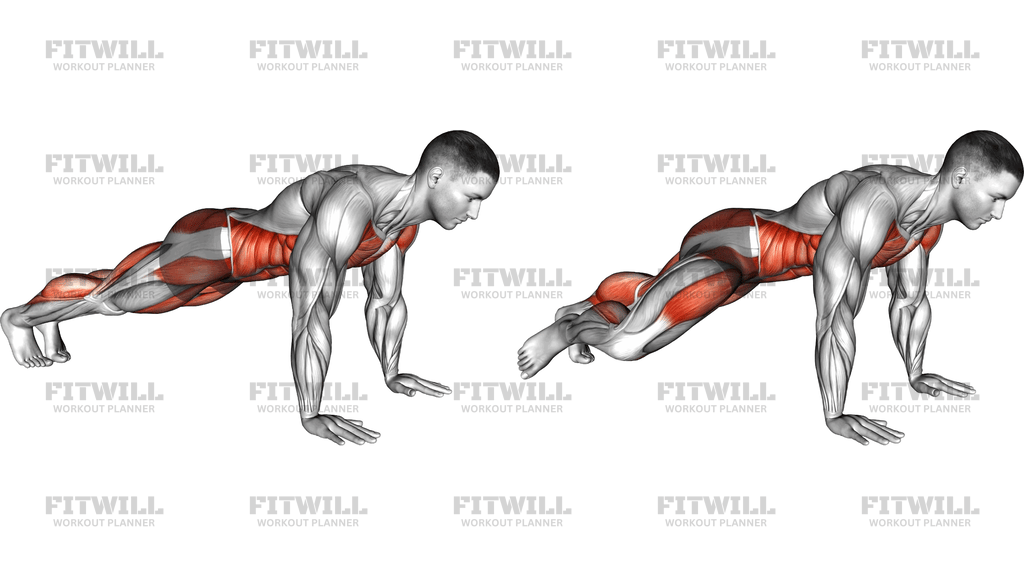
Instructions
- Start on hands and knees on a mat or non-slip surface, then walk your hands forward slightly and extend both legs back so you are in a high plank with hands directly under your shoulders and fingers spread wide.
- Squeeze your legs together, tighten your glutes, and check that your body forms a straight line from head through hips to heels before moving.
- Brace your core as if preparing for a light push to the ribs, and keep your neck neutral by looking at a spot on the floor about a foot in front of your hands.
- Exhale and lift your right foot off the floor, bending the knee and driving it forward and out to the side, outside your right elbow.
- Touch the right foot down lightly beside the hand, keeping the left leg straight and the hips as level as possible.
- Pause briefly in the closed position and feel the right obliques working to keep your trunk from rotating.
- Inhale and slowly return the right foot to the starting plank position, re-extending the hip fully.
- Repeat on the left side, drawing the left knee toward the left elbow along the same wide path.
- Continue alternating sides for your target reps or time, exhaling on each knee drive and inhaling on each return.
- When finished, walk your knees back under your hips and sit back to reset before standing up.
Tips & Tricks
- The most common fault is letting the hips swing up as the knee comes forward — cue yourself to press the floor away and keep the pelvis square to the ground throughout the knee drive.
- If your shoulders drift back behind your wrists as the set gets tiring, walk your hands back so they sit directly under the shoulders again; a shifted hand position turns this into a shoulder exercise and stresses the wrists.
- Aim the knee outside the elbow, not under the chest. If the knee tracks underneath you, the hip is internally rotating and you lose most of the oblique challenge.
- Slow the return leg down rather than the knee drive — most people snap the foot back fast, which lets the lower back arch and removes tension from the trailing glute.
- Spread your fingers and grip the floor; this small habit unloads the wrists and steadies the shoulders during the weight shift toward the working side.
- If you feel your lower back, check that the planted leg stays fully extended and the glute on that side stays engaged — a soft trailing hip is usually the real culprit, not a weak core.
- Round two or three seconds per rep instead of rushing; this exercise rewards control far more than speed, and fast reps usually mean the hips are rotating freely.
- If the full range is too hard, shorten it by bringing the knee only halfway toward the elbow while keeping the hips level, and progress the range as your control improves.
- Place a mat under your knees as well as your hands if you plan to reset between sets — dropping from plank to the floor with tired arms is where most wrist scrapes and face plants happen.
Frequently Asked Questions
What muscles does the Spiderman Front Plank work?
The obliques and deep core do most of the work as they resist rotation while each knee travels toward the elbow. The hip flexors move the leg, and the shoulders, chest, triceps, and glutes hold the plank position isometrically.
How is the Spiderman Front Plank different from a regular plank?
A regular plank is static, while the Spiderman Front Plank adds a moving leg that creates a rotational pull your core has to fight. This makes it harder on the obliques and hip flexors and requires more shoulder and wrist stability.
Should the knee go inside or outside the elbow?
Outside. Driving the knee wide along the outside of the elbow is what targets the obliques and hip external rotators; bringing the knee under the chest turns the rep into a generic knee tuck and loses the rotation-resisting benefit.
Is the Spiderman Front Plank good for beginners?
It can be, but only after a basic high plank or forearm plank feels solid for 30 seconds or more. Beginners should shorten the range by bringing the knee halfway toward the elbow and focus on keeping the hips level rather than reaching the foot all the way to the hand.
Why do my hips keep rising during the movement?
Hiking the hips is usually the body compensating for a weak brace or tight hip flexors. Slow the rep down, deliberately squeeze the glute of the planted leg, and picture the pelvis as a bowl of water you cannot tip in either direction.
Can I do the Spiderman Front Plank on my forearms instead of my hands?
Yes, the forearm version reduces wrist and shoulder strain while keeping the same knee-to-elbow path. You lose some of the shoulder-stabilizing demand, but the core challenge stays largely intact.
How many reps should I do?
Start with 5-8 controlled reps per side, or 20-30 seconds of continuous alternation, and build from there. Because the emphasis is control and anti-rotation, quality reps at a moderate tempo beat fast high-rep sets.
Where should this exercise fit into my workout?
It works well as a hip and core activator in your warm-up before squats, deadlifts, or running, or as a mid-circuit core station. Doing it first in a session also means your shoulders and wrists are fresh enough to hold a clean plank position.
What can I use instead if my wrists hurt during the Spiderman Front Plank?
Switch to the forearm version, or place your hands on dumbbell handles or a bar in a rack so your wrists stay neutral. Both options keep the same movement pattern while removing the extended-wrist position.
Is it safe for people with lower back issues?
The movement is generally spine-friendly because the plank position loads the core without flexing the lower back, but anyone with a history of back problems should keep the range modest and stop if symptoms appear. Checking with a qualified professional before adding new loaded core work is always a sensible step.