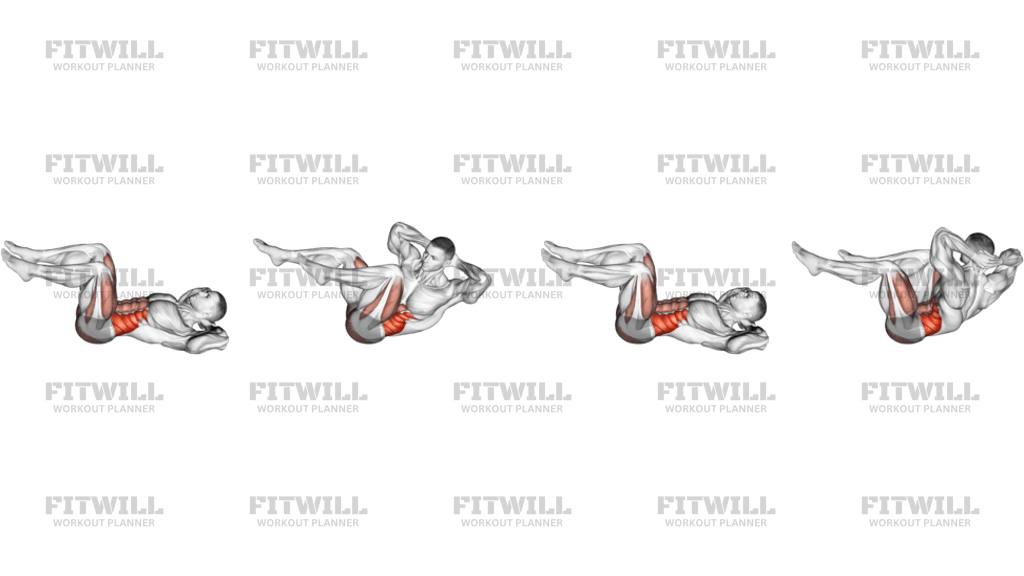
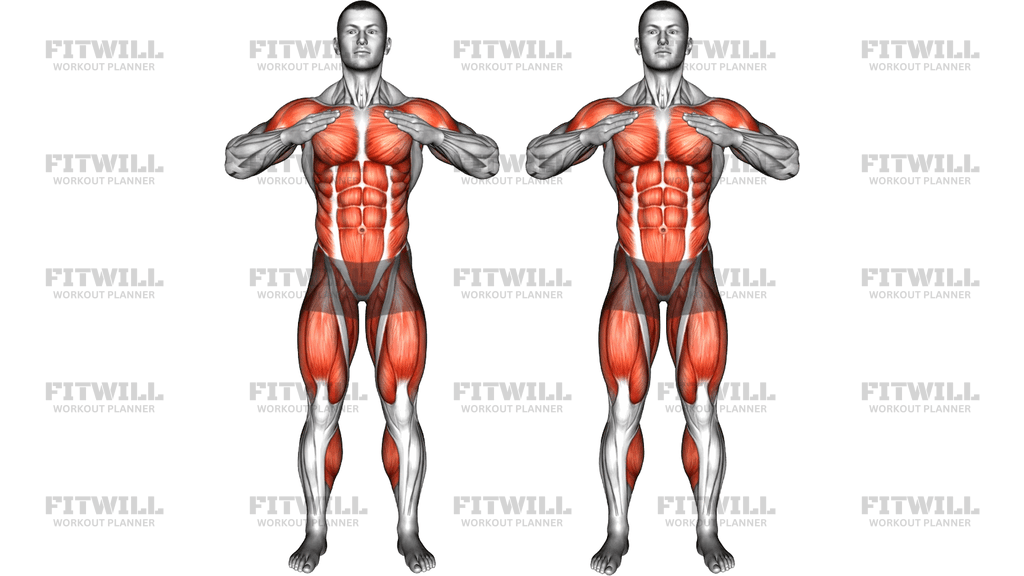
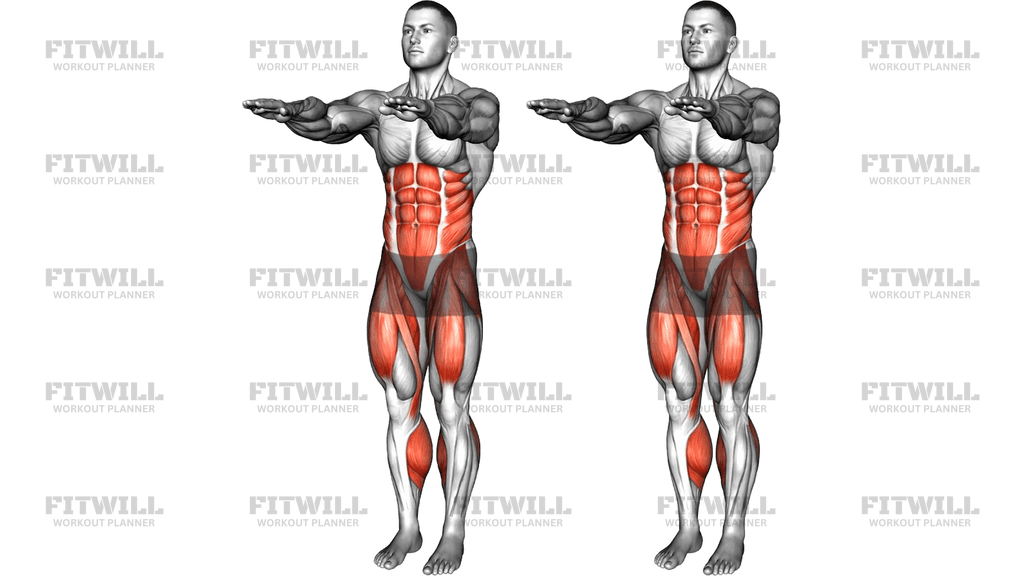
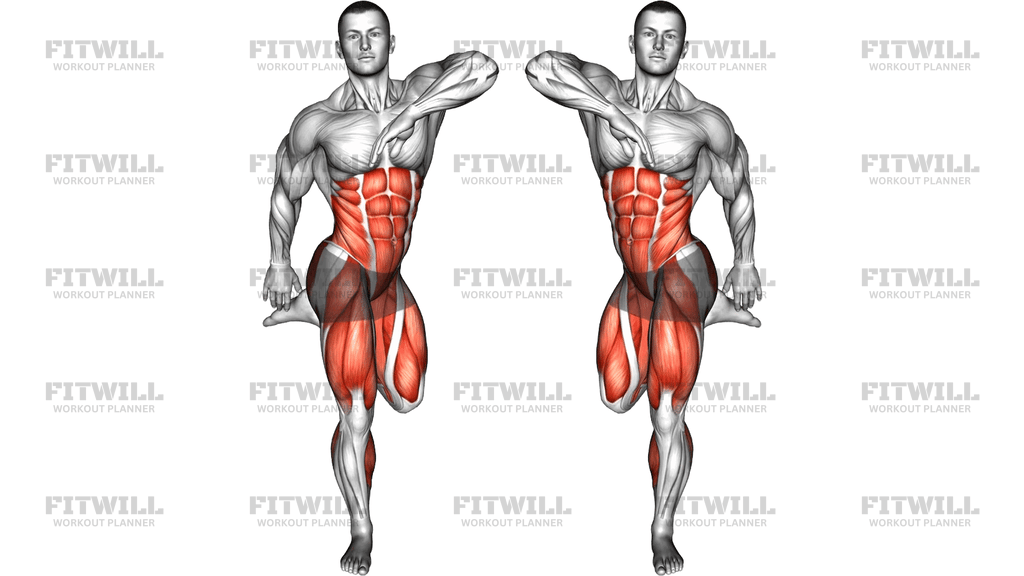
Side Plank Toe Tap
The Side Plank Toe Tap is a lateral core exercise that combines an isometric side plank hold with a controlled tapping motion of the top foot. You hold yourself up on one forearm with the body in a straight line, feet stacked, and the top arm reaching toward the ceiling. From there, you lower the top leg and tap its toes against the floor beside or slightly behind the bottom foot, then lift it back up without letting the hips drop or rotate. Each tap challenges the obliques to keep the torso level while the leg moves independently.
This movement is useful for anyone who has already built a basic side plank and wants to add a dynamic element without loading the spine with external weight. The bottom side of the waist works hard the entire time to hold the plank, while the top hip goes through active abduction and adduction with every tap. That combination makes it a favorite in athletic conditioning, Pilates-style mat work, and general core routines alike, because it trains both stabilization of the trunk and controlled movement of the hip in the same rep.
The setup matters more here than in most floor exercises. Your support elbow should sit directly under the shoulder so the joint stacks vertically, and your feet should be stacked with the bottom foot a bit behind the top foot if you need extra balance. If the elbow drifts forward or the hips sag toward the floor, the shoulder and lower back take over work that belongs to the obliques. Take a moment to line everything up before you start tapping, and keep the top arm extended to give yourself a long lever that encourages a tall, open torso position.
To execute it well, brace the trunk as if bracing for a light push, then lift the hips so the body forms one straight line from head to heels. Lower the top leg with intent, tap the toes down, and lift it back to the stacked position with the same control. The tempo should feel smooth rather than snappy, since the value comes from resisting rotation while the leg travels. Breathe steadily throughout and avoid holding your breath, which tends to cause the ribs to flare and the hips to sag.
Common use cases include core finishers, warm-up activation for sports that involve lateral movement, and progressions for people whose standard side planks have become easy. Because only a small amount of floor space and no equipment are required, it travels well to hotel rooms, outdoor sessions, and home workouts. Place it after heavier strength work or as part of a circuit of two to three sets per side.
The main safety consideration is the support shoulder. If you feel pinching or discomfort at the shoulder joint, come down, reset with the elbow truly under the shoulder, and shorten your hold. It is also normal for the working side of the waist to burn quickly; that is the target area doing its job. If the hips keep dropping no matter how you brace, regress to a side plank from the knees before returning to this version.
Fitwill
Log Workouts, Track Progress & Build Strength.
Achieve more with Fitwill: explore over 9600 exercises with images and videos, access built-in and custom workouts, perfect for both gym and home sessions, and see real results.
Start your journey. Download today!




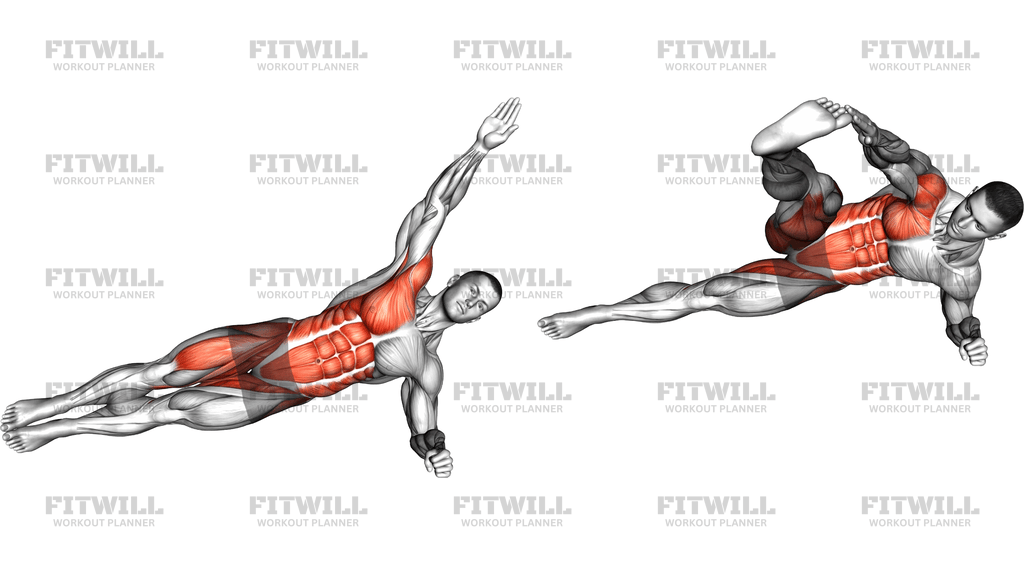
Instructions
- Lie on one side on the floor with your legs stacked and your support forearm flat on the ground, elbow positioned directly beneath the shoulder.
- Extend your top arm toward the ceiling so it lines up roughly with your torso, and place the top foot on top of the bottom foot, drawing the bottom foot slightly back if you need a wider base.
- Brace your trunk and drive the bottom side of your waist up toward the ceiling until your body forms a straight line from head to heels.
- Check that your hips are neither sagging toward the floor nor pushed back behind your shoulder line before you begin the taps.
- Keeping both hips facing forward and the torso still, lift the top leg a few inches away from the bottom leg.
- Slowly lower the top leg and tap its toes against the floor beside or slightly behind the bottom foot.
- Lift the top leg back up to the starting position with the same control, avoiding any swing or momentum.
- Exhale as you tap the toes down and inhale as you raise the leg back up, keeping the breath continuous rather than held.
- Complete all reps on one side, then lower the hips to the floor, shake out the shoulder, and repeat on the other side.
Tips & Tricks
- The most common failure point is the hips dropping as the top leg reaches down. Imagine a string pulling the bottom waist toward the ceiling and keep the hips lifted for every single tap.
- If your torso rolls forward or back with each tap, slow the leg down. Rotation sneaks in when the leg moves faster than your trunk can resist it.
- Stack the support elbow directly under the shoulder before lifting. An elbow that drifts forward turns the exercise into a shoulder endurance test instead of a core drill.
- Keep the tapping foot relaxed. Pointing the toes and reaching with a rigid leg tends to make people swing from the hip rather than move with control.
- A mat under the forearm makes a real difference on hard floors, since a sore elbow invites you to shift weight into the shoulder.
- If you cannot hold a clean side plank for at least 20 seconds, practice that first. The taps amplify the stability demand, so the base hold needs to be solid.
- Widen your stance by drawing the bottom foot slightly behind the top foot if you wobble. This widens the base and keeps the taps honest.
- Do not rush the tempo. Two seconds down and one second up gives the obliques time to work under tension instead of just passing through positions.
- Stop the set when form breaks, not when the leg gets tired. A hip that starts sagging halfway through means the working side of the waist has checked out.
Frequently Asked Questions
Which muscles does the Side Plank Toe Tap work?
The obliques on the bottom side of the waist do most of the stabilizing work, with the deep core and glutes on the top side assisting during each tap. The support shoulder and its stabilizers also work isometrically to keep you propped up.
Is the Side Plank Toe Tap suitable for beginners?
It is best treated as a step beyond the standard side plank. If you can hold a clean forearm side plank for around 20 to 30 seconds per side, you are ready to add the taps; otherwise, build the base hold first or perform the exercise from the knees.
Where exactly should my elbow be during the Side Plank Toe Tap?
The elbow of the supporting arm should sit directly beneath the shoulder, forming a vertical stack from fist to shoulder joint. This keeps the shoulder joint in a safe position and lets the obliques, not the shoulder, do the stabilizing.
Should the tapping foot touch the floor in front of or behind the bottom foot?
Tapping beside or slightly behind the bottom foot is the common setup, because it keeps the hips stacked and discourages forward rotation. The exact spot matters less than keeping the torso still throughout the tap.
Why do my hips keep dropping when I do the Side Plank Toe Tap?
The bottom obliques are fatiguing or your brace is too soft. Slow the tempo, shorten the set, and consciously lift the bottom waist toward the ceiling before each tap; if the drop persists, spend more time on standard side planks.
How many reps and sets should I do?
Two to three sets of 8 to 12 controlled taps per side works well for most people. Since the plank hold is loaded continuously, treat a shorter, high-quality set as more valuable than grinding out reps with sagging hips.
What can I substitute if the Side Plank Toe Tap is too hard?
A standard forearm side plank with a static hold, a side plank performed from the knees, or a side-lying leg raise all train similar lateral hip and waist muscles with less stability demand.
Can I do the Side Plank Toe Tap if my shoulder bothers me during planks?
Discomfort at the shoulder joint is a signal to stop and reset rather than push through. Check that the elbow is truly under the shoulder, and if the feeling remains, choose side-lying variations that do not load the arm.
Should I do both sides back to back or rest between them?
Either works. Alternating sides with minimal rest keeps the session flowing, while a short pause between sides lets you hold better position, which is worth prioritizing when you are still learning the movement.