Standing Isometric Shoulder Internal Rotation Agai
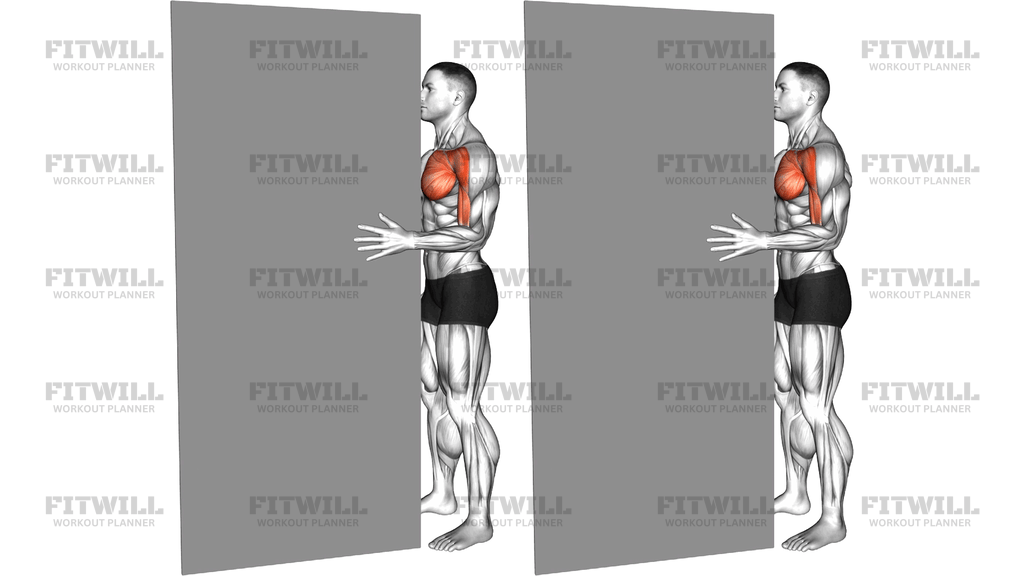
The Standing Isometric Shoulder Internal Rotation Against a Wall is a joint-friendly strength exercise for the internal rotators of the shoulder, performed without any equipment. You stand with one elbow bent to roughly 90 degrees and tucked against your side, place your palm flat against a wall in front of you, and push forward as if trying to rotate your forearm inward past the wall. Because nothing actually moves, the muscle works at a fixed length for the duration of the hold, which makes the drill easy to dose and hard to get wrong.
The main muscle at work here is the subscapularis, the large internal rotator sitting on the front of the shoulder blade, with the pectoralis major and anterior deltoid assisting the press. These muscles are involved in every action where the upper arm rotates inward or the palm drives forward: throwing, swimming, pushing, and simply reaching across your body. Isometric holds are a useful way to load this tissue without moving the joint through a range, which is why this variation shows up so often in shoulder warm-ups and return-to-training programs.
Setup matters more than effort in this drill. Your elbow must stay glued to your ribs and bent at 90 degrees; if the elbow drifts away from your body or the shoulder hikes up toward the ear, the press stops isolating the internal rotators and starts borrowing from the chest and upper traps. Stand close enough to the wall that your forearm sits at a natural height, roughly between waist and lower chest, without you leaning or reaching toward it.
To execute well, brace your trunk, keep your neck relaxed, and build the push gradually over two or three seconds rather than shoving into the wall. Hold the pressure steadily for the prescribed time, breathe normally throughout, then release slowly instead of dropping the arm. The effort should live in the front of the shoulder and armpit area, never in the neck, wrist, or elbow joint itself.
This exercise suits office workers with stiff shoulders, lifters who want a targeted rotator cuff activation before pressing days, and throwers or racket-sport players maintaining internal rotation strength. Because intensity is fully self-regulated, you can push as hard or as gently as the day calls for, which is a flexibility few loaded shoulder exercises offer.
Practically, treat this as a precision movement, not a maximal test. A moderate, clean, pain-free hold beats a hard grind every time. If you feel pinching at the front of the shoulder, reduce the force, lower your hand slightly, or recheck your elbow position before continuing. Stop the set if any sharp discomfort appears and reassess your setup.
[ Workout Log & Planner ]
Put your next workout in Fitwill
Keep your plan and training log ready when you are.


Instructions
- Stand upright beside a wall with your feet about hip-width apart and your working arm closest to the wall surface.
- Bend your working elbow to 90 degrees and pin it against your side, with the upper arm pointing straight down and the forearm pointing forward.
- Place your open palm flat against the wall at roughly waist to lower-chest height, fingers spread and wrist in line with the forearm.
- Keep your shoulders level and relaxed, pull your chin back slightly, and brace your abdominal muscles to stop your trunk from twisting during the press.
- Press your palm forward into the wall as if trying to rotate your forearm inward toward your body, building the force smoothly over two to three seconds.
- Hold the push at a steady effort, keeping the elbow welded to your ribs and the shoulder blade sitting quietly on your back rather than flaring forward.
- Breathe evenly throughout the hold; do not hold your breath or clench your jaw and neck.
- Release the pressure gradually over two to three seconds, then lower your arm and shake it out briefly.
- Complete the prescribed hold time or repetitions on one side, then turn around and match the work with the other arm.
Tips & Tricks
- The most common mistake is pressing so hard that the elbow lifts off the ribs; if you cannot keep it pinned, drop the effort to about half and restart the hold.
- If your shoulder blade juts forward during the push, imagine keeping your chest open and letting the forearm and hand do the work instead of the whole shoulder girdle.
- Watch for trunk rotation, where the body leans into the wall to fake extra force; a mirror or a hand on your hips makes this easy to catch.
- A wrist that bends backward against the wall steals tension from the shoulder; keep the wrist straight and push through the whole palm.
- Vary the angle by placing your hand slightly higher or lower on the wall to bias different fibers of the internal rotators across sets.
- Start with five-second holds at moderate effort and progress the duration before you progress the intensity; isometrics respond well to longer, controlled holds.
- Do the weaker or stiffer side first and match its work on the stronger side rather than the other way around.
- Warm the shoulder up with a few easy arm circles before pressing, since a cold internal rotator can feel grabby at the start of the first hold.
- If the front of the shoulder pinches, reduce the push and check that your elbow is truly at your side; the discomfort usually disappears once the joint angle improves.
Frequently Asked Questions
Which muscles does the Standing Isometric Shoulder Internal Rotation Against a Wall work?
The primary muscle is the subscapularis, the main internal rotator of the shoulder, with the pectoralis major and anterior deltoid assisting the press. The forearms and grip work lightly to keep the palm flat on the wall.
Why does my elbow have to stay at my side during this exercise?
Keeping the elbow pinned at 90 degrees against your ribs fixes the shoulder joint angle so the internal rotators do the work. If the elbow drifts outward, the chest and shoulder blade muscles take over and the drill loses its purpose.
Is the Standing Isometric Shoulder Internal Rotation Against a Wall suitable for beginners?
Yes, it is one of the most beginner-friendly shoulder drills because there is no weight, no range of motion, and the effort is entirely self-controlled. Start with light pressure and short holds of five seconds while you learn the position.
How hard should I push into the wall?
Aim for a moderate effort, roughly five to seven out of ten, where you can hold steady pressure while breathing normally. Maximal pushing usually causes the elbow to lift or the trunk to twist before the shoulder gains anything extra.
How long should I hold each press?
Five to ten seconds per hold works well for most people, repeated for several reps per side. Once holding is comfortable, extend the duration before increasing how hard you push.
I feel this more in my chest than my shoulder. What am I doing wrong?
You are likely pressing with the whole arm and letting the shoulder blade slide forward. Soften the push, recheck that your elbow is touching your ribs, and focus on a small inward twisting intention rather than a big shove.
Can I do this exercise if I don't have a clear wall space?
Any sturdy vertical surface works, including a door frame, a squat rack upright, or a stable pillar. You can also press your palm against your other hand held in front of you, though the wall gives cleaner feedback.
Should I feel any pinching at the front of the shoulder?
No, the hold should feel like muscular effort, not joint pain. If you feel pinching, reduce the force, lower your hand on the wall slightly, and confirm your elbow position; if it persists, stop and get the shoulder assessed.
When is the best time to use this exercise in a workout?
It works well as an activation drill before pressing or throwing, or as a standalone maintenance exercise on rest days. Because it leaves little soreness, it can be done fairly often with modest effort.
Do I need to train both sides even if only one shoulder bothers me?
Yes, work both sides and let the involved side set the number of sets, holds, and effort level. Matching the work keeps shoulder strength and control balanced between arms.