Lying Alternate Bent Leg Raise
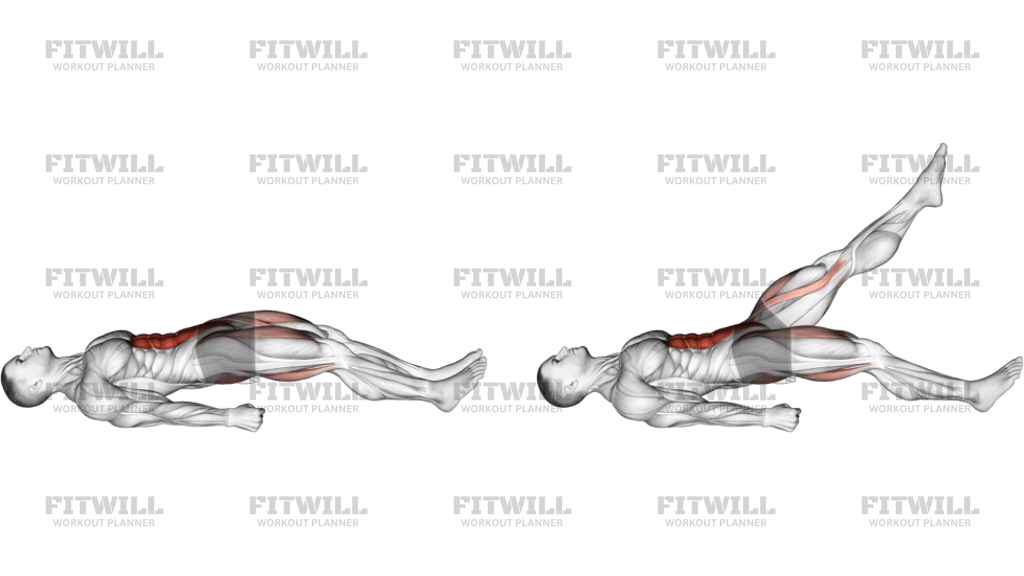
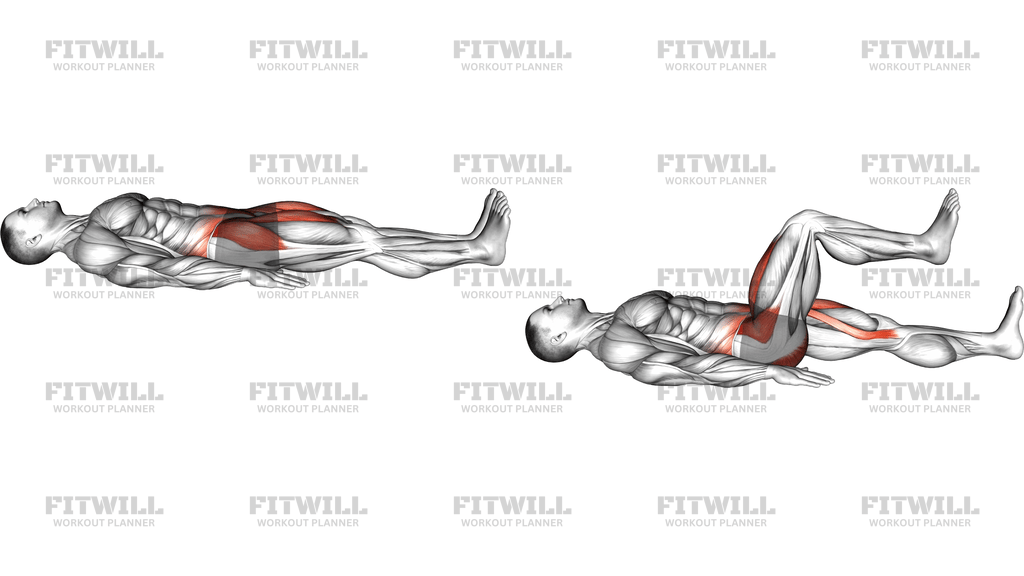
The Lying Alternate Bent Leg Raise is a floor-based core exercise performed from a flat supine position with your arms resting at your sides. From there, you repeatedly bend one knee in toward your chest while the opposite leg stays extended and hovering just above the floor, then switch sides in a steady, controlled rhythm. It looks simple, but holding one leg off the ground while the other drives the knee up creates a continuous demand on the deep abdominal muscles and the hip flexors that never quite gets a break.
This movement is especially useful for people who want to train the lower abdominal region and hip flexors together without loading the spine with weights. Because you are lying on your back with the low back supported by the floor, it is a common starting point for beginners building trunk control, and it is also used in warm-ups, rehabilitation-style conditioning, and sports preparation where running, kicking, or knee-drive mechanics matter.
The main work comes from the hip flexors, particularly the iliopsoas and rectus femoris, which lift and bend the working leg. At the same time, the lower abs and deep core must brace to keep your pelvis stable and your lower back pressed down while the other leg hangs extended. If your abs give up, the low back arches and the hips take over with poor positioning, which is exactly what this exercise is meant to teach you to avoid.
Setup matters more than speed here. Lie flat with your arms alongside your body, palms down for a bit of balance feedback, and keep your head neutral rather than craning the chin forward. Press your lower back gently toward the floor before the first rep and maintain that contact throughout. The working knee should bend and travel up toward your chest under control, while the extended leg stays firm and hovers just off the ground.
Execute each rep deliberately: draw one knee up, pause briefly at the top, lower it back until the leg is nearly straight but still suspended, then switch to the other side. Breathing should stay rhythmic, exhaling as the knee drives up and inhaling on the way down. Avoid rushing, because momentum turns this into a leg-swinging drill rather than a core exercise.
In practice, the Lying Alternate Bent Leg Raise fits well at the start of a core session as an activation drill, in a beginner abdominal circuit, or as a low-fatigue accessory on days between heavier lifts. If you feel it only in the front of your thighs or your lower back, shorten the range, keep the extended leg higher off the floor, or slow the tempo until your abs are doing the stabilizing work.
Fitwill
Log Workouts, Track Progress & Build Strength.
Achieve more with Fitwill: explore over 9600 exercises with images and videos, access built-in and custom workouts, perfect for both gym and home sessions, and see real results.
Start your journey. Download today!




Instructions
- Lie flat on your back on an exercise mat or the floor, legs extended and close together, arms resting alongside your body with palms facing down.
- Keep your head neutral on the floor and press your lower back gently down toward the ground before starting.
- Brace your abdominal muscles as if preparing for a light push to the stomach, and keep this tension for the whole set.
- Bend one knee and draw it up toward your chest while keeping the opposite leg straight and hovering a few inches above the floor.
- Pause briefly at the top of the knee raise, feeling the hip flexor work and your pelvis stay level.
- Lower the bent leg under control until it is almost straight, but do not let the foot touch the floor.
- Immediately switch sides, drawing the opposite knee up while the first leg now holds the extended position.
- Continue alternating legs in a steady rhythm, keeping both feet from contacting the floor between reps.
- Exhale as each knee drives up and inhale as it lowers back down.
- After your final rep, lower both legs to the floor together and release the brace before resting.
Tips & Tricks
- The most common mistake is letting the lower back peel off the floor when the extended leg hangs down. If that happens, hold the straight leg slightly higher off the ground or bend it a little until your abs can keep the pelvis fixed.
- Do not yank the knee up with momentum; the drive should come from the hip flexor and a braced trunk, taking about one second up and one second down.
- Keep the arms relaxed and flat at your sides. If you find them lifting or pressing hard into the floor, your core is losing the stability job.
- Watch the neck. If your chin is poking toward your chest, reset with the back of your head resting heavy on the mat.
- If you feel the work mostly in the front of the thigh instead of the hip and lower abs, slow down and reduce the range of the knee raise.
- Stopping both feet on the floor between reps gives the deep core a rest and cuts the difficulty. Keep both legs suspended if you want the full effect, or let them touch if you are still building control.
- A cushioned mat makes a real difference here because your lower back, hips, and tailbone stay in contact with the ground the entire time.
- Breathe continuously rather than holding your breath. Breath-holding usually signals that the brace is too rigid and the movement is too fast.
- If one side feels weaker or less coordinated, spend a few reps moving only through that side before returning to alternating.
Frequently Asked Questions
Which muscles does the Lying Alternate Bent Leg Raise work the most?
The primary work comes from the hip flexors, especially the iliopsoas, which bend the working knee up toward the chest. The lower abs and deep core stabilize the pelvis and keep the lower back pressed to the floor, while the quads help keep the extended leg straight.
Is the Lying Alternate Bent Leg Raise good for beginners?
Yes, it is one of the more approachable floor core drills because the back is fully supported and no equipment or load is needed. Beginners can make it easier by letting the extended leg sit higher or by lowering it briefly between reps.
Why does my lower back arch during the Lying Alternate Bent Leg Raise?
That arch means your abdominal brace is not holding the pelvis steady while the hip flexors pull on the spine. Keep the extended leg higher off the floor, slow the tempo, and re-press your lower back into the mat before each rep.
Should both feet stay off the floor the whole time?
For the full version, yes, both legs stay suspended so the core never rests between switches. If you are building up to that, it is fine to let the extended leg touch down briefly until your control improves.
How is the Lying Alternate Bent Leg Raise different from a regular lying leg raise?
In a regular leg raise both legs move together with the knees mostly straight, which loads the hip flexors and lower abs harder. Here one knee bends and drives up at a time, so each side gets a short rest and the demand on the trunk is more moderate and controlled.
Can I feel this mostly in the front of my thighs, and is that wrong?
Some work in the quad of the extended leg is normal because it holds the leg straight against gravity. If the thighs dominate completely, slow the reps and make sure your abs are braced so the trunk, not just the legs, is doing its share.
How many reps and sets should I do of the Lying Alternate Bent Leg Raise?
A typical dose is 2 to 3 sets of 10 to 20 alternating reps, counting one rep per knee raise. Focus on keeping the lower back flat and the rhythm even rather than chasing a high number.
What can I use instead if the Lying Alternate Bent Leg Raise bothers my back?
Try bending both knees slightly and keeping the extended leg elevated, or substitute a lying single knee tuck where the resting foot stays on the floor. Both reduce the pull on the lower back while still training the hip flexors and abs.
Do I need a mat or can I do this on a hard floor?
A mat or soft surface is recommended because your spine, hips, and tailbone stay in constant contact with the ground. On a hard floor the pressure points can become distracting and cause you to rush the movement.