Weighted Plate Deadlift Rear Lunge With Overhead
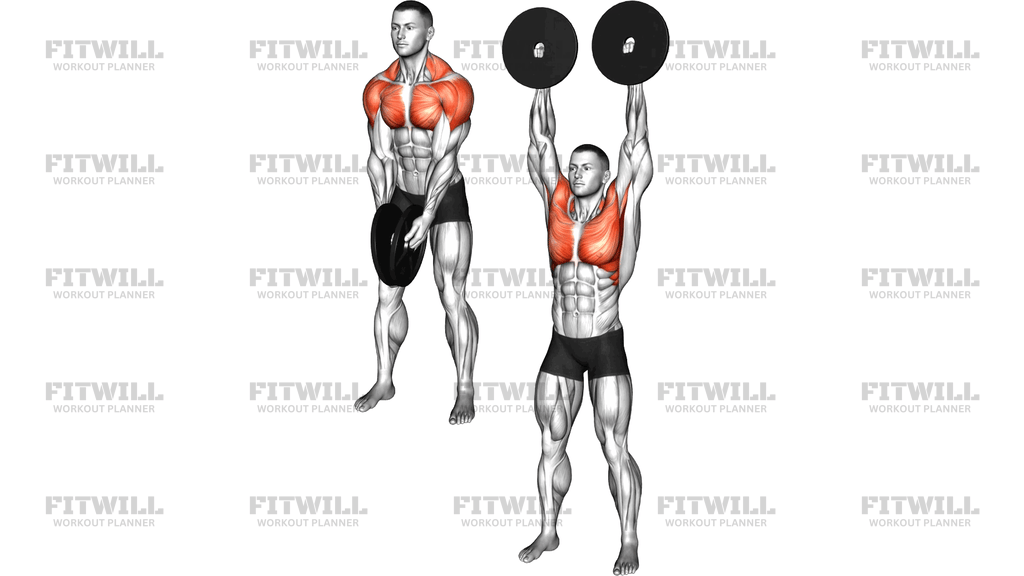
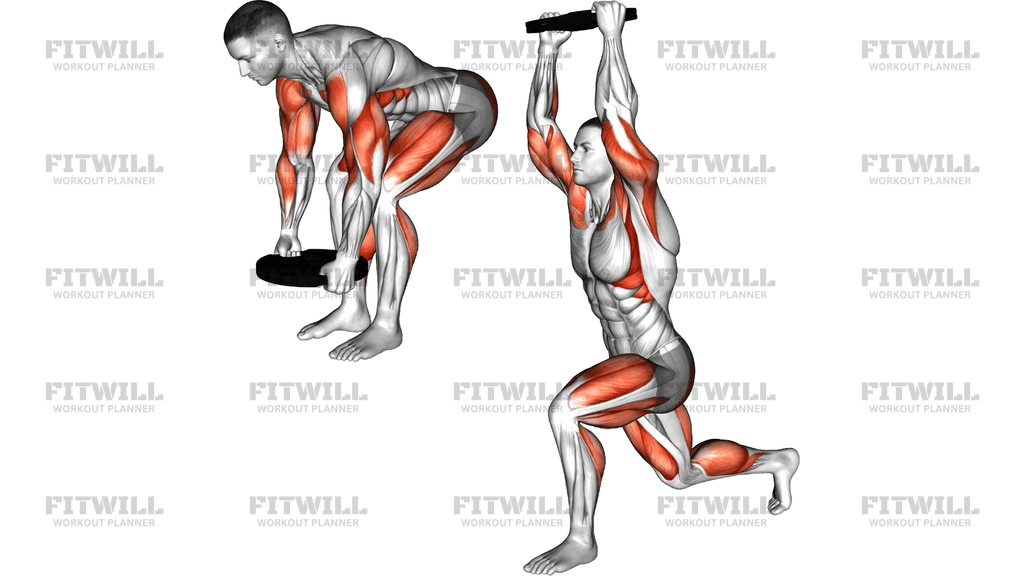
The Weighted Plate Deadlift Rear Lunge With Overhead is a compound flow that strings three demanding positions into one rep: a deadlift off the floor, an overhead hold, and a reverse lunge performed with the plate locked out above your head. You lift a weight plate from the ground to standing, press it to full arm extension, step one leg back into a rear lunge, then reverse the whole sequence back to the floor. Because the load stays in your hands from start to finish, your grip and trunk work the entire time.
This movement earns its place in a program because it trains the whole body under one continuous demand. The deadlift portion loads the hamstrings, glutes, and lower back, the overhead position challenges the shoulders, triceps, and upper back, and the rear lunge adds single-leg work for the quads and glutes while your core fights to keep the plate stacked over your midline. It is essentially a full-body strength starter or finisher that also raises your heart rate quickly.
The setup matters more than it looks. A plate has no handles, so your grip and shoulder position have to do real work from the first hinge. Start with a light plate — 5 to 15 kg is plenty for most people — and make sure you can hold it overhead with straight elbows before adding lunge depth. If your lower back arches or your ribs flare when the plate goes up, the weight is too heavy.
To execute it well, hinge down and grasp the plate on either side, stand up with a flat back, press it overhead until your biceps are beside your ears, then step one foot straight back into a lunge while keeping the plate from drifting forward. Drive through the front heel to stand, lower the plate back to the floor with the same hinge you used to pick it up, and either continue on the same leg or alternate. Move slowly; the value of this exercise comes from controlling transitions, not rushing reps.
It fits well as a warm-up primer with a light plate, a conditioning station in a circuit, or a finisher on a lower body or shoulder day. Because it combines a hip hinge, a press, and a lunge, it is also a space-efficient option when you only have a plate and a few square meters of floor. Keep reps moderate, stop when your overhead position degrades, and treat every pickup and set-down of the plate as a deliberate deadlift rather than an afterthought.
[ Workout Log & Planner ]
Put your next workout in Fitwill
Keep your plan and training log ready when you are.


Instructions
- Place a weight plate flat on the floor between your feet, which are set about hip-width apart with toes pointing forward.
- Hinge at the hips and bend your knees until you can grip the plate firmly on both sides at roughly 3 and 9 o'clock, arms hanging straight down with a flat back.
- Brace your core, pull your shoulders back, and take a breath into your belly before lifting.
- Drive through your whole foot to stand up tall, keeping the plate close to your legs as your hips and knees extend together.
- Press the plate straight overhead until your elbows are locked out and the plate sits directly over your shoulders and hips, biceps beside your ears.
- Step one foot straight back and lower into a rear lunge until your back knee hovers near the floor and your front shin stays roughly vertical, holding the plate still overhead.
- Push through the front heel to bring your back foot forward and return to a full standing position with the plate still locked out.
- Exhale as you press overhead, then inhale at the top before the lunge; breathe out as you drive out of the lunge.
- Hinge at the hips with a flat back and lower the plate under control back to the floor, releasing your grip only once it is fully set down.
- Reset your stance and brace before starting the next rep, alternating legs each round or completing all reps on one side first.
Tips & Tricks
- The most common failure point is letting the plate drift forward during the lunge, which dumps stress onto the lower back — cue yourself to keep it stacked over your hips and front heel.
- Keep a slight bend in your knees during the pickup; pulling the plate with stiff legs turns the first rep into a lower-back strain test.
- If your elbows bend and the plate sinks behind your head during the lunge, you are fatigued or overloaded — cut the set rather than grinding with a collapsing press.
- Shorten your rear lunge depth until you can keep your torso vertical; a long stride with a heavy plate overhead pulls your chest forward.
- Grip the plate on its face, not the edge — fingers over the rim tend to slip once your forearms tire.
- Alternate legs every rep if your balance is shaky, since doing all reps on one leg under fatigue makes the last lunge noticeably wobblier.
- Treat every set-down as a real deadlift; most sloppy reps happen when people drop the plate casually after finishing the lunge.
- Start with a 5 kg plate even if your presses are much stronger — the combined grip, lunge, and overhead hold is harder than any single piece of it.
- If your heels lift in the lunge, widen your stance slightly front to back so your front foot stays flat.
Frequently Asked Questions
What muscles does the Weighted Plate Deadlift Rear Lunge With Overhead work?
The shoulders and triceps handle the overhead press, the glutes, quads, and hamstrings power the deadlift and lunge, and the core, lower back, and traps stabilize the plate throughout. No single muscle does the majority of the work — it is genuinely shared across the body.
Is the Weighted Plate Deadlift Rear Lunge With Overhead suitable for beginners?
Yes, if you start with a light plate and have already learned a basic hip hinge, press, and reverse lunge separately. Beginners should master each component on its own before combining them into one rep.
How should I grip the plate during the Weighted Plate Deadlift Rear Lunge With Overhead?
Hold the plate flat on both sides at the 3 and 9 o'clock positions with your fingers spread on the face of the plate. This gives you the most secure hold for both the deadlift pull and the overhead lockout.
Should I press the plate overhead before or during the lunge?
Press to full lockout while standing, then step back into the lunge with the plate already overhead. Trying to press and lunge at the same time makes it much harder to keep the plate stacked and your torso upright.
Why does my lower back ache after this exercise?
It usually means the plate is drifting forward overhead or you are rounding your back during the pickup and set-down. Reduce the weight, slow the transitions, and check that your ribs stay down when the plate is locked out.
Can I use a dumbbell or kettlebell instead of a plate?
You can, but the change matters: a plate has no handles, so the plate version challenges your grip and forearms far more. A kettlebell held by the horns is the closest substitute if no plate is available.
How heavy should the plate be for the Weighted Plate Deadlift Rear Lunge With Overhead?
Choose a weight you can hold overhead with straight elbows and no back arch for your entire set — for most people that is a 5 to 15 kg plate. The weakest link in this movement is usually the overhead hold, not the lunge.
Should I alternate legs or complete all reps on one side?
Alternating every rep keeps fatigue and balance even between sides, which is helpful since the overhead hold is already tiring. Complete one side at a time only if you are deliberately targeting a weaker leg and can still hold the lockout.
How many reps and sets should I do?
Two to four sets of 5 to 8 reps per leg works well for strength, or lighter plates for 10 to 12 reps if using it as a conditioning finisher. Stop the set as soon as your overhead position starts to break down.
Is it safe to lunge with weight overhead if I have shoulder issues?
If overhead pressing already causes discomfort, skip this movement and train the lunge and deadlift portions with the plate held at your chest instead. Check with a qualified professional before loading an overhead position that bothers you.