Dumbbell Lying Seal Row On Rack
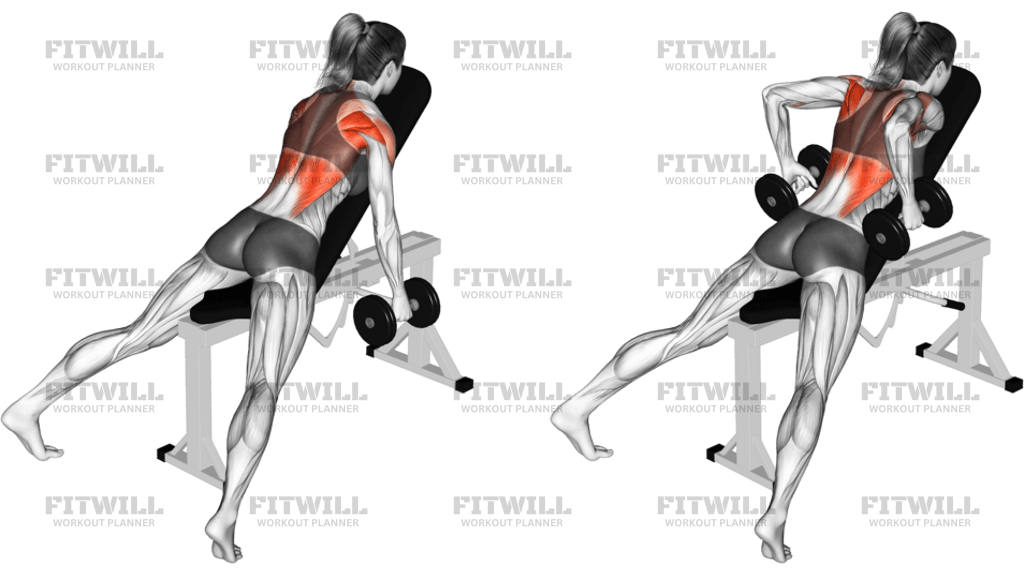
The Dumbbell Lying Seal Row On Rack is a strict rowing variation performed face down on a high bench with dumbbells hanging beneath you. Because your chest, torso, and hips are fully supported by the bench, there is no way to lean back, swing the weight, or borrow momentum from your legs — the upper back alone has to move the load. That built-in strictness is what separates the seal row from practically every other dumbbell row you can do standing or bent over.
This exercise is especially useful for lifters who want bigger, stronger upper back muscles without loading the lower back. In a bent-over row, the erector spinae works hard just to hold your torso up, and fatigue there usually ends the set before the lats and mid-back are properly challenged. Lying prone removes that bottleneck entirely, so the target muscles get all the work. It also suits anyone returning from lower back issues who still wants a heavy rowing stimulus, and lifters whose standing rows have drifted into half-squat Goodmornings.
The main muscles worked are the rhomboids, mid-trapezius, and lats, with the rear delts assisting on the pull and the biceps and forearms handling the grip and elbow flexion. Because the arms hang straight down from the shoulders, the movement path runs vertically — you pull the dumbbells up toward the sides of the bench until your upper arms are roughly level with your torso, squeeze the shoulder blades together, then lower under control to a full hang.
Setup matters more here than in most rowing variations. The bench needs to be high enough that the dumbbells clear the floor at the bottom of the stretch, and positioned so your chin and chest sit just past the edge without your neck craning upward. Your legs can rest along the bench or hang off the far end, but your torso should stay glued to the pad for every rep. If your chest lifts as you pull, the weight is too heavy or the range is too long.
One practical consideration: getting into and out of the position with dumbbells in hand is the clumsy part of the exercise. Set the dumbbells on the floor or on low rack hooks beneath the bench, lie down first or lift them from a standing position before lying chest-down, and never try to twist sideways to reach them mid-set. Keep a dumbbell rack or spotter nearby if you use heavy pairs, since you will need to set the weights down while still lying prone.
Expect to use less absolute weight than on a chest-supported machine row at first — the free-hanging starting position and the dead-stop stretch make the movement honest. Treat it as your strict upper back builder for the day, often paired with lat-focused pulldowns or a looser standing row later in the session.
[ Workout Log & Planner ]
Put your next workout in Fitwill
Keep your plan and training log ready when you are.


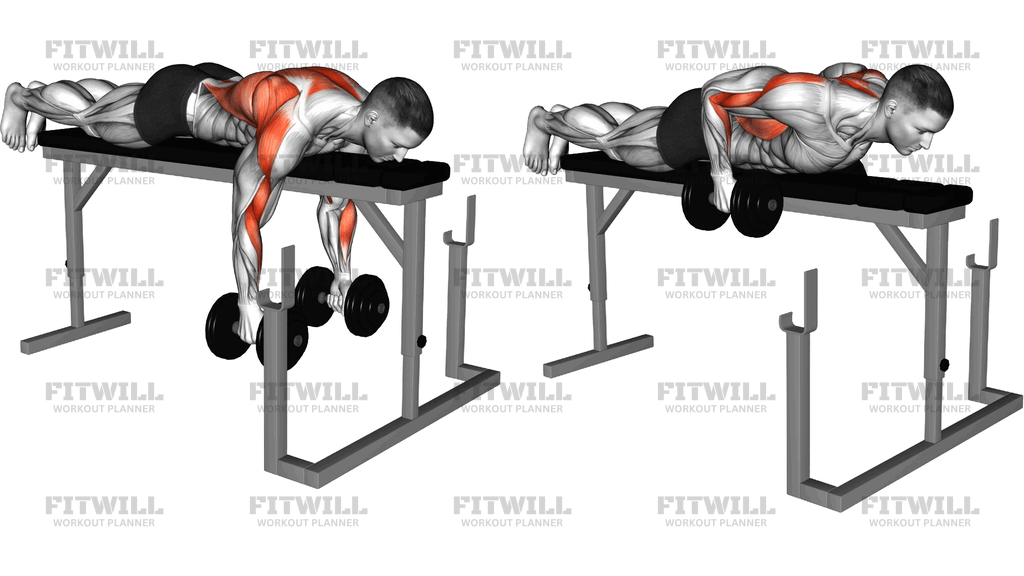
Instructions
- Set a high flat bench so your full torso lies face down along it with your chin and upper chest just past the edge, and the dumbbells hanging below clear the floor by several inches at arm's length.
- Place the dumbbells beneath the bench or on low rack hooks, then lie down prone and take a neutral grip — palms facing each other — with one dumbbell in each hand.
- Let your arms hang straight down from your shoulders and relax your shoulder blades fully so you feel a stretch across the upper back before starting.
- Brace your core lightly, squeeze your glutes, and press your chest gently into the bench so your torso stays planted.
- Row both dumbbells up in a vertical path toward your lower ribs, driving your elbows toward the ceiling and keeping them about 45 degrees from your sides.
- At the top, pull your shoulder blades back and down and hold the squeeze for a beat — your upper arms should be roughly level with your torso.
- Lower the dumbbells slowly to the full dead hang, letting the shoulder blades protract forward before the next rep.
- Breathe out as you row up and in as you lower, keeping your face down and your neck in line with your spine throughout.
- Complete the set, then set the dumbbells on the floor or hooks beneath you before sitting up — do not roll off the bench with weights in hand.
Tips & Tricks
- If your chest peels off the bench at the top of the row, the weight is too heavy — the whole point of this setup is that your torso cannot move, so respect it.
- Do not crane your neck upward to look forward; keep your face down and your head neutral, or you will strain the neck and shorten the range on your upper back.
- Choose a bench height that lets the dumbbells hang free at the bottom. If they touch the floor, you lose the stretched start and the exercise becomes a partial row.
- Control the descent instead of dropping into the hang — the loaded stretch at the bottom is one of the best parts of this movement for the lats and rhomboids.
- Keep your wrists straight and your grip firm but not crushing; a white-knuckle grip fatigues your forearms before your upper back gets its work.
- If both arms fatiguing at once limits your sets, you can alternate sides, but keep the non-working arm hanging still rather than bracing against the bench.
- Pull with your elbows, not your hands. Thinking about driving the elbows to the ceiling keeps the emphasis on the mid-back rather than turning it into a biceps curl.
- Chalk or lifting straps are reasonable once grip becomes the limiting factor at heavier dumbbells — just make sure you can still lower the weights safely to the floor at the end of a set.
- Position your hips so they stay on the bench; sliding forward until your hips hang off turns the setup unstable and lets your lower back arch hard under the load.
Frequently Asked Questions
What muscles does the Dumbbell Lying Seal Row On Rack work?
The primary movers are the rhomboids, mid-traps, and lats, with the rear delts assisting the pull. Your biceps and forearms work to flex the elbows and hold the dumbbells, and your lower back stays almost completely uninvolved because the bench supports your torso.
Why lie face down on a bench instead of doing a normal bent-over dumbbell row?
Lying prone removes all momentum and lower back involvement, so the upper back does every bit of the work. In a bent-over row, most people end up jerking the torso upright as the set gets hard, which shifts effort away from the lats and mid-back.
Is the Dumbbell Lying Seal Row On Rack good for beginners?
Yes, as long as the bench is set up correctly and the weight is modest. The chest-supported position actually teaches beginners what a strict row is supposed to feel like, since they cannot cheat the movement even if they try.
How high should the bench be for seal rows?
The bench must be tall enough that the dumbbells hang clear of the floor with your arms fully extended — most standard flat benches are too low, which is why this is usually done on a high bench or between the uprights of a power rack. If the dumbbells touch down, the stretch and the strictness are lost.
Should I use a neutral grip or pronated grip?
A neutral grip with palms facing each other, as shown, is the most comfortable and shoulder-friendly option and matches the natural path of the arms. A pronated grip biases the upper back slightly more, while a supinated grip shifts some work toward the biceps.
What is the most common mistake with this exercise?
Lifting the chest off the bench to squeeze out extra range. If your torso moves, the support has stopped doing its job and your lower back and momentum are now contributing — drop the weight until every rep happens with your chest planted.
Can I substitute the Dumbbell Lying Seal Row On Rack if my gym has no high bench?
A chest-supported row on an incline bench or a chest-supported machine row is the closest alternative, since both eliminate momentum and protect the lower back. You lose the free-hanging dead-start stretch, but the training effect is similar.
How do I get the dumbbells into position safely?
Place them on the floor or on low rack hooks directly beneath the bench, lie down first, and pick them up one at a time with a controlled motion. Never twist sideways off the bench to reach heavy dumbbells, and set them down the same way before standing up.
How heavy should I go on this movement?
Expect to handle less than your standing dumbbell row weight at first, because the dead hang and strict path are humbling. Add weight only when you can complete all reps with your chest on the bench and a full hang at the bottom of each one.
Is it safe for my lower back?
This is one of the lowest-stress rowing variations for the lower back because the bench supports your torso throughout, and there is no spinal loading in a bent-over position. If you have a history of back problems, start light and check with a qualified professional about your specific situation.