Dumbbell Single Leg Hyperextension
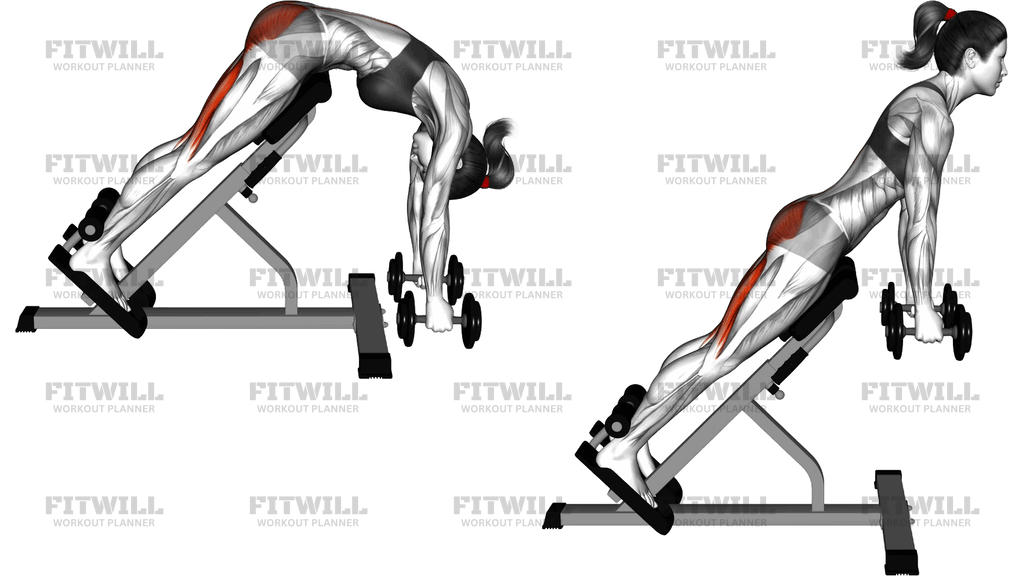
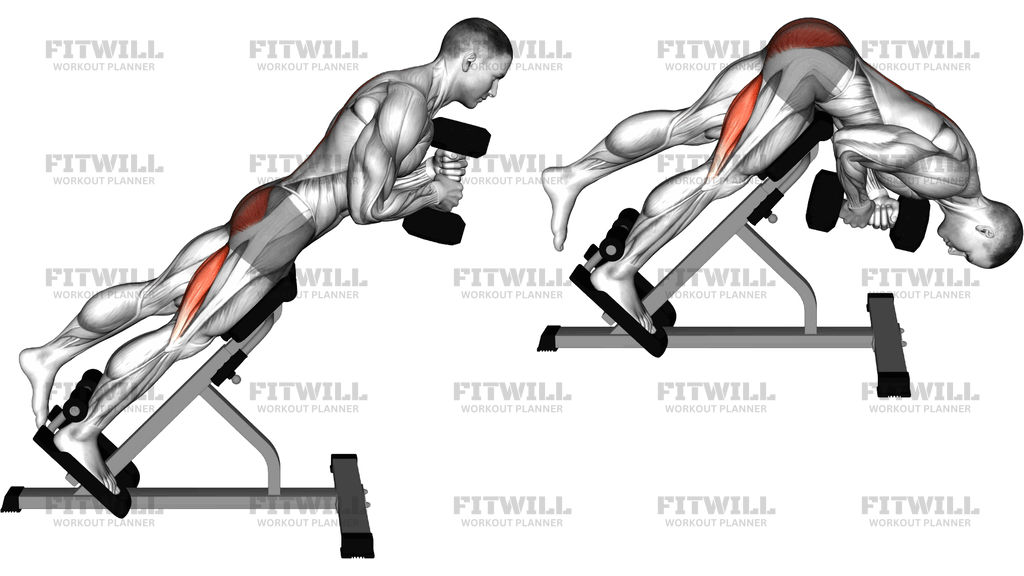
The Dumbbell Single Leg Hyperextension is a unilateral hip hinge performed on a Roman chair or 45-degree hyperextension bench. One foot is anchored under the roller pad while the other leg hangs free, and you hold a dumbbell against your chest as you fold forward over the pad and pull your torso back up to a straight line. Working one side at a time changes the character of the exercise considerably: the anchored leg's glute and hamstring have to drive the entire torso back up, and the free leg adds a stability demand that a two-legged hyperextension never provides.
This movement is useful for lifters who want to load the hip hinge pattern without a barbell, for people addressing side-to-side differences in hamstring or glute strength, and for athletes in sports that demand single-leg power like sprinting, cycling, and skating. Because the torso and dumbbell act as the load arm, even a moderate dumbbell feels substantial once you are angled forward over the pad.
The primary muscles at work are the hamstrings, particularly the biceps femoris on the working side, with strong contribution from the gluteus maximus as the hip extends. The erector spinae in the lower back work isometrically to hold your spine neutral against the pull of the weight, and your deep core stabilizes as the free leg tries to rotate your hips.
Setup matters more here than in the two-legged version. The pad should sit just below your hip crease so you can hinge freely without the pad pressing into your stomach, and the anchored foot must be locked securely under the roller. If the pad sits too high on your thighs, your range shortens; too low, and your lower back takes over the hinge. Take a moment to get this right before adding any weight.
Execution should be slow and deliberate. Lower until you feel a stretch across the working hamstring, then squeeze the glute to rise back to a straight line from head to heel. Do not arch past neutral at the top, and do not let the dumbbell drift away from your chest. Because each rep demands balance, treat your first few sessions as practice with a light weight or body weight only before progressing the load.
[ Workout Log & Planner ]
Put your next workout in Fitwill
Keep your plan and training log ready when you are.


Instructions
- Set the hyperextension bench so the hip pad sits just below your hip crease and the ankle roller sits comfortably behind your foot or calf.
- Hook one foot under the roller pad so the ankle is firmly anchored, and position your lower thighs against the hip pad.
- Hold a dumbbell vertically against your chest with both hands, wrapping your fingers around the upper and lower heads of the weight.
- Extend your free leg straight behind you so it hovers in line with your torso, and keep a soft bend in both knees.
- Brace your abdominal wall and pull your shoulder blades back before you begin the descent.
- Hinge forward at the hip, letting your torso fold over the pad until you feel a firm stretch in the hamstring of the anchored leg, keeping the dumbbell glued to your chest.
- Exhale and drive your hips down into the pad while squeezing the glute of the anchored leg to raise your torso until your head, hips, and heels form one straight line.
- Pause briefly at the top without arching your lower back, then inhale and lower under control over two to three seconds.
- Complete all repetitions on one side, then carefully unhook your foot, reset your position, and switch to the other leg.
Tips & Tricks
- The most common mistake is arching past neutral at the top. Once your body is a straight line, the rep is done; extra arch just compresses the lumbar spine for no added hamstring work.
- If your hips twist as you rise, your free leg is probably dropping or swinging. Actively hold it extended behind you and level with the anchored side.
- Keep the dumbbell pressed to your sternum. Letting it drift forward lengthens the lever arm and turns the set into a lower back strain rather than a hamstring exercise.
- Check pad height before your first rep. If your stomach compresses against the pad at the bottom, the hip pad is too high and you will lose range.
- Start with body weight or a very light dumbbell. The single-leg balance demand makes this feel far heavier than the same weight in a two-legged hyperextension.
- Lower slowly on every rep. Bouncing out of the stretched position is where most lumbar discomfort on this bench comes from.
- Push your hips down into the pad as you come up instead of just lifting your chest. This keeps the drive coming from the hip extensors rather than the spine.
- If your ankle slips off the roller, cross your heel against the pad edge or have the roller pad sit over your lower calf for a more secure lock.
- Do your weaker side first and match the reps with your stronger side so the imbalance does not grow.
Frequently Asked Questions
Which muscles does the Dumbbell Single Leg Hyperextension work?
The hamstrings of the anchored leg do most of the work, especially the biceps femoris, with the gluteus maximus assisting hip extension. The lower back erectors and deep core work isometrically to hold your spine and pelvis steady.
Why do this single-leg instead of a regular Dumbbell Hyperextension?
The single-leg version forces each side to work independently, which exposes and corrects left-right differences. It also adds a balance and anti-rotation demand that strengthens the stabilizers around the hip and pelvis.
What should my free leg do during the Dumbbell Single Leg Hyperextension?
Hold it extended straight behind you, roughly in line with your torso. If it drops toward the floor or swings outward, your hips will rotate and the working side loses tension.
How heavy should the dumbbell be when starting this exercise?
Begin with body weight or a very light dumbbell until you can balance and control the full range. Because you are supported on one leg with the load far from your hips, even 5 to 10 kg is challenging for most people.
How do I set the pad height on the bench for this movement?
The hip pad should sit just below your hip crease so you can hinge at the hip without restriction. If it presses into your stomach or sits on your mid-thigh, adjust it before adding weight.
What can I use instead of a dumbbell in the Dumbbell Single Leg Hyperextension?
You can hold a weight plate to your chest, cross your arms over your chest with no weight, or use a cable handle if your gym setup allows it. The hinge pattern stays the same regardless of the load.
Is the Dumbbell Single Leg Hyperextension safe for the lower back?
It is generally well tolerated when the spine stays neutral and the load is modest. Avoid arching past a straight line at the top, skip bouncing at the bottom, and stop if you feel sharp pain rather than muscular effort.
How many reps should I do per side?
Eight to twelve controlled reps per side works well for strength and muscle. Balance and control tend to fail before the hamstrings do, so prioritize smooth tempo over chasing extra repetitions.
Can beginners do the Dumbbell Single Leg Hyperextension?
Yes, but most beginners should first master the two-legged bodyweight hyperextension to learn the hinge. Once you can hold a neutral spine through the full range, add the single-leg balance demand before adding the dumbbell.