Dumbbell Around Pullover
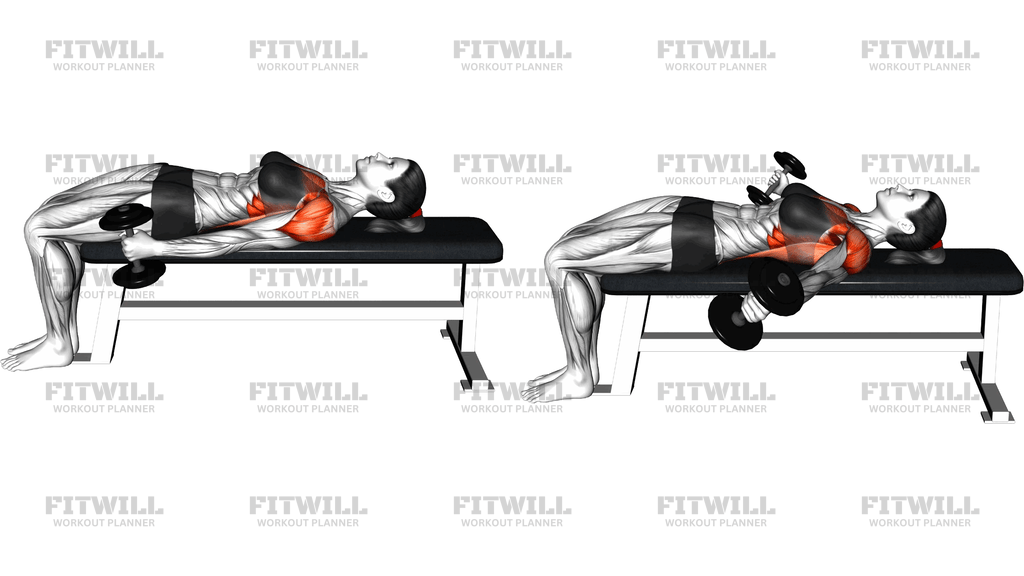
The Dumbbell Around Pullover is a lying pullover variation in which you guide a single dumbbell through a long, arcing path around your body — starting near your hips, sweeping over your torso, and finishing with your arms extended back past your head toward the floor before tracing the same route back. Performed on a flat bench, it blends the qualities of a classic straight-arm pullover with the sweeping shoulder extension that makes the around-the-world pattern feel so distinctive. Because both hands grip one dumbbell, the load stays centered and easy to control through the entire curve.
The main work comes from the chest and lats, which lengthen under load as the weight travels overhead, while the serratus anterior, triceps, and rear delts help guide and stabilize the arm path. Your core stays quietly busy the whole time, keeping your ribs from flaring as your arms move behind your head. This makes the movement a useful bridge between pure pressing work and back work — it trains shoulder extension and horizontal adduction in one continuous sweep.
Lifters choose this exercise to expand their chest and back volume without more pressing, to build mobility through the shoulder in a loaded but controlled range, and to add variety after barbell or machine pullovers. It suits intermediate lifters well; beginners can also use it with a light dumbbell once they are comfortable lying on a bench and holding weight overhead. Because the arms stay relatively long with only a soft elbow bend, the weight travels far from the pivot point, so modest loads create plenty of challenge.
Setup matters more here than in most chest and back movements. Lie lengthwise along a flat bench with your head supported, feet planted on the floor, and hold the dumbbell by one end or around the inner head with both hands. If your lower back arches excessively when the weight moves behind your head, slide your hips slightly forward so only your upper back rests on the bench, or bend your knees a little more. A stable, neutral ribcage position protects your spine and keeps tension on the target muscles instead of your joints.
Execution is about shaping the arc, not rushing it. Keep a slight, fixed bend in your elbows, move the dumbbell in a smooth half-circle around your head until your upper arms are in line with your ears or slightly past, then pause briefly and pull the weight back along the same curve to your hips. Breathe in as the weight travels back, and exhale as you pull it around to the front. If at any point you feel pinching in the shoulder or strain in the neck, shorten the range rather than forcing the end position.
Practically, the Dumbbell Around Pullover fits well as a finisher after pressing or pulling, for two to three sets of ten to fifteen controlled reps. Choose a dumbbell you could hold overhead with confidence, keep your wrists stacked, and prioritize the quality of the arc over depth. Done patiently, it delivers a deep stretch through the chest and lats and a satisfying pull back to the start that few bench exercises replicate.
[ Workout Log & Planner ]
Put your next workout in Fitwill
Keep your plan and training log ready when you are.


Instructions
- Place a flat bench in an open area and sit on it lengthwise with a dumbbell resting on your thighs, gripping one end of the dumbbell with both hands, fingers interlaced around the weight.
- Lie back along the bench until your head is fully supported, then press the dumbbell up over your chest with straight, soft-elbowed arms and plant your feet flat on the floor about hip-width apart.
- Set your ribcage down gently and brace your core lightly so your lower back rests close to the bench without forcing it flat.
- From the dumbbell above your lower chest or hip line, begin sweeping the weight in a smooth arc around and behind your head, keeping the elbow bend constant.
- Continue the arc until your upper arms reach ear level or slightly beyond and the dumbbell hangs toward the floor behind your head, feeling the stretch across your chest and lats.
- Pause for a beat at the back position, keeping your wrists stacked and your shoulders away from your ears.
- Pull the dumbbell back through the same curved path in front of your face and down toward your hips, driving the motion from your chest and back rather than bending your elbows to cheat the weight up.
- Exhale as you pull the weight around to the front, and inhale as it travels back overhead.
- Complete your reps in one continuous, controlled rhythm, then sit up carefully by first lowering the dumbbell to your chest or hips before rising.
Tips & Tricks
- Choose a lighter dumbbell than you would for a press — the long lever arm of straight arms makes a moderate weight feel heavy once it passes behind your head.
- If the dumbbell pulls your shoulders off the bench at the back of the arc, stop the movement at ear level instead of chasing the floor; depth can increase over time.
- Watch for the elbows drifting wider or bending deeper as the weight gets heavy — that turns the pullover into a sloppy triceps extension and steals tension from the chest and lats.
- Keep your head and neck relaxed on the bench; lifting the chin to watch the dumbbell strains the neck and throws off your balance.
- Excessive lower back arching is the most common fault in this setup — bend the knees more or let your hips drop slightly off the bench to flatten your ribcage angle.
- Think of the path as a half-circle around your head, not a straight line past your face; forcing a straight path can clang the dumbbell against your forehead or scalp.
- Squeeze the dumbbell firmly with both hands the entire time — a loose grip over a face-level arc is a safety risk on every rep.
- Warm up the shoulders with a few arm circles or light band pull-aparts first, since the end range places the shoulders in a deep overhead stretch under load.
Frequently Asked Questions
What muscles does the Dumbbell Around Pullover work?
The chest and lats do the primary work as the dumbbell sweeps overhead and back, while the serratus anterior, triceps, rear delts, and core assist with stabilizing the arc. It effectively trains both a pushing-side muscle and a pulling-side muscle in one motion.
How is the Dumbbell Around Pullover different from a standard dumbbell pullover?
In a standard pullover the weight typically starts overhead or at the chest and moves in a single plane. The around version sweeps the dumbbell in a curved, half-circle path around the head from the hips to behind the head, which changes the resistance angle throughout and adds a rotational feel to the arc.
Is the Dumbbell Around Pullover safe for beginners?
Yes, with a light dumbbell and a shortened range. Beginners should stop the arc at ear level rather than lowering all the way behind the head until they know their shoulders tolerate the depth comfortably.
Why should my elbows stay softly bent during this exercise?
A fixed, slight elbow bend keeps the tension on the chest and lats and protects the elbow joints from loading at the end range. If your elbows bend and straighten during the rep, the triceps take over and the pullover effect is lost.
What size dumbbell should I use for the Dumbbell Around Pullover?
Start with a weight you could comfortably hold overhead with straight arms for 20 to 30 seconds, often 5 to 15 kg depending on experience. Because the arms stay long, the exercise feels much heavier than the same dumbbell would in a press.
My lower back arches when the dumbbell goes behind my head — how do I fix it?
Bend your knees more, plant your feet closer to the bench, or slide your hips forward so slightly less of your torso rests on the bench. All three reduce the arch and keep your ribs stacked over your pelvis.
Can I do the Dumbbell Around Pullover if I have shoulder discomfort with overhead positions?
If overhead positions regularly cause pinching, limit the arc to a range that stays pain-free and keep the weight very light, or substitute a floor-based pullover where the floor limits the depth. Persistent shoulder pain should be assessed before loading the movement.
Where should the dumbbell be held during the exercise?
Grip one end of the dumbbell with both hands, fingers interlaced around the head of the weight, so the dumbbell hangs securely and stays balanced through the curved path. Never hold it by the handle in the middle, where it can rotate in your hands.
What can I substitute if I do not have a dumbbell for this movement?
A light kettlebell held by the horns, a small plate gripped on both edges, or a straight-arm cable pullover all train the same chest and lat extension pattern. Choose whichever option lets you keep the smooth arcing path under control.
How many sets and reps of the Dumbbell Around Pullover should I do?
Two to three sets of ten to fifteen slow reps work well, usually as a finisher after presses or pulls. Because the arc is long and the stretch is deep, controlled tempo matters more than adding load quickly.